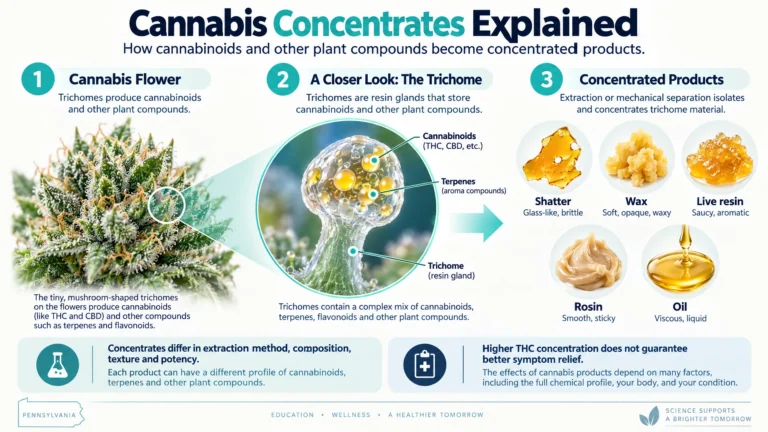

Cannabis concentrates are products made by extracting cannabinoids and terpenes from the plant and removing the excess plant material.
The result is a product that is dramatically more potent than flower. While PA dispensary flower typically tests at 18 to 30% total THC, concentrates run from 60% on the low end to 90%+ for diamonds and some distillates.
Need a PA Medical Marijuana Card?
Get certified online in 15 minutes. 100% Money-Back Guarantee.
Get Certified Now →For Pennsylvania medical marijuana patients, concentrates represent a different relationship with dosing, tolerance, and product selection than flower.
The PA dispensary concentrate menu can look overwhelming on first encounter. Shatter, wax, badder, live resin, live rosin, distillate, RSO, diamonds, sauce, hash, infused pre-rolls: each name describes a different texture, extraction method, and pharmacological profile.
This guide organizes all of it into a readable framework, with the PA-specific legal and clinical context that matters most.
Key Takeaways
| Topic | Key Point |
|---|---|
| What they are | Extracts that concentrate cannabinoids and terpenes from cannabis, removing plant material |
| Potency range | 60% to 90%+ total THC, compared to 18 to 30% for PA dispensary flower |
| Two main categories | Solvent-based (BHO, CO2, ethanol extractions) and solventless (ice water hash, rosin) |
| PA legal context | Pennsylvania law requires vaporization only, open-flame dab rigs are not legal for PA patients; electronic vaporizers are required |
| PA safety guarantee | All PA dispensary concentrates are tested for residual solvents by two independent, state-approved labs |
| Tolerance risk | Concentrates build CB1 receptor tolerance significantly faster than flower due to higher peak THC blood levels, important for medical patients using daily |
What Makes Something a Cannabis Concentrate?
The cannabis plant produces cannabinoids and terpenes in small glandular structures called trichomes.
Do You Qualify for a PA MMJ Card?
Connect with a licensed Pennsylvania state physician online from home.
Trichomes coat the surface of flowers and, to a lesser extent, leaves. They look like a fine crystalline frost under magnification. The active compounds in cannabis are almost entirely concentrated within these trichome heads.
A cannabis concentrate is any product made by separating those trichomes from the plant material and collecting their contents.
The result removes everything that is not pharmacologically active: cellulose, chlorophyll, waxes, and lipids from the plant structure. What remains is a much higher concentration of cannabinoids and terpenes in a smaller volume of material.
Cannabis concentrates remain one of the industry’s most innovative categories. Premium formats like rosin are still growing, and infused flower is seeing significant year-over-year growth of nearly 58% according to 2025 industry data.
This growth reflects patients and consumers discovering that concentrates offer more precise dosing per unit of material, stronger effects for conditions requiring high cannabinoid doses, and in the case of solventless products, the cleanest available expression of a specific cultivar’s terpene and cannabinoid profile.
Solvent-Based Concentrates: The Extraction Methods
Most PA dispensary concentrates other than rosin are produced using a solvent extraction method.
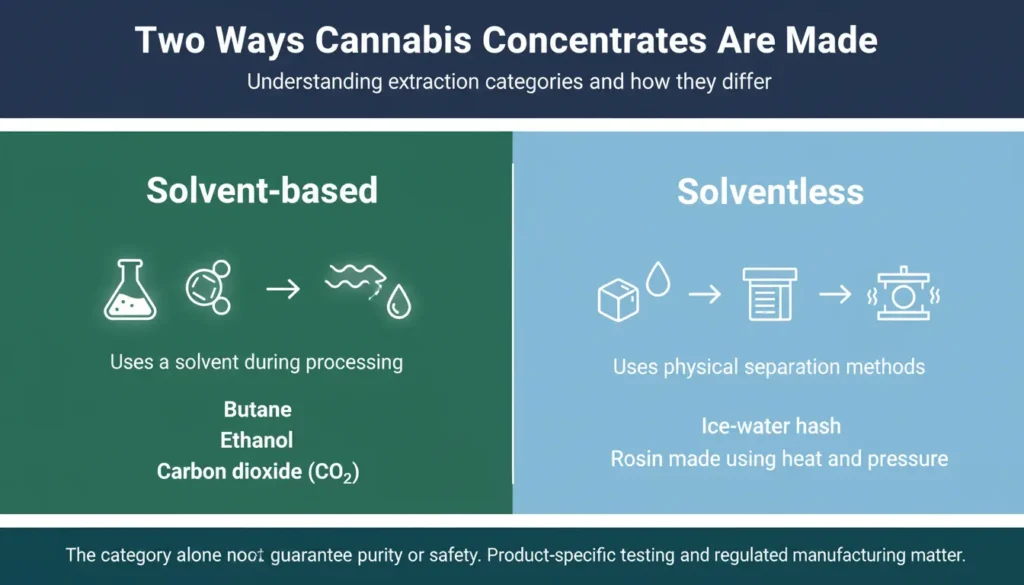
A solvent (butane, CO2, or ethanol) is passed over cannabis plant material. It dissolves the cannabinoids and terpenes, stripping them from the plant. The solvent is then removed through a purging process, leaving behind the concentrated extract.
Butane Hash Oil (BHO): The most common solvent extraction method. Butane is highly selective for cannabinoids and terpenes, producing a clean extract with a well-preserved terpene profile.
After extraction, the butane is purged under vacuum heat. The texture of the final product depends on post-extraction processing: agitation, temperature, and technique determine whether BHO becomes shatter, wax, badder, crumble, or sauce.
CO2 Extraction: Uses supercritical carbon dioxide as the solvent. CO2 leaves no toxic residue and is fully expelled as gas. The resulting oil is lighter in color and slightly different in cannabinoid and terpene composition than BHO. Most CO2 extracts become the base oil for distillate processing or vape cartridge oil.
⚡ Fast & 100% Online PA Medical Cards
Board-Certified Doctors • 100% Money-Back Guarantee
Book Evaluation Now →Ethanol Extraction: Uses food-grade grain alcohol. More efficient than BHO for large-scale processing. Ethanol extracts a broader range of plant compounds including some chlorophyll, which is why some ethanol extracts have a darker color. RSO (Rick Simpson Oil) is the most well-known ethanol-extracted product.
PA dispensary residual solvent testing:
All PA dispensary concentrate products are tested for residual solvents by two independent, PA Department of Health-approved laboratories under 28 Pa. Code Chapter 1171a. Residual solvent testing confirms that purging was complete and no harmful solvent remains in the final product.
This is a meaningful safety guarantee. It is not available for concentrates purchased from unregulated sources.
Solventless Concentrates: Ice Water Hash and Rosin
Solventless concentrates use physical processes (temperature, pressure, and agitation) rather than chemical solvents to separate trichomes from plant material.
Ice Water Hash (Bubble Hash)
Cannabis is agitated in ice water. The cold temperature causes trichome heads to become brittle and break from the plant. The trichomes sink through a series of mesh screens (bubble bags) with progressively finer openings, separating trichomes by size. The collected trichomes are dried to form loose hash or pressed.
The quality is rated by the number of micron bags used and the purity of each collected fraction. The finest fractions (73 to 90 micron range) are called “full melt” and are considered the highest quality for pressing into rosin.
Rosin
Rosin is made by applying heat and pressure to cannabis material (flower, kief, or ice water hash) to squeeze the resinous oil from the trichomes.
No solvents are involved at any stage. The result is the cleanest possible extract: everything that comes out is from the plant, nothing added.
Hash rosin: Made by pressing ice water hash. Considered the premium tier for solventless concentrates. Exceptional terpene preservation and full-spectrum cannabinoid profile.
Live rosin: Made from fresh-frozen cannabis that was never dried or cured. Preserves the full volatile terpene content of the living plant. The most terpene-rich and most expensive format.
Renewing Your PA MMJ Card?
Quick annual recertification online. No paperwork hassle.
Renew Card Online →Flower rosin: Made from pressing cured flower directly. More accessible and lower cost than hash or live rosin, but produces less clean results.
Concentrate formats for common PA qualifying conditions:
| Qualifying Condition | Recommended Format | Why | Avoid |
|---|---|---|---|
| Chronic pain (severe) | Live rosin or hash rosin via e-nail | Full terpene profile + high THC for breakthrough pain | Distillate (lower terpene effect) |
| Nausea (cancer treatment) | Vape cartridge or dab pen | Fast onset; easy to use during treatment fatigue | RSO for active nausea (oral too slow) |
| Anxiety | Low-potency hash or infused pre-roll | Familiar format; gentler concentration | High-THC diamonds or shatter |
| PTSD (nightmares) | Low-dose vape cartridge (bedtime) | Controlled dose; fast onset | Daytime concentrate use if anxiety-prone |
| Cancer (severe pain, appetite) | RSO (oral) | Highest dose per serving for severe cases | Inhalable concentrates if respiratory concern |
For a detailed comparison of hash rosin and live rosin specifically, see our hash rosin vs live rosin guide.
The PA Dispensary Concentrate Menu: Every Type Explained
When you walk into a licensed PA dispensary, the concentrate menu typically organizes products by texture and extraction method. Here is every category you are likely to encounter:
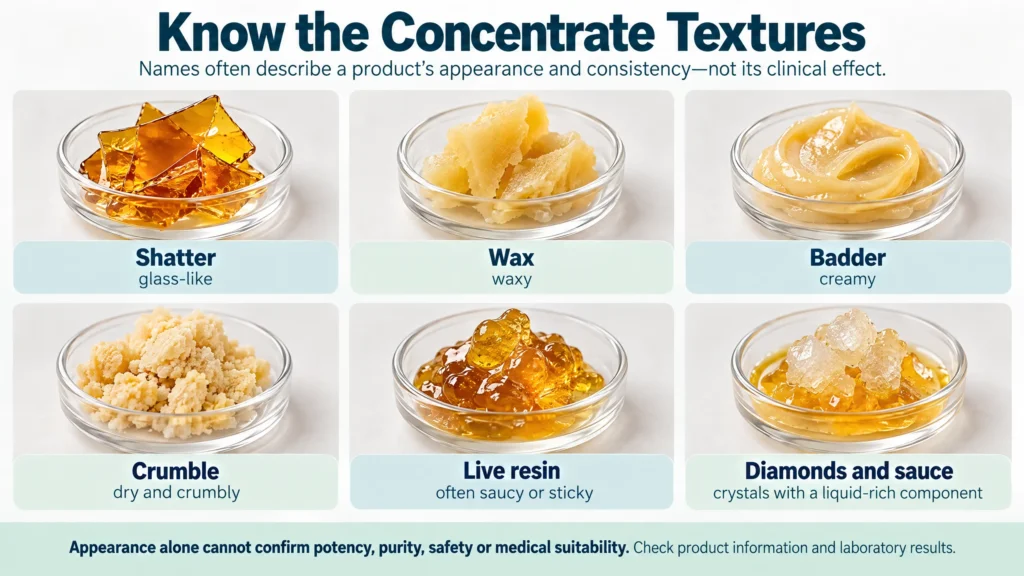
| Concentrate Type | Extraction | Texture | Typical THC% | Notes |
|---|---|---|---|---|
| Shatter | BHO | Glass-like, brittle | 70 to 85% | Stable shelf life; less terpene-forward than newer formats |
| Wax / Budder | BHO | Soft, waxy | 65 to 80% | Easy to handle; more flavorful than shatter |
| Crumble | BHO | Dry, crumbly | 65 to 75% | Lower moisture content; great for mixing with flower |
| Badder | BHO | Creamy, cake-frosting texture | 70 to 80% | Increasingly popular; whipped for texture |
| Live Resin | BHO (fresh-frozen) | Wet, sauce-like | 65 to 80% | Best terpene preservation in solvent category |
| Sauce | BHO | Syrupy, terp-heavy | 40 to 60% (diamonds excluded) | High terpene content; typically paired with diamonds |
| Diamonds (THCA crystals) | BHO or CO2 | Crystalline solid | 90 to 99% THCA | Highest potency; nearly pure THCA |
| Distillate | CO2 + refinement | Clear, viscous oil | 80 to 95% THC | Used in most vape cartridges; terpenes stripped then added |
| Hash (traditional) | Ice water | Compressed powder | 40 to 60% | Wide quality range; gateway to premium formats |
| Live Rosin | Solventless (fresh-frozen) | Fresh press, badder, jam | 65 to 80% | Premium tier; full-spectrum terpene profile |
| Hash Rosin | Solventless (ice water hash) | Pressed, badder, jam | 65 to 80% | Cleanest extract; premium price |
| RSO | Ethanol | Dark, tar-like oil | 60 to 70% | Oral administration; not vaporized |
| Infused Pre-rolls | Flower + concentrate | Rolled (flower format) | Varies by infusion | Accessible entry point for flower users |
Vape Cartridges: Distillate vs Live Resin at PA Dispensaries
Vape cartridges are the highest-volume concentrate format at most PA dispensaries. Understanding what is inside the cartridge matters for product selection.
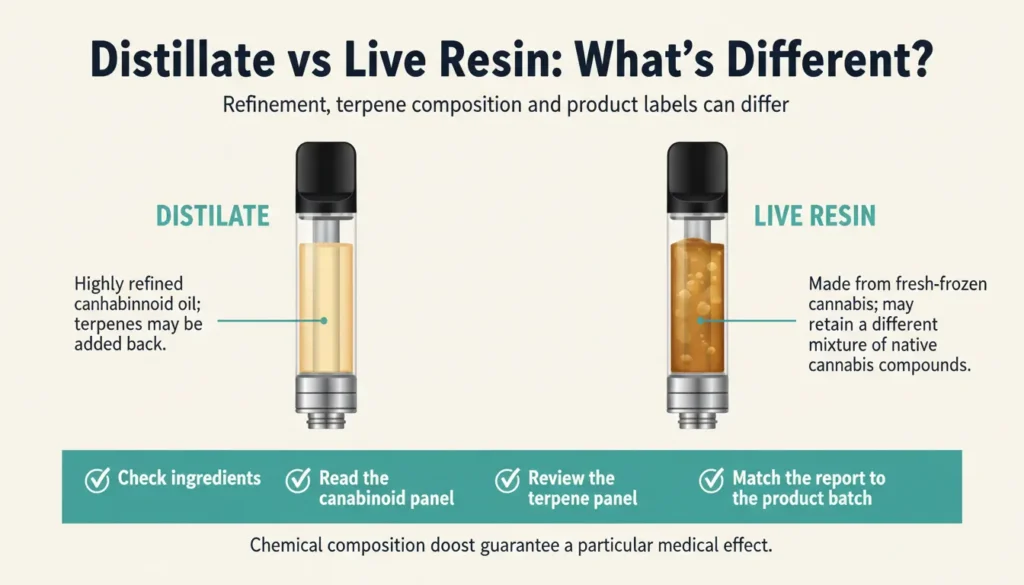
Distillate cartridges
Most PA dispensary vape cartridges contain distillate. Distillate is a highly refined oil produced by passing CO2 extract through a molecular distillation process that strips out all minor cannabinoids, terpenes, waxes, and most compounds other than delta-9 THC.
The result is a nearly pure, clear oil at 80 to 95% THC. It is stable, consistent, and vaporizes cleanly.
The tradeoff: all natural terpenes are removed during distillation. Terpenes are then added back either as cannabis-derived terpenes (CDTs, extracted from cannabis separately) or botanical-derived terpenes (BDTs, from non-cannabis plant sources like lavender or citrus peel).
On the COA of a distillate cartridge, the terpene panel will often show 0% natural terpenes or a very low reading. This is normal for distillate products but explains why distillate cartridges often feel “flatter” in effect profile than full-spectrum products.
Live resin cartridges
Some PA dispensaries carry live resin vape cartridges. These fill the cartridge with live resin extract rather than distillate. The THC% is typically lower (65 to 75%), but the full terpene profile from fresh-frozen cannabis is preserved.
Live resin cartridges tend to have a richer, more complex flavor and a more nuanced effect profile. They are considerably more expensive than distillate cartridges.
How to tell which you have on the COA
Get Approved by a Licensed PA Doctor
Schedule your appointment in minutes. You only pay if approved.
Start Online Application →Look at the terpene panel. A distillate cartridge with added BDTs may list terpenes but will not identify cannabis-specific minor terpenes. A live resin cartridge’s COA will show a diverse terpene panel with multiple terpenes across a wider range. For more on reading the terpene panel on a PA dispensary COA, see our how to read a PA dispensary COA guide.
RSO: The PA Dispensary Oral Concentrate
Rick Simpson Oil (RSO) is a full-extract cannabis oil produced using ethanol extraction. It is distinct from every other concentrate category in one important way: it is not vaporized.
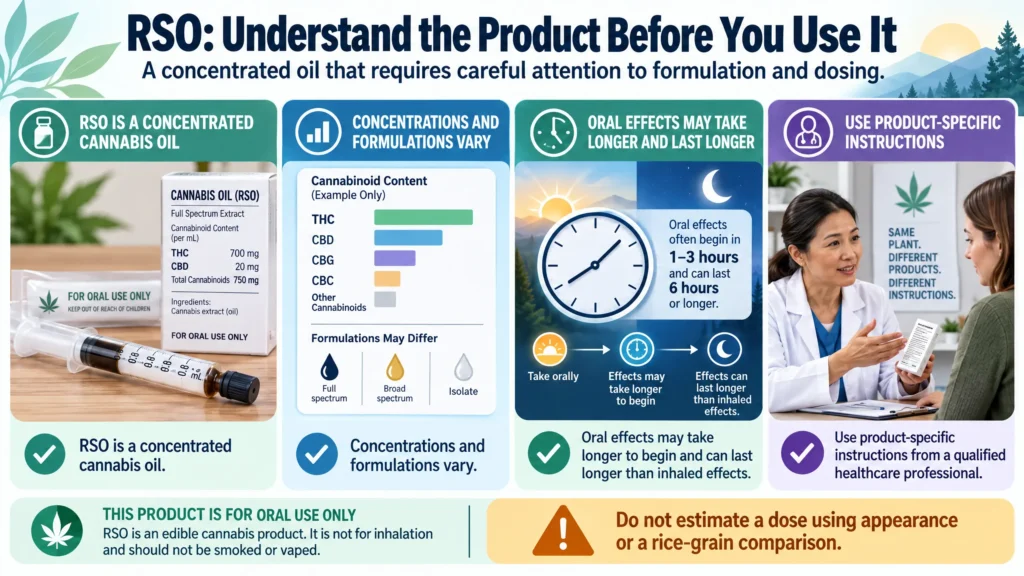
RSO is an oral product. It is typically dispensed in syringes and consumed by placing a small amount under the tongue, swallowing it directly, or mixing it into food.
Because RSO undergoes less refinement than distillate or BHO products, it retains more of the full plant profile including chlorophyll, minor cannabinoids, and a broader compound range. It is dark in color (usually very dark green to nearly black) and has a strong, distinctly plant-like flavor.
RSO was popularized by Canadian engineer Rick Simpson, who advocated for its use for cancer treatment. PA dispensaries carry RSO as a recognized product format used by cancer patients, severe chronic pain patients, and patients seeking the highest available dose in a single oral serving.
Dosing RSO: The concentration is typically 60 to 70% total THC. A rice-grain sized amount (approximately 0.1ml) delivers approximately 60 to 70mg of total THC. This is a significantly higher oral dose than most PA dispensary troches or capsules.
For PA patients new to RSO, the dispensary pharmacist should be consulted for a specific starting dose before purchasing. The oral onset (45 minutes to 2 hours) and long duration (6 to 12 hours) of RSO require the same careful approach as any oral cannabinoid product.
How PA Law Affects Concentrate Consumption
This is the most important PA-specific context in this guide.
Pennsylvania law prohibits smoking cannabis. The only approved consumption method under Act 16 of 2016 is vaporization.
For concentrate consumption, this means:
PA-legal concentrate consumption devices
| Device Type | Legal in PA? | Best For | Notes |
|---|---|---|---|
| Dab pen / wax pen | Yes | Wax, budder, badder, crumble | Most portable option; consistent temp |
| E-nail (electronic dab rig) | Yes | Live rosin, hash rosin, sauce | Precise temperature control; best flavor |
| Vape battery + cartridge | Yes | Distillate and live resin cartridges | Simplest format; most PA patients start here |
| Dry herb vaporizer + concentrate pad | Yes | Hash, kief, dry concentrates | Multipurpose device for patients using both formats |
| Traditional dab rig with butane torch | Not for PA patients | N/A | Open flame falls outside vaporization framework |
What is legal for PA patients
Ready to Get Your Official PA MMJ Card?
State-certified doctor consultations online. No risk—100% refund if not approved.
Claim Your MMJ Card Online →Electronic concentrate vaporizers (e-nails, electronic dab devices, and dab pens) that heat concentrate without open flame. These are widely available and are the correct consumption method for all inhalable PA dispensary concentrates.
Standard vape pens and battery-cartridge systems for cartridge-based products.
Dry herb vaporizers that include concentrate pads or inserts.
What is not legal for PA patients
Traditional dab rigs heated with a butane torch or other open flame. Even though these are widely sold and used recreationally, they constitute combustion or open-flame heating and are outside the vaporization-only framework Pennsylvania law specifies.
This distinction matters practically: if you see concentrate consumption guides that describe butane torch use and dab rigs, that guidance does not apply to legal Pennsylvania medical marijuana patient use.
The PA dispensary pharmacist can advise on specific vaporizer devices appropriate for each concentrate type you are considering. Device compatibility matters: some concentrates (like sticky budder) work well in dab pens, while others (like dry crumble) perform better in certain device types.
Reading a Concentrate COA at PA Dispensaries
Concentrate COAs have additional sections that flower COAs typically do not, and some flower COA features that become more important for concentrates.
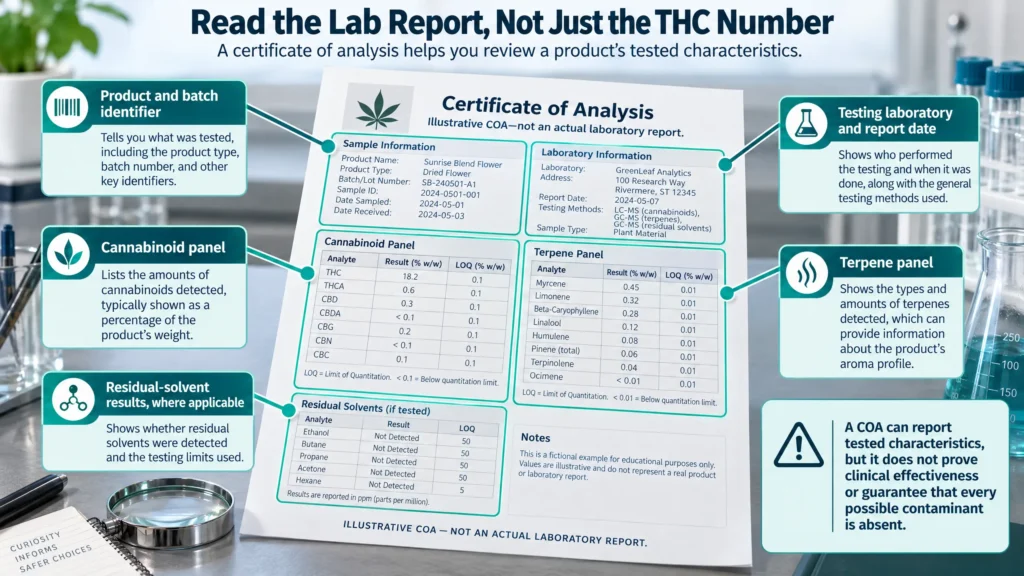
What to look for on concentrate vs flower COAs
| COA Section | Flower | Concentrate (Solvent-Based) | Concentrate (Solventless) |
|---|---|---|---|
| Cannabinoid panel | THCA, delta-9 THC, CBD, CBDA | Same, but THCA typically 70-90% | Same |
| Terpene panel | 1 to 4% total typical | Near-zero for distillate; 1 to 3% for BHO | 3 to 8%+ for live rosin |
| Residual solvents | Not present | Present; all should show ND | Not present (no solvents used) |
| Total THC formula | (THCA × 0.877) + delta-9 | Same formula | Same formula |
| Pass/fail indicators | Pesticides, metals, microbials | Same + residual solvents pass/fail | Same (no solvent panel) |
What is different on a concentrate COA
Residual solvent panel: Present only for solvent-based products. Lists the specific solvents tested (butane, propane, hexane, ethanol, etc.) and the detected levels in parts per million. All results should show ND (Not Detected) or below regulatory limits. If a concentrate COA has no residual solvent panel, ask why.
Terpene panel interpretation: The total terpene percentage on a concentrate COA requires context. A live rosin may show 3 to 8% total terpenes. A distillate will show near-zero terpenes from natural sources. A high terpene percentage on a concentrate COA indicates a more aromatic, full-spectrum product with more entourage effect potential.
What stays the same
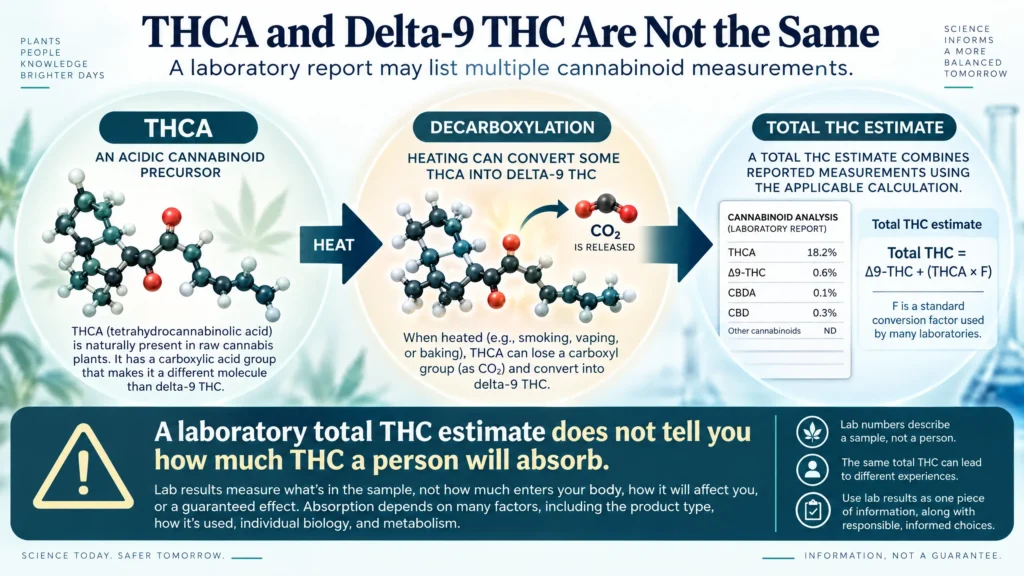
The total THC calculation remains (THCA × 0.877) + delta-9 THC. For concentrates, THCA content is very high. A concentrate showing 85% THCA and 1% delta-9 THC has approximately 75.5% total active THC after decarboxylation.
For more detail on every section of the PA dispensary lab report, see our how to read a PA dispensary COA guide.
Understanding whether THC percentage alone predicts your experience is covered in our does THC percentage matter guide.
Dosing Concentrates: The Transition from Flower
Dosing concentrates requires recalibration from flower dosing intuition.
There is no reliable direct conversion between a “bowl” of flower and a “dab” of concentrate. The variables are too many: surface area of material, device temperature, inhalation speed and depth, and the specific concentrate format all affect how much THC reaches the bloodstream.
The practical guidance for PA patients transitioning from flower
Start with the smallest manageable amount of concentrate.
For most concentrate formats used in an electronic dab device, this means approximately half a rice grain (0.025g) for a first use. Allow 5 to 10 minutes to assess the effect before considering any additional use.
For cartridge products, take a single short puff (2 to 3 seconds), wait 10 minutes, then assess.
Concentrate effects typically onset faster than flower vaporization (1 to 5 minutes) because the higher THC concentration in the inhaled vapor produces faster receptor saturation.
The overconsumption risk
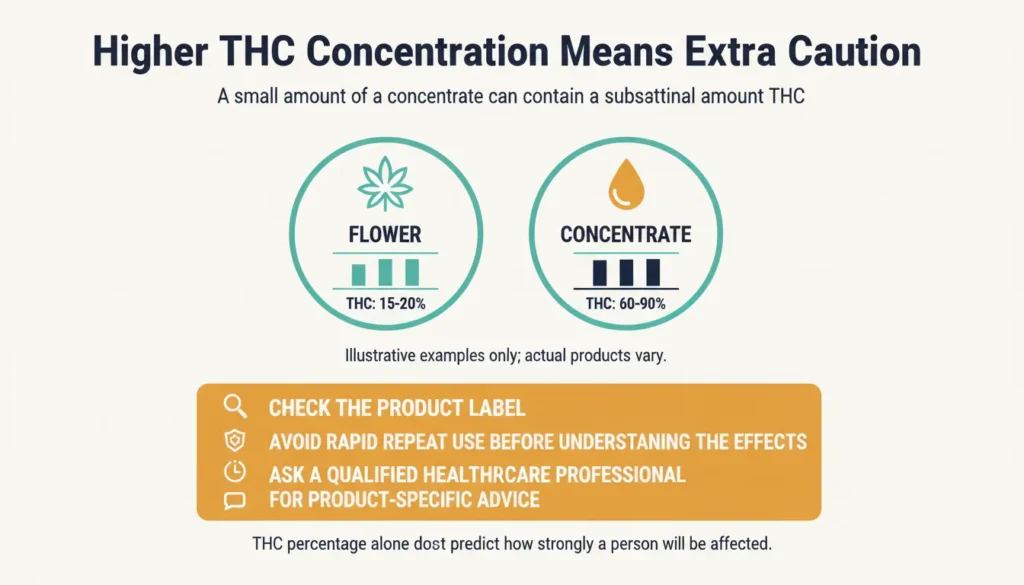
Concentrates at 70 to 85% THC deliver dramatically more THC per unit volume than any flower product. A 0.1g dose of 80% THC concentrate delivers approximately 80mg of THC, the equivalent of 16 standard 5mg dispensary troches consumed simultaneously.
For more on managing too-high THC doses, see our too much THC guide.
Tolerance and Concentrates: The Medical Patient Warning
For PA medical patients using cannabis daily for qualifying conditions, concentrates carry a meaningful tolerance escalation risk that deserves explicit attention.
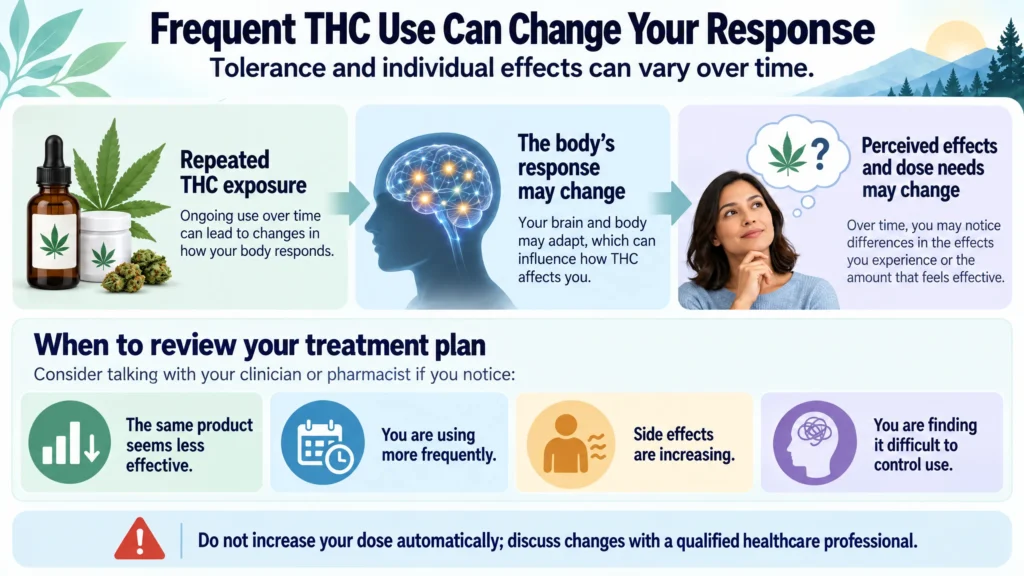
THC at high concentrations produces much higher peak blood levels than flower at equivalent frequency of use. Higher peak THC levels produce faster and more severe CB1 receptor downregulation.
Patients who transition from daily flower use to daily concentrate use frequently find that their effective dose escalates rapidly over months. The same concentrate that produced strong therapeutic effect at 0.05g initially may produce minimal effect at 0.1g three months later.
This is not a concentrate-specific failure. It is pharmacokinetics: higher peak THC blood levels drive faster CB1 receptor internalization.
The practical guidance for PA medical patients using concentrates therapeutically:
Reserve concentrates for breakthrough symptoms requiring rapid, powerful relief rather than daily maintenance use. Use lower-THC flower or ratio tinctures for daily baseline management and concentrates as needed.
If concentrates are required daily for adequate symptom control, build regular cycling breaks into your regimen (see our how to reverse marijuana tolerance guide).
Discuss concentrate use with your PA dispensary pharmacist at your first visit, with your medication list present. The pharmacist can identify whether any of your current medications may interact differently with the higher THC blood levels produced by concentrate use compared to flower.
Frequently Asked Questions
Q: What are cannabis concentrates?
A: Cannabis concentrates are products made by extracting cannabinoids and terpenes from cannabis trichomes and removing excess plant material.
The result is a significantly more potent product than flower, typically 60 to 90%+ total THC compared to 18 to 30% for PA dispensary flower.
Concentrate types include shatter, wax, badder, live resin, live rosin, hash rosin, distillate, RSO, diamonds, sauce, and infused pre-rolls. Each name reflects the extraction method and final texture of the product.
Q: Are cannabis concentrates safe to use?
A: Licensed PA dispensary concentrates are among the safest available anywhere because every product is tested by two independent, state-approved laboratories. Solvent-based products are specifically tested for residual solvents under 28 Pa. Code Chapter 1171a.
The primary safety concerns for medical patients are not contamination but dosing. Concentrates at 70 to 90% THC require significantly smaller amounts than flower, and overconsumption produces intense, potentially distressing effects.
New patients should start with the smallest possible amount and wait at least 10 minutes before considering additional use.
Q: What is the difference between live resin and live rosin?
A: Both are made using fresh-frozen cannabis that was never dried or cured, preserving the living plant’s full volatile terpene content. The difference is in the extraction method. Live resin uses a butane or CO2 solvent extraction, making it a solvent-based product that is tested for residual solvents. Live rosin uses only ice water, heat, and pressure without any solvents, making it a fully solventless product. Live rosin is considered the premium tier for both purity and terpene preservation, reflected in its higher price point at PA dispensaries. For a full comparison.
Q: Can I use a regular dab rig with a torch in Pennsylvania?
A: No. Pennsylvania law under Act 16 of 2016 permits vaporization as the approved cannabis consumption method. Traditional dab rigs heated with a butane torch fall outside the vaporization framework.
PA patients should use electronic concentrate vaporizers (e-nails, electronic dab devices, dab pens) rather than torch-based rigs.
Your PA dispensary pharmacist or budtender can advise on electronic vaporizer options compatible with specific concentrate formats you are considering.
Q: How do I read a concentrate COA at a PA dispensary?
A: Concentrate COAs have the same cannabinoid and terpene panels as flower COAs, plus a residual solvent panel for solvent-based products. The residual solvent panel should show ND (Not Detected) or values below Pennsylvania regulatory limits for every listed solvent.
Total THC on a concentrate COA is calculated the same way as flower: (THCA × 0.877) + delta-9 THC. A concentrate showing 85% THCA and 1% delta-9 THC has approximately 75.5% total active THC.
The terpene panel tells you whether the product is full-spectrum (live rosin, live resin) or terpene-stripped (distillate). High total terpenes indicate more entourage effect potential.
Q: What concentrate format is best for a PA patient new to concentrates?
A: An infused pre-roll is the most accessible entry point because it delivers concentrate-enhanced potency in a familiar format with natural dose modulation from the flower content.
For standalone concentrates, a vape cartridge (starting with single short puffs) or a low-potency hash product is easier to manage than starting with a high-THC dab.
Discuss with your dispensary pharmacist first, particularly if you are transitioning from oral products to inhaled concentrates. The pharmacist can review your qualifying condition and tolerance level and recommend a specific starting format and dose.
The Bottom Line
Cannabis concentrates at PA dispensaries offer the highest potency available in the licensed program, the cleanest available product expression in the case of live rosin and hash rosin, and the most versatile format range from oral RSO to vaporized diamonds.
They also carry the most significant dosing and tolerance risks of any product format in the PA dispensary system.
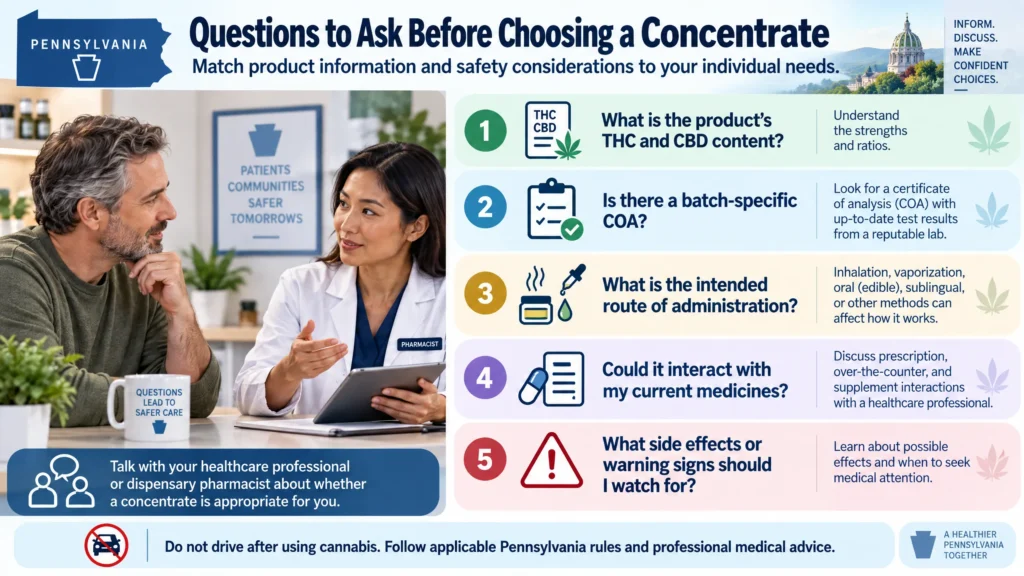
For PA medical patients, the best approach is to understand what each format is, use COA data to make specific informed choices, start at the lowest possible dose, and take advantage of the pharmacist consultation available at every licensed PA dispensary before purchasing concentrates for the first time.
If you are not yet a registered PA patient and want access to COA-verified, pharmacist-guided concentrate products, check your qualifying condition here or get certified at Pennsylvania Marijuana Cards.
This blog post is intended for general educational and informational purposes only and does not constitute medical advice. Cannabis concentrates at 60 to 90%+ THC present a significant overconsumption risk for patients new to this format. Always start with the smallest possible amount and allow adequate time to assess effects before consuming more. Discuss concentrate use with your PA dispensary pharmacist before your first purchase. Do not drive after consuming concentrates. Medically reviewed by Dr. Johnathon Chance Miller, MD.
Sources
- ACS Laboratory: Cannabis Concentrates 101, Guide to Terms, Usage, Potency, and Testing 2025-2026
- BlazeXpress: Types of Cannabis Concentrates Explained, Shatter, Wax, Live Resin and Rosin (June 2026)
- ExpressBuds: Exploring the Most Popular Types of Cannabis Concentrates
- VapeJet: Live Resins, Rosins, Wax, Budder, What to Know About Concentrate Types
- PA Department of Health: 28 Pa. Code Chapter 1171a, Medical Marijuana Laboratory Testing Requirements