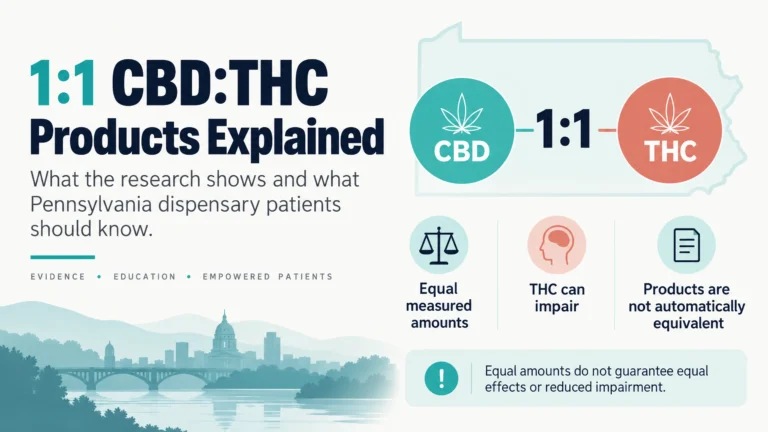

Of all the cannabinoid ratios available at Pennsylvania dispensaries, 1:1 CBD:THC has the strongest clinical evidence base. Not because it is the newest. Because it has been studied the longest.
Sativex (nabiximols), a pharmaceutical-grade 1:1 THC:CBD oromucosal spray developed by GW Pharmaceuticals, has been tested in more than 1,500 multiple sclerosis patients across randomized controlled trials.
Need a PA Medical Marijuana Card?
Get certified online in 15 minutes. 100% Money-Back Guarantee.
Get Certified Now →It is approved in the EU, Canada, and other regions for MS-related spasticity and neuropathic pain. The Italian real-world registry followed 1,615 MS patients and found 70.5% achieved clinically meaningful improvement in their first month.
No other cannabinoid ratio has that depth of human evidence behind it.
For Pennsylvania medical marijuana patients, 1:1 products are available across multiple formats at licensed dispensaries. Understanding why this ratio works, when it is the right choice, and how to verify it on your COA makes the difference between a product that performs and one that disappoints.
Key Takeaways
| Topic | Key Point |
|---|---|
| Clinical evidence anchor | Sativex (nabiximols): 1:1 THC:CBD pharmaceutical spray; over 1,500 MS patients across multiple RCTs; approved EU and Canada for MS spasticity and neuropathic pain |
| Why 1:1 specifically | CBD at equal concentration modulates CB1 receptor sensitivity, reducing THC’s anxiogenic potential while preserving and potentially enhancing its analgesic and therapeutic effects |
| The entourage finding | A 2021 review found 1:1 ratio products outperformed either cannabinoid alone for certain pain contexts, demonstrating a measurable synergistic outcome |
| PA dispensary formats | Tinctures, capsules, troches, and some cartridges; tincture offers most dose-titration flexibility; capsule offers most consistent absorption schedule |
| COA verification required | A product labeled “1:1” may not actually be equal; verify by checking CBD and THC mg-per-serving on the cannabinoid panel, they should match within 10% |
| Who it suits best | Chronic pain with anxiety component, neuropathic pain, MS-related spasticity, mixed presentations; not ideal as first product for new patients or THC-sensitive patients |
What Is a 1:1 CBD:THC Product?
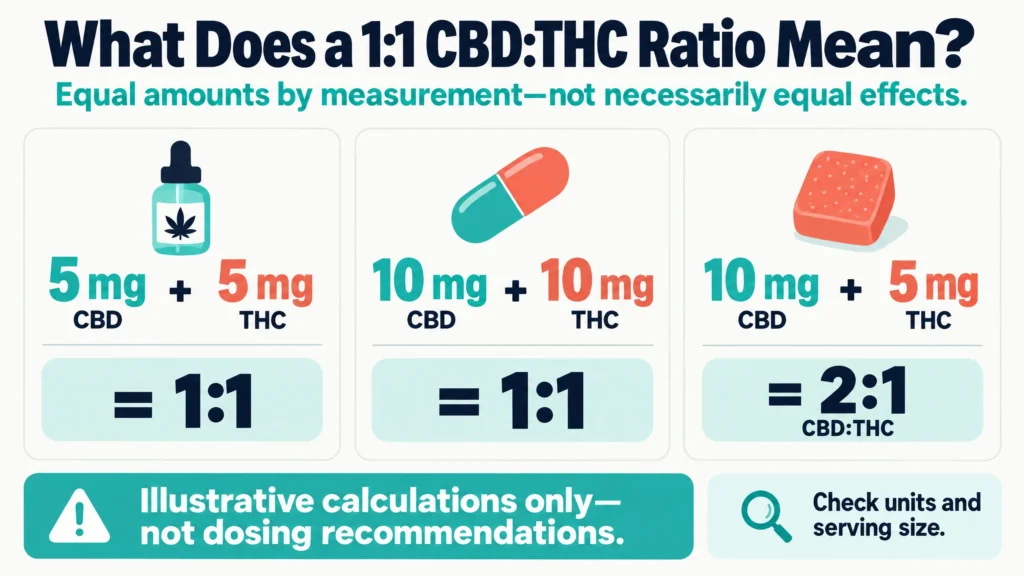
A 1:1 CBD:THC product contains equal amounts of cannabidiol and delta-9-tetrahydrocannabinol per serving. If a product contains 10mg CBD per serving, it also contains 10mg THC. If it contains 5mg CBD, it contains 5mg THC.
Do You Qualify for a PA MMJ Card?
Connect with a licensed Pennsylvania state physician online from home.
This distinguishes 1:1 products from:
CBD-dominant products (10:1, 5:1, 20:1 CBD:THC), where CBD vastly outweighs THC, psychoactivity is minimal or absent, and the primary therapeutic mechanism is CBD’s non-intoxicating pathways.
THC-dominant products (the highest-THC flower, concentrates, or high-potency tinctures), where THC is the primary active compound and psychoactivity is significant.
At 1:1, both cannabinoids are present in therapeutically meaningful amounts simultaneously. The result is not simply THC-effect plus CBD-effect. It is a pharmacologically distinct experience where CBD actively modulates how THC interacts with CB1 receptors.
The most important practical consequence: 1:1 products produce noticeable psychoactivity, unlike CBD-dominant products. A patient expecting a CBD-dominant experience from a product labeled “balanced” or “1:1” will be surprised by the THC component. Setting accurate expectations before the first dose is essential.
The Clinical Evidence: Sativex and 1,500+ Patients
The strongest available argument for 1:1 products is not theoretical. It comes from Sativex.
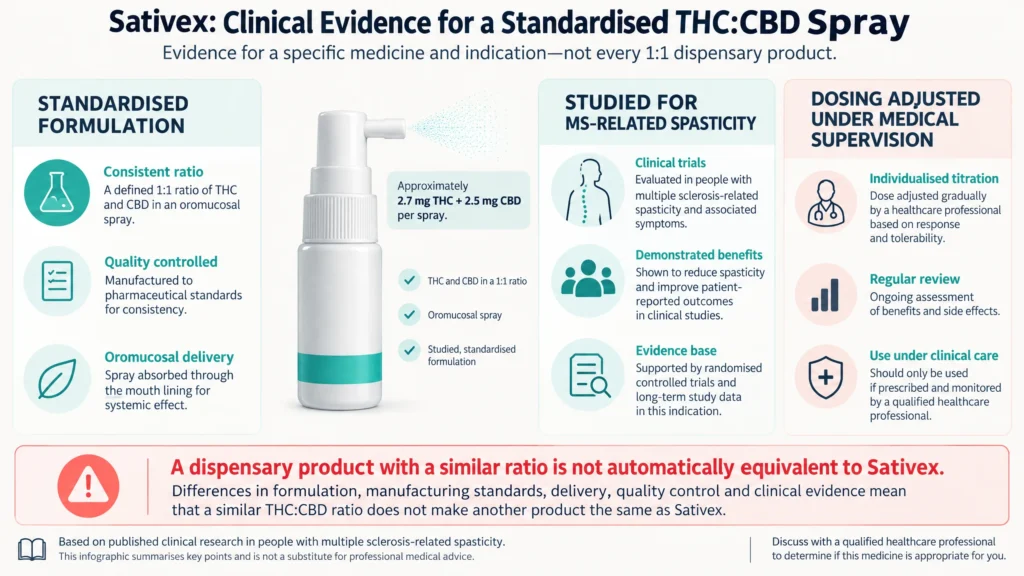
Sativex (nabiximols) is a pharmaceutical 1:1 THC:CBD oromucosal spray containing cannabis extract standardized to approximately equal concentrations of both cannabinoids. It was developed by GW Pharmaceuticals, the same company that developed Epidiolex.
Multiple randomized, double-blind, placebo-controlled clinical trials tested Sativex for MS-related spasticity and neuropathic pain:
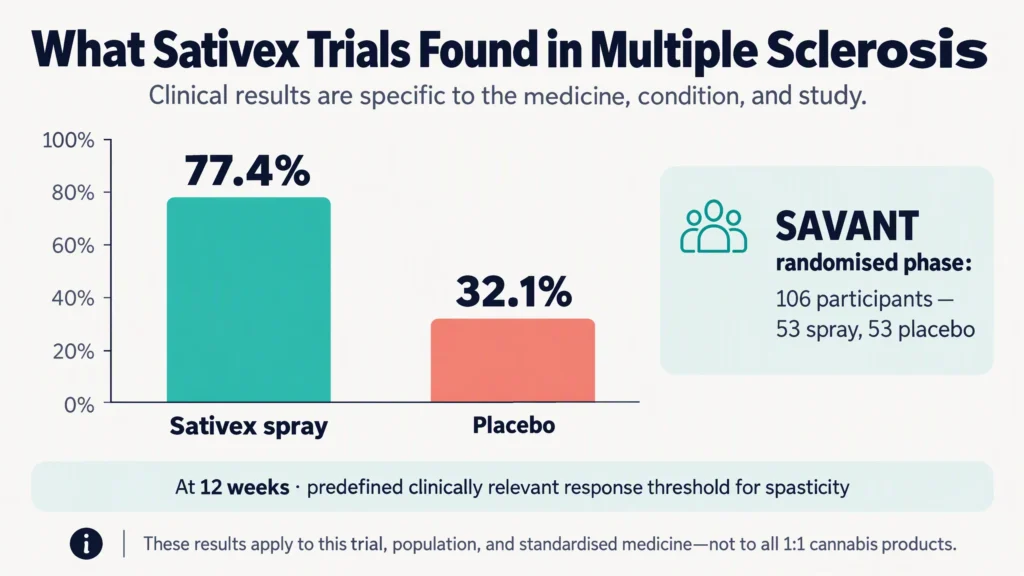
The first pivotal Phase III trial enrolled 189 patients and found a significant reduction in spasticity scores with Sativex compared to placebo. The SAVANT trial analyzed Sativex alongside standard anti-spasticity medications and found consistent, clinically meaningful relief regardless of spasticity severity or duration.
The Italian AIFA e-registry followed 1,615 MS patients starting Sativex in real-world clinical practice. At one month, 70.5% of patients achieved a clinically meaningful reduction in spasticity scores.
⚡ Fast & 100% Online PA Medical Cards
Board-Certified Doctors • 100% Money-Back Guarantee
Book Evaluation Now →Adverse events across trials were predominantly mild to moderate, dizziness, nausea, fatigue, and their incidence was reduced significantly with gradual dose titration.
An expert review in Expert Review of Neurotherapeutics summarized: randomized controlled trials across more than 1,500 patients with MS-related resistant spasticity provided conclusive evidence of 1:1 THC:CBD spray’s efficacy.
Why this matters for PA dispensary patients
Sativex is a highly standardized pharmaceutical product. PA dispensary 1:1 tinctures are not pharmaceutically standardized. But the clinical evidence from Sativex establishes two things that translate:
First, the 1:1 ratio produces therapeutic outcomes superior to placebo in rigorous controlled conditions. Second, the ratio is well-tolerated when titrated gradually, patients in Sativex trials self-titrated to their effective dose rather than receiving a fixed dose, a process directly analogous to what PA dispensary patients do.
Why the 1:1 Ratio Works: The CB1 Modulation Mechanism
The 1:1 ratio is not simply “half the THC with CBD added.” The two compounds interact at CB1 receptors in a way that produces pharmacologically distinct effects from either alone.
THC’s CB1 mechanism
THC binds to CB1 receptors as a full agonist. This activation produces analgesia, muscle relaxation, mood elevation, and appetite stimulation. It also produces the psychoactive “high” and, at higher doses, the anxiety and paranoia that make high-THC products problematic for sensitive patients.
CBD’s modulating effect at 1:1
CBD does not bind strongly to CB1 receptors as an agonist. Instead, it acts as a negative allosteric modulator at CB1, changing the shape of the receptor in a way that reduces THC’s binding efficacy at that receptor site.
The practical effect: CBD present at equal concentration to THC reduces CB1 receptor activation per unit of THC. This is why a 1:1 product with 10mg THC produces less anxiety and less psychoactivity than 10mg THC taken alone, while preserving a significant portion of THC’s analgesic effect.
CBD also inhibits FAAH (the enzyme that breaks down anandamide), raises natural endocannabinoid tone, activates 5-HT1A serotonin receptors, and engages CB2 receptors. These parallel pathways add to the therapeutic effect while the CB1 allosteric modulation makes the THC component more comfortable and less unpredictable.
The result at 1:1 is a product where THC’s therapeutic range is wider and its ceiling dose before anxiety or adverse effects is higher than with THC used alone.
For a full explanation of how CB1 and CB2 receptors work, see our endocannabinoid system guide.
The Entourage Effect Made Measurable
Renewing Your PA MMJ Card?
Quick annual recertification online. No paperwork hassle.
Renew Card Online →The entourage effect is often described as a theory: Cannabinoids work better together than apart. At 1:1 ratio, that theory has a measurable outcome.
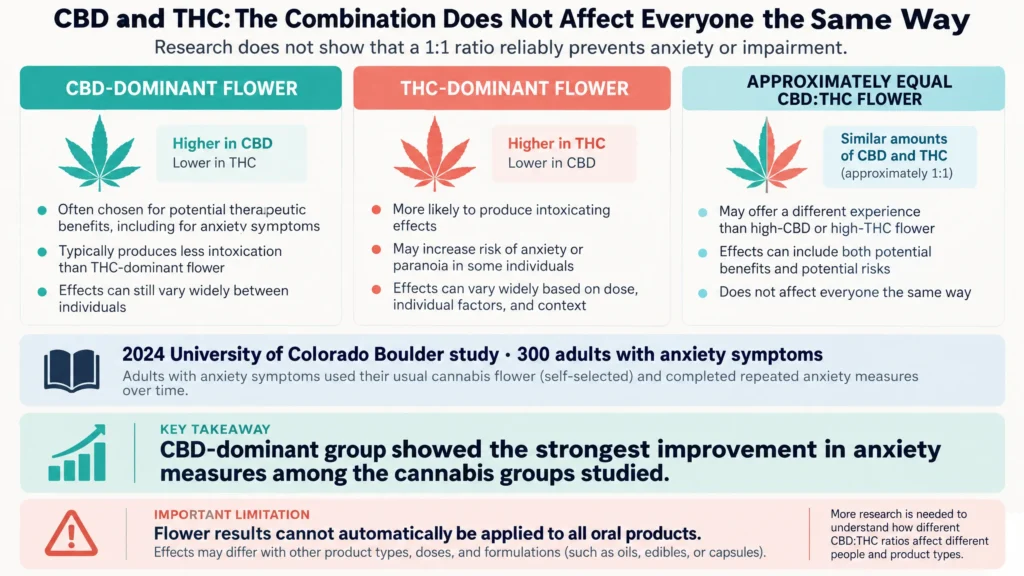
A 2021 review of cannabinoid research found that a roughly 1:1 ratio outperformed either cannabinoid alone in certain pain contexts, a documented outcome difference, not just a theoretical expectation.
A 2024 randomized trial from the University of Colorado Boulder tested CBD-dominant, THC-dominant, and THC/CBD equivalent products for anxiety. It was the first randomized trial of commercially available cannabis products.
THC-dominant products produced higher anxiety ratings. CBD-dominant products reduced tension most acutely. The THC/CBD equivalent products reduced tension and produced the most balanced experience across participants.
Neither CBD alone nor THC alone reproduces the clinical outcomes seen with 1:1. The combination at equal ratio produces something measurably different from either component in isolation.
This is why the Sativex clinical program chose the 1:1 ratio rather than testing CBD-only or THC-only formulations for MS spasticity and neuropathic pain, preclinical and early clinical data showed the combination at that ratio produced outcomes that neither cannabinoid achieved alone.
Which Conditions Benefit Most from 1:1
Not every PA qualifying condition responds equally well to a 1:1 approach. The evidence pattern from Sativex and other research points to specific clinical presentations where 1:1 outperforms either higher or lower ratios.
| Condition | Why 1:1 Fits | Evidence Basis |
|---|---|---|
| MS-related spasticity | THC for muscle relaxation + CB1; CBD for modulation and anti-inflammatory | Sativex RCTs, 1,500+ patients, EU-approved |
| Neuropathic pain | Dual CB1 analgesia (THC) + CB2 anti-inflammation (CBD) | Sativex approval for MS neuropathic pain |
| Chronic pain with anxiety component | THC analgesic effect moderated by CBD’s anxiolytic action | 2021 review; 1:1 outperforms THC alone for anxious pain patients |
| Sleep with pain component | THC for sleep onset; CBD for sleep continuity; both active simultaneously | Clinical practice data; Sativex sleep disturbance reduction |
| Post-operative pain | Dual mechanism; reduced opioid need potential | University of Michigan CBD knee arthroplasty context; analogy to Sativex trials |
| Treatment-resistant pain (failed NSAIDs or opioids) | Maximum analgesic engagement of both CB1 and CB2 pathways | Sativex enrolled patients with treatment-resistant spasticity |
Ratio comparison: which to choose based on your situation:
| If Your Primary Need Is… | Best Ratio | Why |
|---|---|---|
| Anxiety without significant pain | 5:1 to 20:1 CBD:THC | CBD-dominant avoids THC anxiogenic risk at the necessary dose |
| Chronic pain with anxiety | 1:1 | THC analgesia + CBD modulation; most evidence in this combination |
| Maximum pain relief (refractory) | 1:2 or 1:3 CBD:THC | Higher THC needed; still include CBD to moderate psychoactivity |
| Sleep with pain | 1:1 bedtime | Both cannabinoids active; THC for onset, CBD for continuity |
| First-time cannabis patient | 10:1 or 20:1 CBD:THC | Establish THC tolerance before introducing higher THC ratios |
| Daytime use with zero impairment | 20:1 or CBD-only | 1:1 products impair driving and complex cognitive tasks |
Conditions where CBD-dominant products (5:1 or 10:1) often serve better than 1:1: anxiety without significant pain, depression management, daytime professional use where impairment is unacceptable, pediatric epilepsy contexts, and first-time patients with no cannabis history.
For the anxiety-specific ratio guidance, see our THC tincture guide and terpenes for anxiety guide.
Who Should Start with a Different Ratio
1:1 is a well-tolerated ratio with a strong safety record in clinical trials, but it is not the right first product for every PA patient.
Start with a CBD-dominant product (5:1 or 10:1) instead if
Get Approved by a Licensed PA Doctor
Schedule your appointment in minutes. You only pay if approved.
Start Online Application →You have no previous cannabis experience. The 10mg THC in a standard 1:1 serving can produce significant psychoactivity in a THC-naive patient. Starting with a CBD-dominant product to establish tolerance first is significantly safer.
You are highly THC-sensitive. Some patients experience anxiety or paranoia at THC doses as low as 2.5mg. A 1:1 product delivers 5 to 10mg THC per standard serving.
Your primary goal is daytime mood or anxiety management without impairment. CBD-dominant products provide mood and anxiety benefit without the cognitive effects of a meaningful THC dose.
You are on antidepressants (SSRIs, SNRIs). CBD at the doses in 1:1 products already engages serotonin pathways; combining with SSRI medication requires physician oversight regardless of ratio.
Consider a higher-THC ratio (2:1 or 1:2 THC:CBD) instead if
Standard 1:1 dosing at your current titration level is not providing adequate pain or spasticity relief after 4 to 6 weeks of consistent use.
Your qualifying condition involves severe refractory pain that has not responded to other treatments.
Your dispensary pharmacist and certifying physician have reviewed your situation and recommend higher THC engagement.
For chronic pain management guidance specific to PA patients, see our best CBD tinctures guide.
PA Dispensary 1:1 Product Formats: Tincture, Capsule, Troche
PA dispensaries typically carry 1:1 products across several formats. The right format depends on your condition and how you need relief to work.
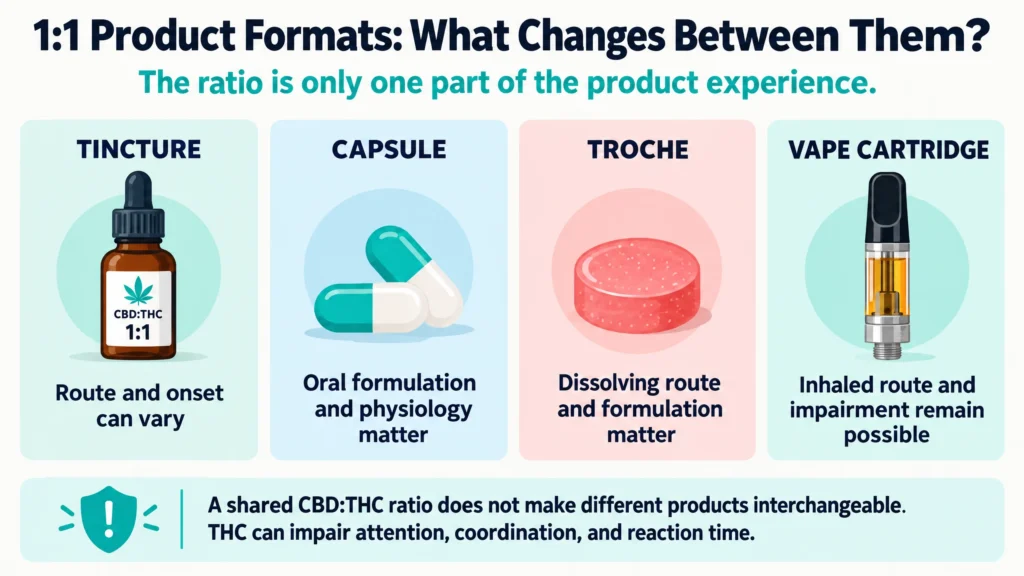
1:1 product formats at PA dispensaries:
| Format | Onset | Duration | Best Use Case | Dose Flexibility |
|---|---|---|---|---|
| Tincture (sublingual) | 15 to 45 min | 3 to 6 hours | Chronic pain, sleep, titration | Highest, adjust by fraction of dropper |
| Capsule (swallowed) | 45 min to 2 hours | 5 to 8 hours | All-day coverage, predictable schedule | Low, fixed at capsule dose |
| Troche (dissolved in mouth) | 15 to 45 min | 3 to 5 hours | Discrete use, consistent dosing without measuring | Medium, fixed at troche dose |
| Vape cartridge 1:1 | 2 to 10 min | 1 to 3 hours | Acute breakthrough; not for sustained relief | Low per puff; cumulative dose requires attention |
1:1 Tincture (most flexible)
Sublingual tinctures held under the tongue for 60 seconds absorb in 15 to 45 minutes. The defining advantage of tinctures for 1:1 dosing is precision, you can increase or decrease by a fraction of a dropper to fine-tune your dose.
Ready to Get Your Official PA MMJ Card?
State-certified doctor consultations online. No risk—100% refund if not approved.
Claim Your MMJ Card Online →Most PA dispensary 1:1 tinctures are 10mg CBD plus 10mg THC per milliliter (1ml serving) or 5mg plus 5mg per 0.5ml half-serving. This allows starting at half a serving (5mg each) and titrating up by 5mg CBD and 5mg THC at a time.
Best for: chronic pain management, sleep, and conditions requiring the flexible Sativex-style self-titration approach.
1:1 Capsule (most consistent)
Capsules are swallowed and absorbed through the GI tract, producing onset in 45 minutes to 2 hours but with longer duration (5 to 8 hours) and more consistent absorption from one dose to the next.
For patients managing chronic pain, MS-related spasticity, or other conditions where sustained relief over the course of a day matters more than rapid onset, a morning capsule can provide a baseline that lasts through a typical work day.
Best for: chronic conditions, patients with predictable dosing schedules, those who prefer not to taste the product.
1:1 Troche (fastest reliable oral onset)
Troches are small lozenges dissolved in the mouth without swallowing, absorbing sublingually and buccally simultaneously. Onset is similar to tinctures (15 to 45 minutes) but dose is fixed at the troche’s manufactured amount, typically 5mg CBD plus 5mg THC or 10mg each.
Best for: patients who prefer a discrete, no-measure format with predictable dosing and faster oral onset than capsules.
How to Verify 1:1 on Your PA Dispensary COA
This is the quality control step most patients skip, and it matters.
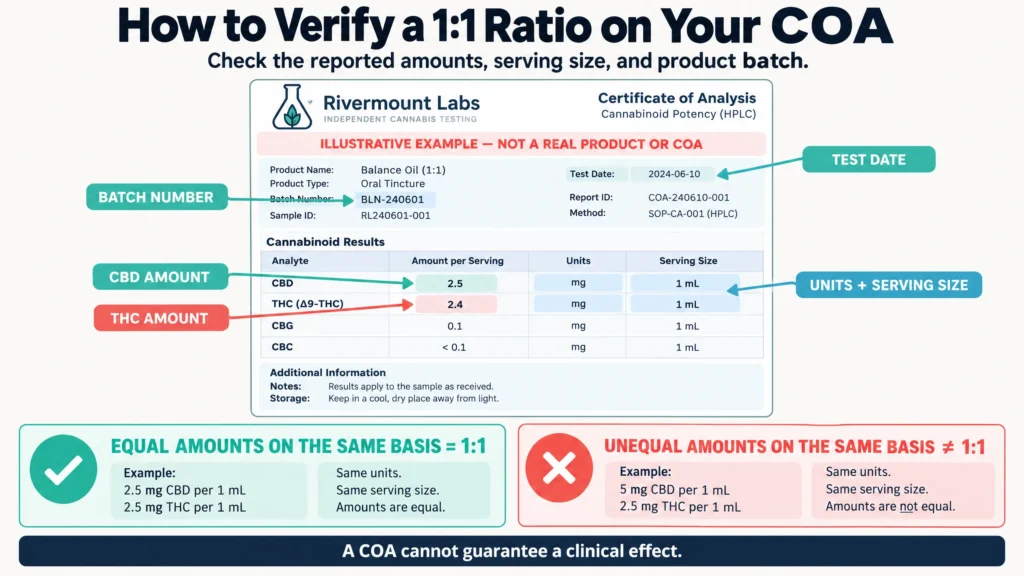
A product labeled “1:1” or “balanced” on the PA dispensary menu is not guaranteed to actually contain equal CBD and THC. Manufacturing variation, batch differences, and rounding on labels mean the actual ratio may differ from the marketed ratio.
The only reliable verification is the cannabinoid panel on the COA.
COA verification for 1:1 products: what to check
| COA Check | What to Look For | Red Flag |
|---|---|---|
| CBD mg per serving | Should match THC within 10% | CBD much higher or lower than THC |
| THC mg per serving | Should match CBD within 10% | THC significantly above CBD (not true 1:1) |
| Delta-9 THC vs THCA | For oral products: delta-9 THC is the active figure | High THCA with low delta-9 may mean incomplete decarboxylation |
| Batch number | Confirm batch matches product label | Mismatched batch = potentially different formulation |
| Pass/fail indicators | All should show PASS | Any fail on pesticides, metals, microbials warrants asking |
What to look for?
Find the CBD and THC rows on the cannabinoid panel. Each will show a percentage or mg/serving figure for the current batch.
For a true 1:1 product, CBD mg should equal THC mg within approximately 10% variance. A product showing 10.2mg CBD and 9.8mg THC per serving is true 1:1. A product showing 10mg CBD and 13mg THC per serving is closer to a 1:1.3 ratio and will produce more THC-dominant effects than a true 1:1.
The THCA consideration
On the COA, you will see both THCA (the raw acid form) and delta-9 THC listed separately. For oral products like tinctures, capsules, and troches, the relevant number is the already-decarboxylated delta-9 THC, not THCA. THCA in oral products converts partially during manufacturing and partially in the body.
For a thorough explanation of reading every section of your PA dispensary product’s lab report, see our how to read a PA dispensary COA guide.
Dosing 1:1 Products: The Self-Titration Principle
The Sativex clinical trials used patient-guided self-titration rather than fixed dosing. Patients adjusted their dose to achieve symptom relief up to a maximum amount. This approach proved safe and effective across 1,500+ patients.
The same principle applies to PA dispensary 1:1 products and is the recommended approach.
Starting point
Half of a standard serving (typically 5mg CBD plus 5mg THC for a tincture designed at 10mg each per serving). For cannabis-naive patients, consider starting at one quarter of a serving on the first two to three uses.
Titration schedule
Use the same starting dose for three to five days, noting effect duration, onset time, and whether the therapeutic benefit lasts long enough for your needs. If the effect is insufficient, increase by one quarter to one half serving. Allow another three to five days before increasing again.
What to watch for
Any new anxiety, increased heart rate, or cognitive discomfort signals the THC dose is approaching your personal threshold. At 1:1, CBD’s modulating effect prevents the dose escalation that causes these effects with THC-only products, but individual thresholds still exist. If these symptoms appear, reduce dose at the next session rather than pushing through.
Timing for common uses
For sleep: 60 to 90 minutes before bed. For chronic pain: tincture morning and evening; capsule taken with breakfast. For spasticity: consistent daily timing aligned with peak spasticity hours.
For more on microdosing and starting-dose approaches for PA patients, see our how to microdose medical marijuana guide.
Frequently Asked Questions
Q: What does a 1:1 CBD:THC product feel like?
A: At typical starting doses (5 to 10mg of each cannabinoid), a 1:1 product produces noticeable but moderate psychoactivity from the THC alongside the calming effects of CBD.
Most patients describe the experience as clearer and more functional than an equivalent THC dose without CBD. The CBD component reduces the likelihood of anxiety or racing thoughts, while preserving THC’s mood-elevating and analgesic effects.
Impairment is real. Do not drive after using 1:1 products.
Q: Is 1:1 CBD:THC right for anxiety?
A: 1:1 is appropriate for patients whose anxiety co-occurs with significant pain, sleep disruption, or muscle tension, conditions where THC’s direct CB1 effect adds meaningful benefit beyond CBD alone. For patients whose primary symptom is anxiety without those physical components, a CBD-dominant product (5:1 or 10:1) is typically more appropriate. The 2024 University of Colorado Boulder randomized trial found CBD outperformed THC-equivalent products for acute anxiety reduction, though THC/CBD equivalent products also reduced tension meaningfully. For anxiety-first guidance.
Q: Can I use a 1:1 product during the day?
A: With caution. Most patients find standard 1:1 doses (10mg THC plus 10mg CBD) produce noticeable impairment incompatible with driving, complex professional tasks, or childcare responsibilities.
Patients who have developed tolerance over months of consistent use often find lower 1:1 doses (5mg each) manageable for some daytime tasks.
For first-time or low-tolerance patients, 1:1 products should be used in the evening or when impairment is acceptable.
Q: How is a PA dispensary 1:1 tincture different from Sativex?
A: Sativex is a pharmaceutical-grade oromucosal spray with standardized 1:1 concentrations, tested in randomized controlled trials, and approved in the EU and Canada.
PA dispensary 1:1 tinctures are state-tested for potency and contaminants but are not pharmaceutically standardized to the same precision. The therapeutic rationale is the same and PA dispensary products carry verified COA data, but dose precision requires calculating from the COA rather than relying on a standard pharmaceutical dose.
Your PA dispensary pharmacist can help you select and dose a 1:1 tincture appropriately using the Sativex evidence as the clinical reference.
Q: What should I ask my PA dispensary pharmacist about 1:1 products?
A: Ask for the current batch COA for any 1:1 product you are considering, and confirm the CBD and THC mg-per-serving from that batch specifically.
Ask which format (tincture, capsule, troche) best suits your condition and dosing needs. Ask about the terpene profile, since 1:1 products with dominant myrcene or linalool will be more sedating than those with dominant limonene.
Ask about the starting dose recommendation given your previous cannabis experience and current medications.
The Bottom Line
1:1 CBD:THC is the most clinically validated cannabinoid ratio in medical cannabis research, with a pharmaceutical-grade product based on that exact ratio demonstrating efficacy across more than 1,500 patients in rigorous controlled trials.
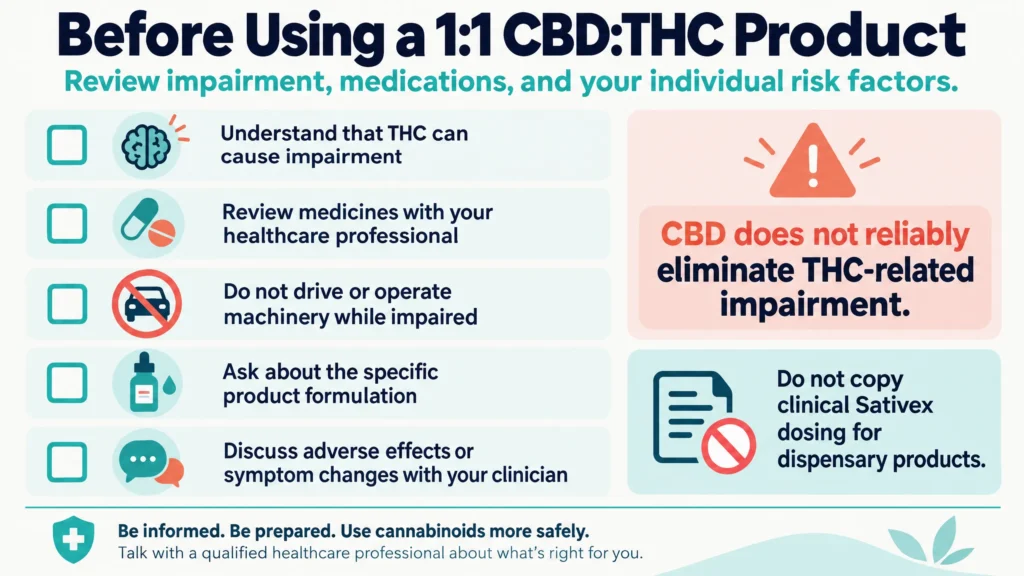
At PA dispensaries, 1:1 products are available in tinctures, capsules, and troches. They are best suited for patients managing chronic pain, neuropathic pain, MS-related spasticity, or mixed pain-anxiety presentations. They are not the right starting point for cannabis-naive patients or those primarily managing anxiety without a significant physical symptom component.
The COA verification step takes two minutes and ensures the product labeled “1:1” actually delivers what the label claims.
If you are not yet a registered PA patient and your condition involves chronic pain, spasticity, or a mixed symptom presentation, check your qualifying condition here or get certified at Pennsylvania Marijuana Cards.
This blog post is intended for general educational and informational purposes only and does not constitute medical advice. 1:1 CBD:THC products produce noticeable psychoactivity. Do not drive or operate machinery after use. Cannabis interacts with SSRIs, antiepileptic medications, and other drugs through CYP450 enzyme pathways. Disclose all cannabis product use to your prescribing physician and PA dispensary pharmacist before starting. Medically reviewed by Dr. Johnathon Chance Miller, MD.
Sources
- Expert Review of Neurotherapeutics 2011: Sativex in MS-Related Resistant Spasticity, 1,500+ Patient Review
- Journal of Neurology, Neurosurgery and Psychiatry 2016: Italian AIFA Registry, 1,615 MS Patients, 70.5% Responders at 1 Month
- Multiple Sclerosis News Today: Sativex Provides Consistent Relief for Drug-Resistant MS Spasticity, SAVANT Trial
- PMC / Medicines 2018: Pain Modulation After Sativex in MS Patients, QST and Laser-Evoked Potentials
- Nutrition Insight 2024: First Randomized Trial of Commercial Cannabis Products, CBD Addresses Anxiety Better Than THC (Bidwell, University of Colorado Boulder)
- Medical News Today: The Entourage Effect, 2021 Review Findings
- Cannigma: CBD to THC Ratio, Evidence Review Including 1:1 Outperforming Single Cannabinoids in Pain
- PA Department of Health: Medical Marijuana Program