
You picked up a pack of delta 9 gummies from a smoke shop or ordered them online. They’re labeled hemp-derived, under 0.3% THC, Farm Bill compliant. Perfectly legal in Pennsylvania — right?
So why are you still nervous about that K9 unit sniffing around your car at a traffic stop?
Need a PA Medical Marijuana Card?
Get certified online in 15 minutes. 100% Money-Back Guarantee.
Get Certified Now →The anxiety is understandable, and the question is legitimate. This guide gives you a straight answer: what drug dogs can actually detect, how Pennsylvania law treats delta 9 gummies right now, a critical legal development that changes everything in November 2026, and why a PA MMJ card may ultimately be the cleaner legal path if you’re a regular cannabis user in this state.
Important note: This article covers hemp-derived delta 9 gummies sold at smoke shops and online — not marijuana-derived products, which are only available at licensed PA dispensaries to registered patients. If you’re a PA medical marijuana patient, your dispensary-purchased products are covered under different rules. Read on — there’s important information for you too.
First: The Two Types of Delta 9 in Pennsylvania

Before getting into drug dogs, you need to understand a distinction that most people using delta 9 gummies in Pennsylvania haven’t fully thought through.
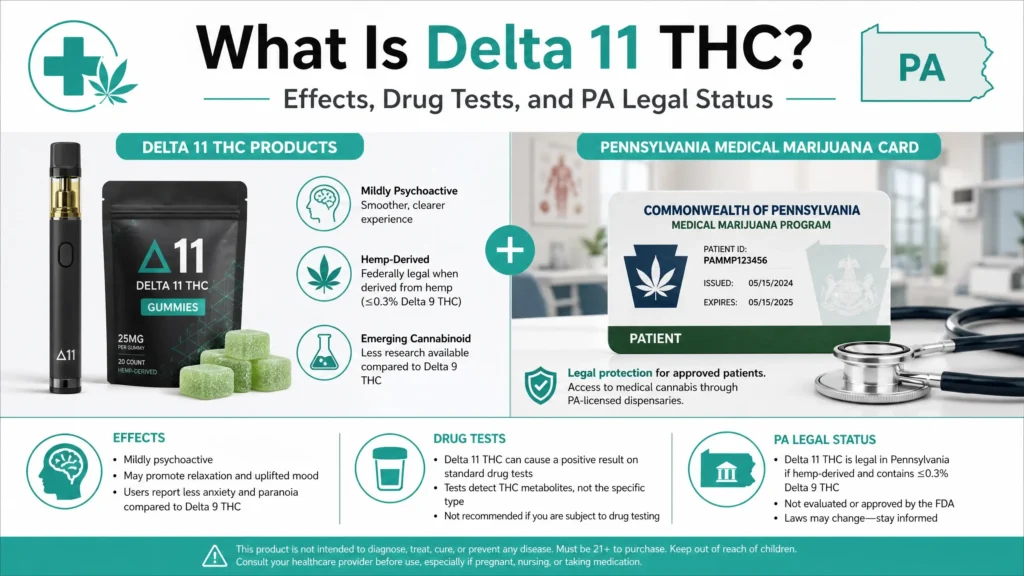
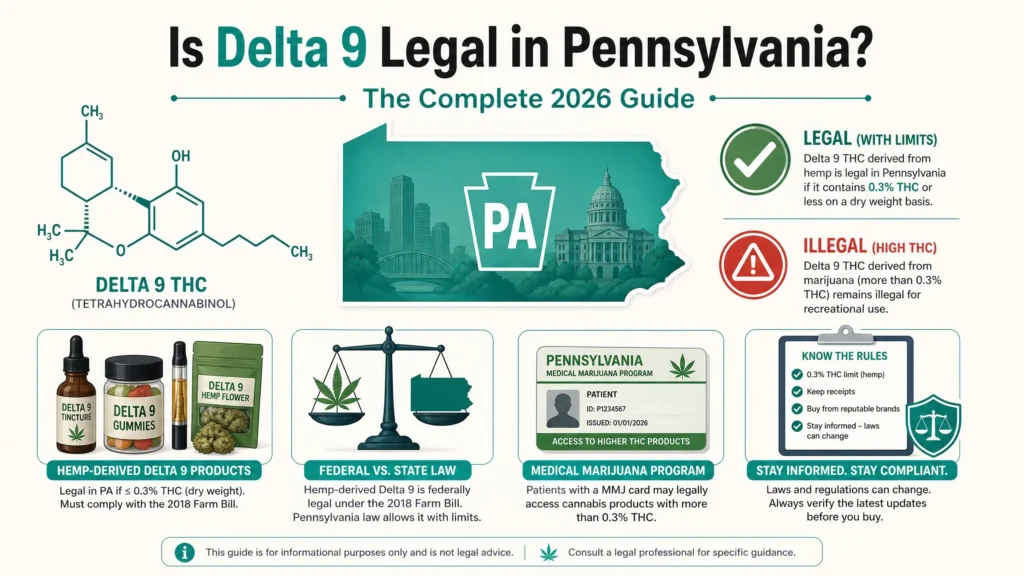
Type 1 — Hemp-Derived Delta 9 (≤0.3% THC by dry weight) Legal under the 2018 Federal Farm Bill and Pennsylvania’s hemp program (3 Pa. C.S.A. § 701 et seq.). Sold at smoke shops, convenience stores, and online retailers throughout PA. No MMJ card required. No dispensary involved. These gummies contain real delta-9 THC — the same molecule as in marijuana — but at a concentration that falls below the federal hemp threshold.
Do You Qualify for a PA MMJ Card?
Connect with a licensed Pennsylvania state physician online from home.
Type 2 — Marijuana-Derived Delta 9 (above 0.3% THC by dry weight) Only legal in Pennsylvania for registered medical marijuana patients through licensed dispensaries under Act 16 of 2016. Recreational possession remains a criminal offense in PA. Importantly, Pennsylvania dispensaries are not permitted to sell edibles or gummies — so even MMJ patients cannot legally obtain marijuana-derived delta 9 gummies from a PA dispensary.
Why this distinction matters for the drug dog question: A K9 unit cannot tell the difference between these two types. To a trained dog’s nose, delta 9 THC from hemp and delta 9 THC from marijuana are chemically indistinguishable. The legal category exists only on paper — not in scent molecules.
Can Drug Dogs Smell Delta 9 Gummies? The Science

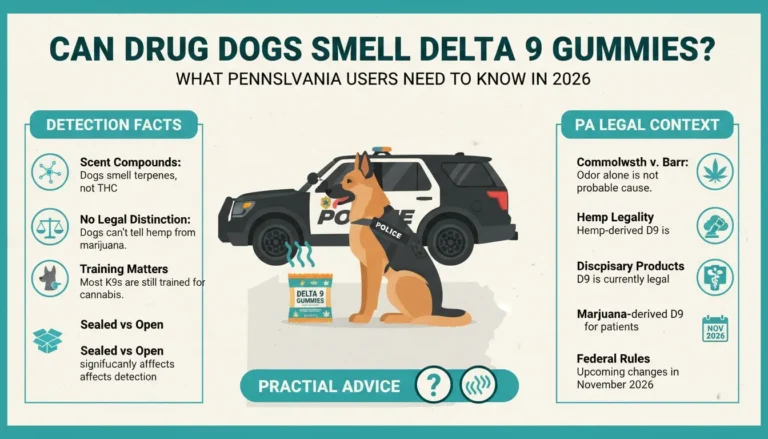
The direct answer: yes, drug dogs can potentially detect delta 9 gummies — but detection is significantly less reliable than with cannabis flower, and several factors determine whether it actually happens.
Here is how canine detection actually works.
Drug dogs are not trained to sniff out specific molecules like “THC.” They are trained to alert on volatile organic compounds (VOCs) — the chemical fingerprint of a substance as it evaporates and travels through air. For cannabis products, those VOCs are primarily terpenes: compounds like caryophyllene oxide, beta-caryophyllene, myrcene, and limonene that give cannabis its distinctive aroma.
The challenge with gummies specifically: Commercial manufacturing largely removes terpenes from the final product. When cannabis extract is processed into a gummy — purified, infused into a flavored candy base, and sealed — most of the volatile aromatic compounds that dogs are trained on are significantly reduced or absent.
As THCGummies.com’s May 2026 analysis notes: “Drug dogs can potentially detect scent molecules escaping through packaging, but commercially sealed gummy packages provide significant scent containment. The combination of reduced terpenes in processed edibles and quality packaging makes detection unlikely in most real-world scenarios.”
This is meaningfully different from cannabis flower, where terpene-rich plant material is highly detectable even through multiple layers of packaging.
What Affects Whether a Dog Actually Detects Them

Detection is not binary — it depends on several factors specific to the product and the situation.
Factors that INCREASE detection risk:
- Homemade or artisanal gummies retain more terpenes from cannabis butter or crude extract than commercially manufactured, distillate-based gummies
- Opened packaging — once the seal is broken, volatile compounds escape rapidly
- Handling residue — touching gummies and then the outside of the bag creates a scent trail on the packaging exterior
- Heat — warm conditions increase volatility; gummies stored in a hot car emit more detectable compounds
- High potency products — more THC-containing extract generally means more residual aromatic compounds
- Older or degraded packaging — time and micro-imperfections allow scent to escape gradually
- Full-spectrum gummies — products made with full-spectrum extract retain more terpenes than isolate or distillate-based gummies
⚡ Fast & 100% Online PA Medical Cards
Board-Certified Doctors • 100% Money-Back Guarantee
Book Evaluation Now →Factors that DECREASE detection risk:
- Commercial distillate-based gummies — most hemp delta 9 gummies sold in smoke shops and online use distillate, which has minimal terpene content
- Vacuum-sealed, child-resistant commercial packaging — significantly reduces scent emission
- Cold storage — reduces volatility of any remaining aromatic compounds
- Fruit-flavored coatings — strong food flavors can partially mask underlying cannabis VOCs, though trained K9s can often identify the cannabis signal beneath food scents
Bottom line on detection probability: A trained K9 working a targeted cannabis search has a reasonable chance of alerting on any cannabis-containing product, including commercial delta 9 gummies. In casual or incidental scenarios — a routine traffic stop where no targeted drug search has been ordered — the risk of detection from a sealed, commercial delta 9 gummy package is lower but not zero.
The Critical Legal Problem: Dogs Can’t Tell Legal from Illegal
This is the most important thing Pennsylvania delta 9 gummy users need to understand.
Drug dogs are trained to alert on cannabis scent compounds. They are not trained, and are not capable, of distinguishing between:
- Hemp-derived delta 9 (≤0.3% — federally legal)
- Marijuana-derived delta 9 (above 0.3% — federally illegal)
- Delta 8, delta 10, THCA, or other hemp-derived cannabinoids
- CBD products that retain cannabis terpene profiles
A dog’s alert is a chemical response to a scent profile. The legal classification of the substance producing that scent is irrelevant to the dog. As Zaleaf’s July 2025 analysis puts it: “A dog’s nose doesn’t understand legal nuances. They smell cannabis compounds and alert — period.”
This creates a real-world problem: a dog can alert on your perfectly legal, Farm Bill-compliant, hemp-derived delta 9 gummies. That alert can trigger a search. The search leads to discovery of the gummies. Now you are explaining to law enforcement why what looks like THC gummies is actually legal hemp.
Having your COA (Certificate of Analysis) on hand and your products in original, labeled packaging is your most practical legal protection in this scenario. But it does not prevent the initial alert or the search.
Pennsylvania Law: What Happens After a Dog Alerts
A K9 alert in Pennsylvania does not automatically result in arrest or prosecution — but what happens next depends on the specific circumstances.
If you are a registered PA MMJ patient: Your patient card establishes that you are a registered participant in a state-legal medical marijuana program. However, it does not authorize possession of gummies or edibles — even from a licensed dispensary, because Pennsylvania’s Medical Marijuana Act prohibits dispensaries from selling edible products. If you have gummies, they are either hemp-derived (from an outside retailer) or obtained outside the licensed system.
If you are not an MMJ patient: Law enforcement can conduct a search following a valid K9 alert. If the gummies are in original commercial packaging with a COA showing ≤0.3% delta-9 THC by dry weight, you have a strong factual basis to assert legality. Field tests for THC are notoriously unreliable — they cannot distinguish hemp-derived from marijuana-derived THC.
The key documentation to have:
- Original retail packaging with full label information (manufacturer, ingredients, THC mg per serving, batch number)
- COA from a third-party lab confirming ≤0.3% delta-9 THC by dry weight
- Purchase receipt if available
Renewing Your PA MMJ Card?
Quick annual recertification online. No paperwork hassle.
Renew Card Online →What Pennsylvania criminal law says about possession: Recreational marijuana possession in PA remains a criminal offense. First-time possession of a small amount (30 grams or less) of marijuana carries a misdemeanor charge, up to 30 days in jail, and a $500 fine. Without documentation proving your delta 9 gummies are hemp-derived, a field test positive for THC could initiate a possession charge that you would need to resolve through the legal system — even if you are ultimately found not guilty.
Commonwealth v. Barr: The PA Supreme Court Decision That Matters

In December 2021, the Pennsylvania Supreme Court issued a landmark ruling in Commonwealth v. Barr that directly affects this situation.
The Court held that the odor of marijuana alone is NOT sufficient probable cause to conduct a warrantless vehicle search in Pennsylvania. This ruling recognized that because medical marijuana is legal for over 440,000 registered patients in PA, the smell of cannabis no longer conclusively indicates illegal activity.
What this means for delta 9 gummy users in PA:
- A K9 alert on your vehicle — without additional indicators of criminal activity — should not by itself authorize a warrantless search under Pennsylvania law
- Your attorney can challenge a search conducted based solely on a K9 cannabis alert without corroborating circumstances
- This ruling applies to state law enforcement; federal officers operating under federal jurisdiction (at borders, federal facilities, etc.) are not bound by it
The important caveat: Commonwealth v. Barr protects against warrantless searches based solely on cannabis odor. It does not prevent law enforcement from conducting a consensual search (which you can decline), obtaining a warrant, or initiating an investigation if other probable cause exists alongside the odor. And the ruling does not eliminate the potential legal jeopardy of having unverified THC gummies in your possession.
For a detailed breakdown of how PA cannabis odor law works, including the Barr ruling and its practical limits, review Pennsylvania’s medical marijuana laws and patient rights.
The November 2026 Federal Law Change That PA Users Must Know

This is the most time-sensitive information in this entire article — and virtually no PA-focused cannabis site has covered it yet.
On November 12, 2025, President Trump signed H.R. 5371 — a federal spending bill that contained amendments fundamentally redefining hemp under federal law. These changes take effect on November 12, 2026.
What changes in November 2026:
The new law imposes a 0.4 milligram per container cap on delta-9 THC in hemp-derived products. To put that in perspective: most commercial delta 9 gummies currently sold in Pennsylvania contain 5mg, 10mg, or even 25mg of THC per gummy. A 0.4mg per-container cap — not per gummy, but for the entire package — would eliminate virtually the entire hemp-derived delta 9 gummy market as it currently exists.
The Haze Connect’s March 2026 analysis confirms: “Most Delta 9 edibles become illegal. The 0.4 milligram per-container cap would eliminate the vast majority of hemp-derived Delta 9 gummies, tinctures, and edibles currently on the market.”
Get Approved by a Licensed PA Doctor
Schedule your appointment in minutes. You only pay if approved.
Start Online Application →What is being done about it:
There are active legislative efforts to repeal or revise H.R. 5371 before the November 2026 deadline:
- H.R. 6209 (Mace/Massie Bill): Introduced November 2025 — would fully repeal the hemp amendments and restore the 2018 Farm Bill framework
- The HEMP Act (H.R. 1287): Introduced January 2026 — bipartisan bill to create a federal regulatory framework for hemp-derived cannabinoids while maintaining legal access
As of May 2026, neither bill has passed. The November 2026 deadline remains in effect.
What this means for PA users: The hemp-derived delta 9 gummies currently sold legally at Pennsylvania smoke shops and online may effectively become federally prohibited within six months. If you use these products for a genuine medical condition — anxiety, chronic pain, PTSD, insomnia — the PA medical marijuana program may offer a more legally stable long-term alternative.
PA Dispensaries Don’t Sell Gummies — Here’s Why That Matters

Here is a fact about Pennsylvania’s medical marijuana program that surprises many patients: PA licensed dispensaries are not permitted to sell traditional edibles — no gummies, no baked goods, no candy-form products.
This is explicitly prohibited under the Pennsylvania Medical Marijuana Act. The approved product forms at PA dispensaries include:
- Dry leaf or plant material (for vaporization — not smoking)
- Tinctures and oils
- Capsules
- Topical forms
- Liquid concentrates
The restriction exists because Pennsylvania regulators expressed concern about accidental consumption by children and dosing accuracy in food-form products.
Why this creates a legal gap for regular cannabis users in PA:
Many Pennsylvanians who prefer edible cannabis consumption have turned to hemp-derived delta 9 gummies from smoke shops as their only accessible option. But as of November 2026, those products face effective federal elimination. Registered MMJ patients cannot get gummies from their dispensary. And recreational gummies remain illegal under PA state law (marijuana-derived).
This gap is real and affects thousands of Pennsylvanians managing conditions like anxiety, chronic pain, PTSD, and others through what is currently a legal hemp product that may not remain legal through year-end 2026.
The MMJ Card: A Cleaner Legal Position for Regular PA Cannabis Users
Ready to Get Your Official PA MMJ Card?
State-certified doctor consultations online. No risk—100% refund if not approved.
Claim Your MMJ Card Online →If you are a Pennsylvania resident using delta 9 gummies to manage a genuine medical condition — and you have a qualifying condition — a PA medical marijuana card gives you several advantages that hemp gummy users do not have:
Legal protection that hemp gummy users lack:
| Situation | Hemp Delta 9 Gummy User | Registered PA MMJ Patient |
|---|---|---|
| K9 alert during traffic stop | Must prove product is hemp-derived with COA | Patient card documents legal participation in state MMJ program |
| Commonwealth v. Barr protection | Partial — based on hemp legality argument | Stronger — recognized as MMJ patient under PA law |
| Employer/background check | Registry not shared (HIPAA) | Registry not shared (HIPAA) |
| Product availability after Nov 2026 | Highly uncertain — federal law change | Dispensary products unaffected by hemp law changes |
| Product quality assurance | Varies — market unregulated | State-mandated COA required for all products |
| Edibles/gummies access | Legal now, uncertain after Nov 2026 | Not currently available at PA dispensaries |
The honest limitation: PA MMJ patients also cannot currently purchase gummies from dispensaries. But the November 2026 federal law change doesn’t affect dispensary-dispensed products at all — those are covered under state medical law, not the Farm Bill. And PA dispensaries do offer tinctures, capsules, and other oral forms that provide comparable therapeutic effects to gummies.
More importantly, being a registered MMJ patient gives you a documented legal status in Pennsylvania that a hemp gummy buyer simply does not have.
If you have a qualifying condition — anxiety disorders (the most common qualifying condition in PA, cited in ~60% of certifications), chronic pain, PTSD, Crohn’s disease, cancer, or any of the other 20+ qualifying conditions — getting your card through a same-day telehealth certification may be the most practical long-term move.
Certification pricing through Pennsylvania Marijuana Cards:
| Physician Fee | PA State Fee | Total | |
|---|---|---|---|
| New Patient | $159 | $50 | $209 |
| Renewal | $149 | $50 | $199 |
| MMAP Qualifying Patients (Medicaid, SNAP, WIC, CHIP, PACE, PACENET) | — | $0 (waived) | Physician fee only |
Start your same-day telehealth certification here.
Practical Tips If You Currently Use Hemp Delta 9 Gummies in PA

If you plan to continue using hemp delta 9 gummies in Pennsylvania before the legal landscape changes in November 2026, here is the practical guidance:
Always carry:
- Products in original, sealed, labeled retail packaging
- The COA from the manufacturer (a QR code on the label typically links to this, or download it before you travel)
- Purchase receipt if available
Always avoid:
- Opened or repackaged gummies in non-original containers
- Transferring gummies into unlabeled bags or containers
- Keeping gummies in a hot car (increases scent emission)
- Crossing state lines with gummies — interstate transport of THC products creates federal exposure regardless of hemp status, and state laws vary dramatically
Know your rights under Commonwealth v. Barr:
- Odor of cannabis alone is not standalone probable cause for a warrantless vehicle search in Pennsylvania
- You can politely decline a consent search
- If a search occurs over your objection based solely on cannabis odor, that evidence may be suppressible — consult a Pennsylvania attorney
If questioned by law enforcement:
- Remain calm and polite
- Provide your COA and original packaging
- State clearly that the product is hemp-derived and federally compliant under the 2018 Farm Bill
- Do not argue or resist
- Contact a Pennsylvania criminal defense attorney if charges are initiated
Frequently Asked Questions — Can Drug Dogs Smell Delta 9 Gummies
Q: Can drug dogs smell delta 9 gummies?
A: Yes, drug dogs can potentially detect delta 9 gummies, but detection is significantly less reliable than with cannabis flower. Commercial delta 9 gummies are manufactured using distillate-based extracts with most terpenes removed, which reduces the volatile organic compounds that trained K9s detect. Sealed, commercial packaging further reduces scent emission. However, dogs trained on cannabis scent profiles may still alert on delta 9 gummies — especially if packaging is open, the product contains full-spectrum extract, or there is handling residue on the outside of the packaging. Detection depends on the dog’s training, the product type, packaging quality, and environmental conditions.
Q: Can drug dogs tell the difference between legal hemp delta 9 gummies and illegal marijuana?
A: No. Drug dogs cannot distinguish between hemp-derived delta 9 THC (≤0.3% by dry weight — federally legal) and marijuana-derived delta 9 THC (above 0.3% — federally controlled). Dogs are trained to detect the terpene-based scent profile of cannabis compounds, not the legal classification of the product. A K9 alert on legal hemp gummies is legally and chemically identical to an alert on marijuana. This is why carrying your Certificate of Analysis (COA) and original retail packaging is essential when transporting hemp delta 9 products in Pennsylvania.
Q: Are delta 9 gummies legal in Pennsylvania in 2026?
A: As of May 2026, hemp-derived delta 9 gummies containing no more than 0.3% delta-9 THC by dry weight are legal to purchase and possess in Pennsylvania under the 2018 Farm Bill and Pennsylvania’s state hemp program. However, a federal law change signed November 2025 (H.R. 5371) will impose a 0.4 milligram per-container cap on hemp-derived THC products effective November 12, 2026 — which would effectively ban most commercial delta 9 gummies currently on the Pennsylvania market. Legislative efforts to repeal this change are active as of May 2026 but have not yet passed.
Q: What does Commonwealth v. Barr mean for PA cannabis users stopped by police?
A: The December 2021 Pennsylvania Supreme Court ruling in Commonwealth v. Barr established that the odor of marijuana alone is not sufficient probable cause for a warrantless vehicle search in Pennsylvania. The Court recognized that with 440,000+ registered medical marijuana patients in the state, cannabis odor no longer conclusively indicates illegal activity. This means a K9 alert on your vehicle — without additional indicators of criminal activity — should not by itself authorize a warrantless search under Pennsylvania law. However, this ruling does not prevent consensual searches, warrant-based searches, or federal enforcement and does not eliminate legal risk from possessing unverified THC products.
Q: Why can’t PA MMJ patients buy delta 9 gummies from dispensaries?
A: Pennsylvania’s Medical Marijuana Act explicitly prohibits licensed dispensaries from selling traditional edible food-based products, including gummies, baked goods, and candy-form cannabis products. Pennsylvania dispensaries are limited to selling dry leaf (for vaporization), tinctures, oils, capsules, topicals, and liquid concentrates. PA regulators imposed this restriction over concerns about accidental consumption by children and dosing accuracy in food products. This creates a gap for patients who prefer edible consumption — currently addressed by the hemp-derived delta 9 market, which faces uncertainty after November 2026.
Q: What should I do if a drug dog alerts on my delta 9 gummies in Pennsylvania?
A: Remain calm and polite. Present your COA (Certificate of Analysis) from the manufacturer and your product in its original retail packaging. Clearly state that the product is hemp-derived and compliant with the 2018 Farm Bill. Know that under Commonwealth v. Barr, cannabis odor alone should not authorize a warrantless search in Pennsylvania. Do not consent to a search if you choose not to. If charges are filed, contact a Pennsylvania criminal defense attorney immediately. The COA is your most important legal document — keep a digital copy on your phone and a printed copy with your products.
Q: Does a PA medical marijuana card protect you from drug dog searches?
A: A PA MMJ card does not prevent a K9 from alerting on cannabis scent — dogs respond to chemical compounds, not legal status. However, being a registered PA MMJ patient provides important legal context that a hemp gummy user does not have: it documents your legal participation in Pennsylvania’s state-sanctioned medical marijuana program. Under Commonwealth v. Barr, this makes cannabis odor even less reliable as standalone probable cause. Additionally, dispensary-purchased MMJ products come with state-mandated COAs and are covered under the PA Medical Marijuana Act — providing a clearer legal standing than over-the-counter hemp gummies if products are ever questioned by law enforcement.
Q: Will delta 9 gummies be banned in Pennsylvania after November 2026?
A: Under the current text of H.R. 5371, signed November 2025, hemp-derived products will be subject to a 0.4 milligram per-container THC cap beginning November 12, 2026. This would effectively eliminate nearly all commercial delta 9 gummies currently sold legally in Pennsylvania and across the U.S., as most products contain 5–25mg of THC per gummy. Active legislative efforts — including H.R. 6209 (the Mace/Massie Bill) and the HEMP Act (H.R. 1287) — are working to repeal or revise this change before the deadline. As of May 2026, neither bill has passed. PA users who rely on hemp delta 9 gummies for medical management of qualifying conditions should explore whether a PA MMJ card provides a more stable long-term access path.
This blog post is intended for general educational and informational purposes only and does not constitute legal advice. Pennsylvania cannabis laws, federal hemp regulations, and law enforcement practices are subject to ongoing changes. The information in this article reflects the legal landscape as of May 2026. Always consult a licensed Pennsylvania attorney for legal guidance specific to your situation. For medical questions about qualifying conditions and the PA MMJ program, consult a licensed physician. Medically reviewed by Dr. Johnathon Chance Miller, MD.
Sources
All sources verified as of May 2026.
- THCGummies.com — “Can Drug Dogs Smell Edibles? What Science Says in 2026” (April 2026)
- Zaleaf — “Gummy Bears Beware — Can Drug Dogs Really Smell THC Edibles?” (July 2025)
- Bridge Legal — “Can Drug Dogs Smell Delta 8 Gummies: Facts and Safety”
- Cheef Botanicals — “Can Drug Dogs Smell Edibles? Exposing How Detection Works” (January 2026)
- The Haze Connect — “Is THCA Legal? 2026 State-by-State Guide to THCA Flower Laws” (March 2026)
- The Marijuana Herald — “Legal Status of Hemp-Derived THC Products in All 50 States” (November 2025)
- PennsylvaniaStateCannabis.org — “Is Delta-9 Legal in Pennsylvania?”
- Elevate Right — “Is THCA Legal in Pennsylvania?” (March 2026)
- David McKenzie Law Firm — “Pennsylvania Marijuana Edibles Laws: Legal Status and Criminal Consequences” (April 2026)
- Commonwealth v. Barr, 266 A.3d 25 (Pa. 2021) — Pennsylvania Supreme Court
- Triangle Hemp Wellness — “Is Delta 9 THC Legal? 2026 Federal & State-by-State Guide” (April 2026)
- H.R. 5371 — Continuing Appropriations, Agriculture, Legislative Branch, Military Construction and Veterans Affairs, and Extensions Act, 2026 (signed November 12, 2025)
- Pennsylvania Medical Marijuana Act — Act 16 of 2016 (35 P.S. §§ 10231.101–10231.2110)