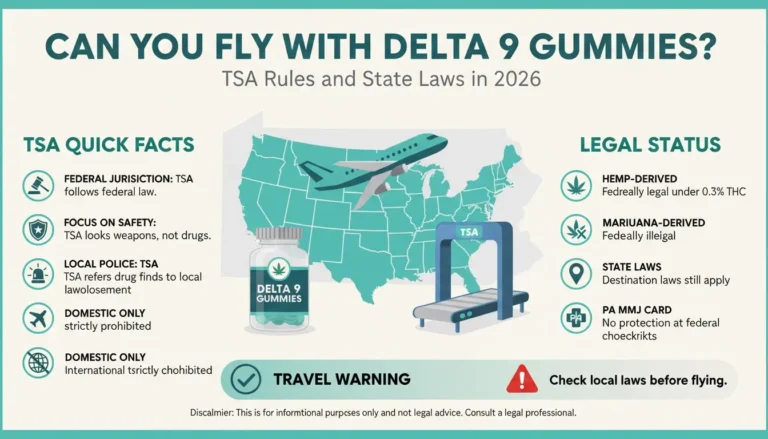

Heading to the airport with delta 9 gummies in your bag and wondering if that is going to be a problem? You are not alone. This is one of the most commonly searched cannabis travel questions of 2026 — and the answer is more layered than most articles let on.
The short version: it depends entirely on where your delta 9 gummies came from, where you are flying to, and — critically — one approaching legal deadline that most travelers have not heard about yet.
Need a PA Medical Marijuana Card?
Get certified online in 15 minutes. 100% Money-Back Guarantee.
Get Certified Now →This guide gives you the full picture, including the one thing Pennsylvania medical marijuana patients specifically need to understand before packing anything cannabis-related for a flight.
The Key Distinction: Hemp-Derived vs. Dispensary Delta 9 Gummies

Before anything else, there is a distinction that determines your entire legal position at the airport. It is not about how many milligrams are in the gummy. It is not about which state you are flying from. It is about where the gummy was made and what it is legally classified as.
Hemp-derived delta 9 gummies are products manufactured from hemp plants — cannabis plants containing no more than 0.3% delta-9 THC by dry weight under the federal definition established by the 2018 Farm Bill. These products are sold at smoke shops, online retailers, health stores, and gas stations. Because they technically qualify as hemp under federal law, they occupy a legal gray zone that allows them on flights under current TSA guidelines — with conditions we will cover shortly.
Dispensary delta 9 gummies — including any edible purchased at a licensed Pennsylvania medical marijuana dispensary — are derived from marijuana, not hemp. They contain delta-9 THC at concentrations far exceeding the 0.3% dry weight threshold. As The Hemp Doctor’s travel guide clearly states, dispensary products don’t meet the dry weight limit and remain illegal under federal law — they cannot be taken on domestic flights regardless of state legalization and regardless of whether you hold a valid PA medical marijuana card.
Do You Qualify for a PA MMJ Card?
Connect with a licensed Pennsylvania state physician online from home.
This single distinction is the most important thing to understand before you pack anything cannabis-related for air travel.
| Product Type | Source | Federal Status | Can You Fly With It? |
|---|---|---|---|
| Hemp delta 9 gummies (≤0.3% by dry weight) | Smoke shop / online retailer | Currently federally legal hemp | Yes — with conditions |
| PA dispensary edibles | Licensed PA MMJ dispensary | Federally illegal marijuana | No — never |
| CBD gummies (no THC) | Any source | Federally legal | Yes |
| PA dispensary any other product | Licensed PA MMJ dispensary | Federally illegal marijuana | No — never |
What TSA’s Official Policy Actually Says
The Transportation Security Administration’s official policy on medical marijuana, last updated April 27, 2026, states directly: TSA security officers do not search for illegal drugs, but if any illegal substance or evidence of criminal activity is discovered during security screening, TSA will refer the matter to a law enforcement officer.
This is the foundational reality of flying with any cannabis-adjacent product. TSA agents are trained to identify security threats — weapons, explosives, prohibited liquids. They are not drug enforcement agents and they are not actively looking for cannabis products in your bag.
However, three things are important to understand about what this means practically:
TSA agents are not chemists. They cannot look at a delta 9 gummy and determine whether it came from a hemp plant or a marijuana plant. They cannot verify a product’s THC percentage on the spot. As The Hemp Doctor’s legal travel analysis notes, whether your gummies make it past the checkpoint can depend on an individual officer’s discretion — and not every TSA officer is familiar with the nuances of federal hemp law.
If TSA spots something that looks like cannabis, they must refer it. Even if your product is perfectly legal, a gummy labeled “Contains THC” or branded with cannabis imagery can trigger a referral to airport law enforcement simply because it looks like it might be marijuana. The referral then starts a separate process with local police — which brings us to what actually happens next.
A PA medical marijuana card carries zero weight at TSA. The TSA operates under federal law. Medical marijuana remains federally classified as a controlled substance. Your PA MMJ card is a state-level document. It provides no legal protection, no special exemption, and no ability to override federal drug law at a federal security checkpoint.
The Dry Weight Loophole — and Why It Matters

Here is something that surprises many people: hemp-derived delta 9 gummies sold legally at smoke shops and online retailers can be genuinely psychoactive — sometimes delivering 10mg, 15mg, or even 20mg of delta 9 THC per piece — and still qualify as legal hemp under federal law.
How? The 0.3% threshold is calculated by dry weight of the entire product — not by milligrams of THC per serving. Because a gummy is dense and heavy relative to its cannabinoid content, a 5-gram gummy can legally contain up to 15mg of delta 9 THC and still remain under 0.3% by dry weight. A 10-gram gummy can legally contain up to 30mg. This is the exact framework Congress created in the 2018 Farm Bill and it has been consistently upheld.
The practical consequence for air travel: a hemp delta 9 gummy that produces effects identical to a dispensary edible — the same high, the same potency, the same duration — may be perfectly legal to carry onto a plane, while an identical-looking dispensary gummy is a federal crime to transport by air.
⚡ Fast & 100% Online PA Medical Cards
Board-Certified Doctors • 100% Money-Back Guarantee
Book Evaluation Now →The legal difference is entirely in the paperwork and the source plant. The TSA agent looking at your gummy in an X-ray cannot distinguish between them. This is exactly why clear original packaging and a Certificate of Analysis matter so much when traveling with these products.
What Happens If TSA Finds Your Gummies

Understanding the realistic outcome if TSA stops you provides important context for your decision-making.
If a TSA officer spots what appears to be a cannabis product during screening, the process generally goes like this:
Step 1 — TSA refers to local law enforcement. TSA agents do not have arrest authority for drug possession. Their job is to refer suspicious items to airport police or local law enforcement officers. TSA itself does not confiscate or charge you.
Step 2 — Local police determine legality. Airport law enforcement then evaluates the product. This is where your documentation matters — a clearly labeled hemp product with a Certificate of Analysis showing compliant THC levels significantly helps your case. As The Hemp Doctor’s airport guide explains, the typical outcome for a clearly compliant hemp product is minor — officers may simply confiscate the product or instruct you to discard it.
Step 3 — Outcome depends on airport jurisdiction. This is the variable that most people underestimate. The airport police enforcing local law at your departure airport are bound by the laws of that state. Philadelphia International Airport is in Pennsylvania — PA law enforcement is generally familiar with hemp-derived products. But if you are departing from an airport in a state that has banned hemp-derived THC, or from a state with strict cannabis laws, the outcome may be more serious.
The realistic range of outcomes for compliant hemp products: product confiscation, being asked to discard before boarding, a brief delay, or — in states with restricted hemp laws — potential citation. For dispensary products (marijuana-derived), the outcome range is more serious: confiscation, missed flight, citation, or in strict-enforcement states, arrest.
Destination State Laws: The Second Legal Layer Most People Miss

This is where many travelers who feel confident about TSA get caught off guard. Federal law is not the only law that applies when you land.
Even if your hemp delta 9 gummies are perfectly compliant with federal standards and TSA waves you through without a second look, the laws of your destination state apply the moment you arrive. As EMSEKFLOL’s interstate cannabis legal analysis puts it plainly: if you fly from a legal state and land in a state where even hemp-derived THC is restricted, you are subject to the laws of that destination. Law enforcement at your arrival airport will enforce local statutes.
The state landscape for hemp-derived delta 9 as of May 2026 is patchwork. While most states permit hemp products meeting the federal 0.3% standard, a meaningful number have enacted their own restrictions. Based on Triangle Hemp Wellness’s March 2026 state-by-state legal guide and the Marijuana Policy Project’s state regulatory tracker, states with notable restrictions or bans on hemp-derived intoxicating products as of May 2026 include:
- Idaho — among the most restrictive in the country; all forms of THC are prohibited under state controlled substances law regardless of hemp source
- Alaska — all THC derivatives classified as Schedule IIIA controlled substances under state law
- Arizona — all THC isomers and derivatives classified as controlled substances unless sold through licensed cannabis dispensaries
- Colorado — previously legal, delta 8 and similar hemp intoxicants now classified as controlled substances; only products through licensed cannabis system permitted
- Connecticut — hemp products with significant THC content restricted to licensed cannabis retailers
Additionally, several states that permit hemp delta 9 have imposed strict per-serving milligram caps and packaging requirements. Flying with a product legal in Pennsylvania but exceeding another state’s per-serving limit creates legal exposure at your destination.
Renewing Your PA MMJ Card?
Quick annual recertification online. No paperwork hassle.
Renew Card Online →The practical advice: Before flying anywhere with hemp delta 9 gummies, spend five minutes checking the specific laws of your destination state. The Baker Institute’s state-by-state hemp legality map and LegalClarity’s delta 9 state guide are the most current resources for this.
The November 2026 Federal Deadline: What Is Changing and When

This is the piece of information that most competing articles either miss entirely or mention only briefly — and it may be the most important thing in this entire guide for anyone planning to travel with hemp delta 9 products beyond this year.
On November 12, 2025, President Trump signed the Continuing Appropriations and Extensions Act, 2026 (P.L. 119-37), which fundamentally rewrites the federal definition of hemp. As LegalClarity’s federal hemp law analysis explains, three changes matter most for travelers:
Total THC replaces delta-9 THC. The old 0.3% standard measured only delta-9 THC by dry weight. The new definition measures total THC — including THCA, delta-8, delta-10, and other intoxicating cannabinoids. Most commercially available hemp delta 9 gummies that are currently legal will fail this broader standard.
Synthetic cannabinoids banned outright. Products containing cannabinoids that cannot be naturally produced by the cannabis plant at those concentrations — which includes most commercially synthesized hemp-derived cannabinoids — are explicitly excluded from the definition of hemp regardless of THC percentage.
A 0.4 milligram per-container cap on finished retail products. As Snopes’ detailed breakdown of the federal ban confirmed, the new law imposes a strict milligram cap on finished packaged products — a threshold that virtually all psychoactive hemp edibles on the market today far exceed.
The deadline: November 12, 2026. These changes take effect exactly one year from the signing date. After that date, a hemp delta 9 gummy that was perfectly legal to carry on a flight the day before could expose you to the same federal penalties as flying with marijuana.
As Higher Standard’s TSA travel guide notes, the current 0.3% delta-9 THC standard is what TSA follows through most of 2026 — but that window closes in November.
If you are reading this in May 2026, you have approximately six months of the current legal framework remaining for hemp delta 9 gummies. After November 12, 2026, the landscape changes decisively.
International Travel: A Hard No
This section is brief because the answer is straightforward: do not fly internationally with any delta 9 gummies — hemp-derived or dispensary-purchased.
Most countries prohibit all THC-containing products regardless of how they are classified under U.S. federal hemp law. The 2018 Farm Bill’s hemp definition has no legal weight outside the United States. Customs and border enforcement in your destination country will apply their own national laws, which in many cases treat any detectable THC as a controlled substance.
Get Approved by a Licensed PA Doctor
Schedule your appointment in minutes. You only pay if approved.
Start Online Application →Consequences of being stopped at international customs with cannabis products range from confiscation and fines to detention and criminal charges. In some countries — particularly parts of Asia, the Middle East, and Southeast Asia — cannabis possession carries severe mandatory sentences. No gummy is worth that risk.
As RESTART CBD’s international travel guidance states plainly: do not travel internationally with delta 9 THC products. Many countries prohibit all THC products, including hemp-derived versions.
Pennsylvania Medical Marijuana Patients: The Critical Rule

If you are a Pennsylvania resident who holds an active medical marijuana card, this section is specifically for you — and the rule it covers is one that surprises many certified patients.
Your PA medical marijuana card does not help you at the airport. At all.
This is not a qualification or a nuance. It is a hard legal reality. The TSA operates under federal law. Medical marijuana is federally classified as a Schedule I controlled substance under the Controlled Substances Act. Pennsylvania’s Medical Marijuana Act is a state law. State law has no authority over federal jurisdiction, and airports — from the TSA checkpoint inward — are federal territory.
As CannabisRegulations.ai’s airport compliance guide states explicitly: even a medical card does NOT override federal rules for air travel.
This means that if you purchased edibles, tinctures, capsules, or any other product from a licensed Pennsylvania dispensary and you bring them to the airport, you are carrying a federally illegal controlled substance into a federal jurisdiction. The fact that you purchased it legally, with a valid physician certification, from a state-licensed dispensary, changes nothing about the federal legal analysis at TSA.
What PA MMJ patients can do instead:
If you are a certified PA patient traveling for an extended period and need cannabis medication, here are your realistic options:
- Check dispensary availability at your destination. If you are traveling to a state with a medical marijuana program, research whether your PA MMJ card may be recognized under that state’s reciprocity rules before you travel. States vary significantly on reciprocity — some honor out-of-state medical cards, many do not.
- Research the dispensaries at your destination. If your destination state has recreational or medical marijuana and you qualify, you may be able to purchase at a licensed dispensary upon arrival — legally, without transporting anything across state lines.
- Plan for a gap in access. For short trips, many patients simply plan around the travel period, adjusting their schedule before departure and re-establishing access upon return.
- Do not transport dispensary products by air under any circumstances. The legal and personal risk is not proportionate to any convenience.
The Broader Context for Pennsylvania Cannabis Users
If you are a Pennsylvania resident currently relying on hemp-derived delta 9 gummies from smoke shops or online retailers — partly because you lack legal access to regulated cannabis — it is worth understanding what the November 2026 federal ban means for your access.
Ready to Get Your Official PA MMJ Card?
State-certified doctor consultations online. No risk—100% refund if not approved.
Claim Your MMJ Card Online →The same hemp products you may be buying today will be federally prohibited within months. Pennsylvania’s own state legislation, Senate Bill 49, advanced with a 10-1 bipartisan committee vote in March 2026, may close access at the state level even sooner.
For Pennsylvania residents using delta 9 hemp gummies for anxiety, chronic pain, sleep disruption, PTSD, or other health reasons — a Pennsylvania medical marijuana card provides the only legal, sustainable path forward after those bans take effect.
Pennsylvania recognizes 24 qualifying conditions. Anxiety disorder is by far the most common — accounting for approximately 60% of all PA MMJ certifications according to research published in the Annals of Internal Medicine in July 2025, based on analysis of over 1.7 million certification records. You can view the complete list of qualifying conditions here, or learn specifically about anxiety disorder and PA MMJ certification here.
The certification process is done entirely online through telehealth. No clinic visit required.
Cost breakdown:
| Fee | Amount |
|---|---|
| Physician certification fee (new patient) | $159 |
| PA state registration fee | $50 |
| Total (new patient) | $209 |
| Physician certification fee (renewal) | $149 |
| PA state registration fee | $50 |
| Total (renewal) | $199 |
Pennsylvania residents qualifying for Medicaid, SNAP, WIC, CHIP, PACE, or PACENET may have the $50 state fee waived through Pennsylvania’s MMAP program. Start the process at Pennsylvania Marijuana Cards.
Practical Checklist for Traveling With Hemp Delta 9 Gummies
If you have determined that your hemp delta 9 gummies are compliant and you have decided to travel with them before the November 2026 federal ban, here is the practical guidance that reduces your risk of delays or complications:

Before you pack:
- Confirm your product is hemp-derived with less than 0.3% delta-9 THC by dry weight — not dispensary-purchased
- Verify the laws of your destination state permit hemp-derived delta 9 products
- Check whether your destination state has per-serving milligram caps your product exceeds
- Confirm you are not traveling internationally
At the airport:
- Keep products in original, factory-sealed retail packaging with clear labeling showing hemp-derived status and THC percentage
- Do not transfer gummies into unlabeled bags, candy containers, or any packaging that removes the compliance information
- Carry the Certificate of Analysis — either printed or saved on your phone as a PDF. The COA should come from an ISO/IEC 17025 accredited laboratory and show post-decarboxylation total THC testing. As LegalClarity’s airport guide explains, a credible COA that uses post-decarboxylation testing methods is your strongest documentation of legal compliance
- If your product has a QR code linking directly to lab results, that is the gold standard for TSA interactions
- Do not consume cannabis products in airports, airport lounges, or on flights
Liquids rule reminder: Gummies are solid and do not fall under TSA’s 3-1-1 liquids rule. Tinctures and beverages do — they must be in containers of 3.4 ounces (100ml) or less and placed in a quart-sized clear plastic bag for carry-on. Vape devices and cartridges must go in carry-on only — never checked baggage — due to lithium battery fire risk regulations.
Frequently Asked Questions
Q: Can you fly with delta 9 gummies in 2026?
A: The answer depends on what type of delta 9 gummies you have. Hemp-derived delta 9 gummies containing 0.3% or less delta-9 THC by dry weight are currently federally legal under the 2018 Farm Bill and are not explicitly prohibited by TSA — provided they are in original packaging with clear labeling and you can produce a Certificate of Analysis. Dispensary delta 9 gummies — purchased at any licensed marijuana dispensary, including Pennsylvania dispensaries — are federally illegal to transport by air regardless of your state’s cannabis laws or your medical marijuana card status. The current hemp framework applies through November 12, 2026, after which federal law changes significantly. Always verify your destination state’s laws before flying, as state restrictions at your arrival point apply independently of TSA clearance.
Q: What does TSA do if they find delta 9 gummies in your bag?
A: TSA agents are focused on aviation security — they are not actively searching for drugs. If a product that appears cannabis-related is spotted during routine screening, the TSA officer is required to refer the matter to local airport law enforcement — they do not make the determination themselves and cannot arrest you. Local police then evaluate whether the product is legal under applicable law. For clearly labeled, compliant hemp products with a COA available, the most common outcomes are: being asked to discard the product, temporary delay for verification, or confiscation. For dispensary products (marijuana-derived), outcomes are more serious and depend heavily on airport jurisdiction — ranging from confiscation to citation to arrest in strict-enforcement states. The more documentation you have showing hemp compliance, the better your position in any TSA interaction.
Q: Does a Pennsylvania medical marijuana card let you fly with cannabis products?
A: No. A Pennsylvania medical marijuana card provides no protection or exemption from federal law at airports. TSA operates under federal jurisdiction, and medical marijuana remains a Schedule I federally controlled substance. State medical marijuana laws do not supersede federal law at TSA checkpoints. This means a PA MMJ patient carrying dispensary-purchased edibles, tinctures, or any other cannabis product through airport security is carrying a federally illegal controlled substance in a federal jurisdiction — regardless of how legally they obtained it in Pennsylvania. PA MMJ patients traveling by air should leave all dispensary products at home and research their destination state’s dispensary options or reciprocity policies before traveling.
Q: What is changing about flying with delta 9 gummies after November 2026?
A: The federal definition of hemp changes significantly on November 12, 2026, following the signing of P.L. 119-37 in November 2025. The new law replaces the current delta-9-only 0.3% threshold with a total THC standard — meaning all THC isomers and analogues count toward the limit. It also bans cannabinoids that cannot be naturally produced by the cannabis plant at meaningful concentrations, and imposes a strict 0.4 milligram per-container cap on finished retail products. Under this new standard, virtually all psychoactive hemp gummies currently sold at smoke shops and online — including most hemp delta 9 gummies available today — will be federally prohibited. After November 12, 2026, flying with these products carries the same federal legal exposure as flying with marijuana.
Q: Which states should Pennsylvania travelers be careful flying to with hemp delta 9?
A: Several states have enacted their own restrictions on hemp-derived THC products that are stricter than federal law. As of May 2026, notable states to research carefully before flying with any hemp delta 9 products include Idaho (all THC forms prohibited regardless of hemp source), Alaska (all THC derivatives classified as controlled substances), Arizona (all THC isomers classified as controlled substances outside licensed cannabis system), and Colorado (hemp intoxicants now classified as controlled substances, only licensed cannabis system permitted). Additional states including Connecticut restrict hemp THC products to licensed cannabis retailers. The legal landscape shifts frequently — always verify the specific current laws of both your departure and arrival states before traveling, using authoritative state government sources or a current legal resource rather than retailer blogs.
Q: Can I fly internationally with hemp delta 9 gummies?
A: No. International travel with any THC-containing product — including hemp-derived delta 9 — is strongly inadvisable and in most cases illegal. The 2018 Farm Bill’s hemp classification has no legal standing outside the United States. International customs and border authorities apply their own national laws, which in the vast majority of countries treat any detectable THC as a controlled substance. Consequences range from confiscation and fines to detention and serious criminal charges depending on the destination country. Countries in Asia, the Middle East, and Southeast Asia impose particularly severe penalties for cannabis-related offenses, including for products that would be considered federally legal in the United States. No cannabis product is worth the risk of international drug charges.
Medically reviewed by Dr. Johnathon Chance Miller, MD. This content is for educational purposes only and does not constitute legal advice. Cannabis and hemp laws are subject to rapid change at both the federal and state level — always verify current regulations with official sources before traveling. If you face legal questions related to cannabis and air travel, consult a licensed attorney familiar with both federal cannabis law and the laws of your relevant states. Do not consume cannabis products in airports or on aircraft.
Sources
- Transportation Security Administration. “Medical Marijuana.” Official TSA Policy, last updated April 27, 2026.
- LegalClarity. “Is It Legal to Fly With Delta 9 THC? TSA Rules Explained.” April 2026.
- LegalClarity. “Which States Have Legalized Delta 9 THC?” April 2026.
- The Hemp Doctor. “Can You Fly With Delta 9 Gummies? A 2026 Traveler’s Guide.” November 2025.
- Higher Standard. “Can You Fly With THC Gummies? Air Travel Rules Explained.” March 2026.
- RESTART CBD. “Traveling With Hemp Delta 9 THC: TSA Rules Explained.” March 2026.
- Triangle Hemp Wellness. “Is Delta 9 THC Legal? 2026 Federal & State-by-State Guide.” March 2026.
- Snopes. “Unpacking the federal ban on certain hemp products included in deal to end shutdown.” November 2025.
- CannabisRegulations.ai. “Traveling With Hemp CBD in 2025: TSA Rules, Airport Enforcement & Documentation Guide.” March 2026.
- Baker Institute. “Mapping Hemp Products’ Legal Status Across US States.” December 2024.
- Marijuana Policy Project. “What Are State Regulators Doing?” Hemp-derived cannabinoid tracker.
- The Marijuana Herald. “Legal Status of Hemp-Derived THC Products in All 50 States.” November 2025.
- Senator Daniel Laughlin, Pennsylvania Senate. “Laughlin’s Senate Bill 49 Amended to Include New Federal Hemp Standards.” March 2026.
- Drake C, et al. “Medical Cannabis Certifications After Pennsylvania Added Anxiety Disorders as a Qualifying Condition.” Annals of Internal Medicine, July 2025.
- Pennsylvania Department of Health. Medical Marijuana Program.
- EMSEKFLOL. “Can You Travel With Delta 9?” April 2026.