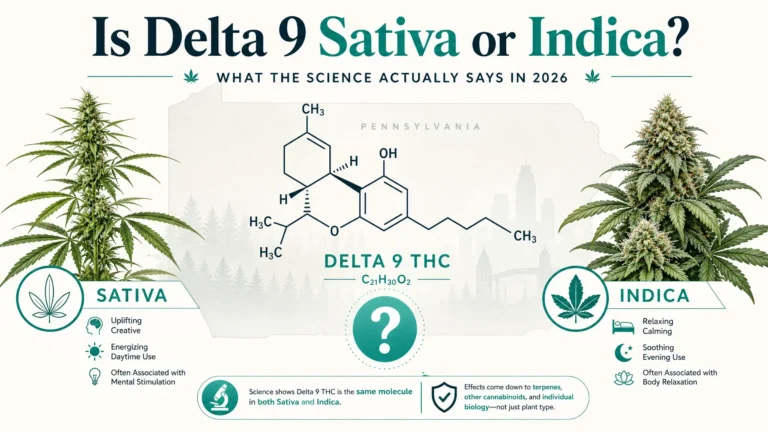

You’ve seen it on dispensary menus and smoke shop shelves: delta 9 products labeled “sativa” for daytime energy or “indica” for nighttime relaxation. So which one is delta 9?
Neither. And both. And this question — while completely reasonable — is actually the wrong question to ask.
Need a PA Medical Marijuana Card?
Get certified online in 15 minutes. 100% Money-Back Guarantee.
Get Certified Now →Delta 9 THC (delta-9-tetrahydrocannabinol) is a molecule. Sativa and indica are plant types. Asking whether delta 9 is sativa or indica is like asking whether caffeine is arabica or robusta. The compound exists in both — and the compound itself doesn’t determine the experience. What surrounds it does.
This guide explains why the sativa/indica system was always more marketing than science, what peer-reviewed research actually shows about cannabis classification, and — most practically — how Pennsylvania medical marijuana patients can use this knowledge to make smarter product choices at a licensed PA dispensary in 2026.
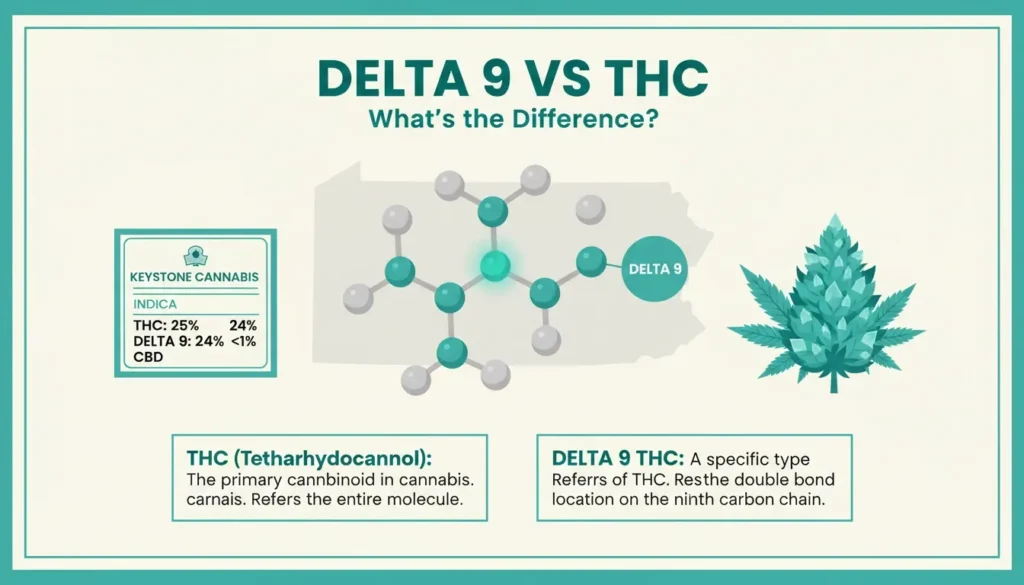
Delta 9 THC: A Molecule, Not a Plant Type

Delta-9-tetrahydrocannabinol is the primary psychoactive cannabinoid in cannabis. It is present in every strain of cannabis — sativa, indica, and hybrid alike — in varying concentrations. It is the same molecule regardless of which plant it comes from.
When delta 9 enters the body, it binds to CB1 receptors concentrated in the brain and central nervous system. That interaction produces the effects cannabis is known for: altered mood, relaxation, euphoria, increased appetite, changes in time perception, and — at higher doses — anxiety or paranoia in sensitive individuals.
Do You Qualify for a PA MMJ Card?
Connect with a licensed Pennsylvania state physician online from home.
What delta 9 does NOT do is make a product inherently energizing or sedating based on which plant variety it came from. The molecule’s mechanism is the same whether it originated from a tall, narrow-leafed sativa plant or a short, bushy indica plant. The effect profile comes from the full chemical composition of the product — the cannabinoids, terpenes, and other compounds surrounding the delta 9, combined with your individual biology, dose, and delivery method.
Where Did Sativa and Indica Labels Come From?

The sativa/indica distinction has a specific origin — and it was never about effects.
In 1785, French biologist Jean-Baptiste Lamarck described two morphologically distinct cannabis plants: tall, thin-leafed plants from equatorial regions (Cannabis sativa) and shorter, bushier plants from the Hindu Kush region of Central Asia (Cannabis indica). These were purely botanical classifications — describing how the plants looked and where they grew, not how they made people feel.
The effect-based meaning came much later, through decades of underground cannabis culture in the 1970s through 1990s. Growers and consumers started associating “sativa” with cerebral, energizing effects and “indica” with body-heavy, sedating effects. When legal dispensaries opened across the U.S., they inherited this consumer vocabulary and built their menus around it — not because the science supported it, but because customers expected it.
As Delta Extrax summarizes: “The sativa/indica divide originally had nothing to do with effects. Early botanists classified cannabis plants based on appearance and growth patterns. Over time, culture and marketing twisted those categories into effect-based stereotypes.”
What Science Says: The Labels Don’t Hold Up

Modern genetic and chemical research has examined the sativa/indica distinction rigorously — and the results are consistent.
The genetics finding: A landmark study published in Nature Plants analyzed over 100 cannabis samples, genotyping them for over 100,000 single nucleotide polymorphisms (SNPs). The conclusion: sativa- and indica-labeled samples were genetically indistinct on a genome-wide scale. The labels do not correspond to meaningful genetic differences.
A separate PMC study analyzing 81 cannabis samples confirmed that genetic analyses “failed to find clear genetic support for commonly referenced Sativa, Indica and Hybrid types.” Most samples contained significant genetic inconsistencies, and many strains with the same name showed completely different genetic profiles depending on the source.
The chemical finding: A PMC study examining 2,662 dispensary cannabis samples — across 396 breeder-reported strain names — found only three distinct chemical clusters when sorted by actual terpene and cannabinoid content. Nearly 400 names mapped to just three real chemical types. The strain names, in other words, vastly overstated the actual diversity of products available.
The consumer experience finding: Research published in Experimental and Clinical Psychopharmacology examining consumer-reported effects of indica and sativa cannabis found that the label was a weak predictor of subjective experience. What correlated more strongly with reported effects was the product’s actual terpene and cannabinoid profile — its chemovar.
⚡ Fast & 100% Online PA Medical Cards
Board-Certified Doctors • 100% Money-Back Guarantee
Book Evaluation Now →As the Social Dispensary’s May 2026 analysis puts it: “A myrcene-dominant strain with high THC tends to be described as relaxing whether it’s labeled indica or hybrid. A terpinolene-dominant strain tends to be described as uplifting regardless of label.”
What Actually Determines How Delta 9 Feels

If not the sativa/indica label, what actually shapes your delta 9 experience? Four factors — and they interact with each other.
1. Terpene profile Terpenes are the aromatic compounds in cannabis that work alongside delta 9 THC to shape the overall effect. Myrcene promotes physical relaxation. Limonene modulates serotonin and promotes mood elevation. Linalool activates GABA-A receptors for calming effects. Beta-caryophyllene binds CB2 receptors for anti-inflammatory and anxiolytic effects. The dominant terpene in a product is the strongest predictor of its effect character — more predictive than the sativa/indica label.
2. Cannabinoid ratio Delta 9 THC alongside CBD produces a different experience than delta 9 alone. CBD modulates THC’s psychoactive intensity at the CB1 receptor level. Higher CBD reduces anxiety risk, reduces cognitive impairment, and softens the overall effect. Minor cannabinoids — CBG, CBN, THCV — also contribute meaningfully to the full effect profile.
3. Your dose Cannabis exhibits a biphasic dose response. At low-to-moderate doses, delta 9 is typically anxiolytic and mood-elevating. At high doses, it can become anxiogenic and sedating — regardless of the strain label. A “sativa” at 50mg can feel very different from the same product at 5mg.
4. Your individual biology Endocannabinoid system differences, tolerance, sex, body composition, and prior cannabis experience all influence how delta 9 affects you. Two people consuming the same product in the same dose can report meaningfully different experiences. This is why cannabis shopping based on a friend’s recommendation often fails — their endocannabinoid system is not yours.
Meet the Chemovar: The Framework That Actually Works
The alternative to sativa/indica is called the chemovar — short for “chemical variety.” It classifies cannabis by its actual chemical fingerprint: the specific cannabinoids and terpenes present and their relative concentrations.
A 2012 study by Hazekamp and Fischedick published in Drug Testing and Analysis was among the first to formally propose chemovar classification for cannabis, arguing that the indica/sativa distinction was less predictive of effects than the ratio of cannabinoids and the dominant terpene cluster.
The Cannigma’s February 2026 data-backed strain guide puts it plainly: “What reliably predicts your experience isn’t the name on the label; it’s the chemical composition inside the flower: the cannabinoid ratios and, crucially, the terpene profile.”
The chemovar model is increasingly used in medical cannabis settings because it’s reproducible and specific — unlike a strain name that may vary significantly between growers and batches.
The Three Chemovar Types Explained
The standard chemovar classification divides cannabis into three primary types based on cannabinoid dominance:

| Chemovar Type | Cannabinoid Profile | Typical Use Case |
|---|---|---|
| Type I | THC-dominant (high THC, low CBD) | Most dispensary products fall here; full psychoactive effect |
| Type II | Balanced THC and CBD | Reduced psychoactivity; common for anxiety-prone patients |
| Type III | CBD-dominant (high CBD, low/trace THC) | Non-intoxicating; commonly used in pediatric or THC-sensitive patients |
Renewing Your PA MMJ Card?
Quick annual recertification online. No paperwork hassle.
Renew Card Online →Modern Canna’s chemovar classification framework and other medical cannabis lab systems extend this further with terpene-based sub-classifications — allowing much more precise product matching than a sativa/indica label ever could.
Beyond the three-type cannabinoid framework, SC Labs has developed a seven terpene class system that maps cultivars to effect clusters by dominant terpene chemistry — a model gaining traction among dispensaries that want to move beyond the indica/sativa binary.
Terpenes: The Real Effect Predictors

Here is a practical terpene-to-effect reference for PA dispensary shopping. These are the terpenes most relevant to medical cannabis patients — and what they actually do:
| Terpene | Aroma | Likely Effect Character | Found In |
|---|---|---|---|
| Myrcene | Earthy, musky | Relaxing, physical, sedating | OG Kush, Northern Lights, Granddaddy Purple |
| Limonene | Citrus, lemon | Uplifting, mood-elevating, anxiety-buffering | Lemon Haze, Jack Herer, Durban Poison |
| Linalool | Floral, lavender | Calming, GABA-activating, sleep-supporting | Lavender, some OG crosses |
| Beta-Caryophyllene | Pepper, spice | Anti-inflammatory, non-intoxicating anxiolytic | GSC (Girl Scout Cookies), Chemdog |
| Alpha-Pinene | Pine, fresh | Focus-supporting, mentally clarifying | Blue Dream, Jack Herer, Trainwreck |
| Terpinolene | Herbal, floral | Stimulating, potentially anxiety-worsening in sensitive users | Jack Herer, Ghost Train Haze |
As weed.com’s 2025 terpene guide confirms: “Modern research shows the indica/sativa model is botanically accurate but pharmacologically meaningless. The effects don’t come from plant shape or leaf structure — they come from terpenes.”
For PA patients managing anxiety specifically, the terpene angle is particularly important. Research on linalool’s GABA-A activation, limonene’s confirmed role in reducing THC-induced anxiety in the Johns Hopkins human trial, and beta-caryophyllene’s CB2 receptor mechanism all point to specific terpene targets — none of which are captured by the sativa/indica label.
When Sativa and Indica Labels Are Still Useful
Honesty matters here: the sativa/indica system is scientifically outdated, but it isn’t entirely useless.
Where the labels still add value:
- As a starting conversation. Telling a budtender “I’m looking for something more sativa-like” communicates your general direction — uplifting vs. relaxing — even if the label doesn’t guarantee the outcome. It’s a rough starting point, not a prescription.
- As breeder intent. When a cultivator labels something sativa-dominant, they’re communicating something about the genetics they selected and the effect profile they targeted. It may not always deliver that experience, but it reflects the breeding goal.
- For total novices. For someone who has never used cannabis and wants the simplest possible framework, sativa/indica gives a rough directional sense. As they gain experience and start reading COAs, the chemovar model becomes more useful.
The Social Dispensary’s analysis from May 2026 captures the nuance well: “Dispensary menus keep indica/sativa labels because consumers expect them. Budtenders use them as a starting point for conversation. Breeders use them to communicate intent. What matters more: terpene dominance, cannabinoid ratio, specific cultivar reputation.”
The label is a hint. The COA is the truth.
How to Shop by Chemovar at a Pennsylvania Dispensary

Pennsylvania state law mandates that every licensed dispensary product carry a Certificate of Analysis (COA) before sale — which means the chemical data you need to move beyond indica/sativa is already available at every PA dispensary. You just need to know how to ask for it.
The PA dispensary chemovar shopping script:
Get Approved by a Licensed PA Doctor
Schedule your appointment in minutes. You only pay if approved.
Start Online Application →Step 1 — Define your goal, not a label. Instead of “I want an indica,” say: “I’m looking for something relaxing that won’t make me anxious. I manage well with moderate THC.”
Step 2 — Ask for the COA or terpene panel. “Can you show me the terpene profile for this product?” Every PA dispensary pharmacist or budtender can pull this. Many products have a QR code on the packaging linking directly to the lab report.
Step 3 — Look at the dominant terpene.
- Myrcene dominant → relaxing, body-focused, evening use
- Limonene dominant → uplifting, mood-elevating, daytime use
- Linalool dominant → calming, anxiety-reducing, sleep-supporting
- Pinene dominant → mentally clarifying, focus-supporting, daytime
- Caryophyllene dominant → anti-inflammatory, non-intoxicating anxiolytic, anytime
Step 4 — Check the cannabinoid ratio. A Type II chemovar (balanced THC:CBD, roughly 1:1 or 2:1) is generally better for anxiety-prone patients than a pure Type I THC-dominant product.
Step 5 — Start with the lowest effective dose. Regardless of terpene profile or chemovar type, dose is the most modifiable factor in your experience. The 2026 industry trend — confirmed by Cannigma’s strain guide — is moving away from the THC potency arms race and toward precision chemical matching. Start low, note the effect, and adjust.
Step 6 — Keep a simple record. Note the dominant terpene, THC%, CBD%, and how the product made you feel. After two to three sessions with a product, you will have personal data that no label can replace.
What This Means for PA Medical Marijuana Patients
For patients in Pennsylvania’s medical marijuana program, this knowledge has direct practical implications.
With over 440,000 registered PA MMJ patients as of May 2026, Pennsylvania dispensaries carry a wide range of chemovars across flower, concentrate, tincture, capsule, and topical formats. The state’s mandatory COA requirement means verified terpene and cannabinoid data is accessible for every product before purchase.
The most common qualifying condition in Pennsylvania is anxiety disorder — cited in approximately 60% of all certifications statewide. For anxiety patients in particular, choosing by chemovar (linalool-forward, limonene-dominant, moderate THC) rather than by sativa/indica label reduces the risk of choosing a product that worsens rather than helps symptoms.
You can review Pennsylvania’s full list of qualifying conditions here — including anxiety disorders, chronic pain, PTSD, cancer, Crohn’s disease, multiple sclerosis, and 20+ others.
Ready to Get Your Official PA MMJ Card?
State-certified doctor consultations online. No risk—100% refund if not approved.
Claim Your MMJ Card Online →If you qualify and are ready to begin the certification process, Pennsylvania Marijuana Cards offers same-day telehealth certifications with Dr. Johnathon Chance Miller, MD — completed entirely online.
| Physician Fee | PA State Fee | Total | |
|---|---|---|---|
| New Patient | $159 | $50 | $209 |
| Renewal | $149 | $50 | $199 |
| MMAP Qualifying Patients (Medicaid, SNAP, WIC, CHIP, PACE, PACENET) | — | $0 (waived) | Physician fee only |
Start your same-day certification here.
Frequently Asked Questions — Is Delta 9 Sativa or Indica
Q: Is delta 9 THC sativa or indica?
A: Delta 9 THC is neither sativa nor indica — it is a chemical molecule (delta-9-tetrahydrocannabinol) found in all cannabis plant varieties, including both sativa and indica strains. Sativa and indica are botanical classifications describing plant morphology — leaf shape, height, and growth region — not the compound’s effects. Delta 9 is present in both plant types at different concentrations. Whether a delta 9 product feels energizing or relaxing depends on the terpene profile, cannabinoid ratio, your dose, and your individual biology — not which plant type it came from.
Q: What actually determines whether a cannabis product feels more sativa or indica?
A: The dominant terpene profile is the strongest predictor of effect character. Myrcene-dominant products tend to feel relaxing and body-focused, regardless of whether they’re labeled sativa or indica. Limonene-dominant products tend to feel uplifting and mood-elevating. Linalool produces calming effects through GABA-A receptor activation. A landmark Nature Plants study analyzing over 100 cannabis samples with 100,000+ genetic markers found that sativa- and indica-labeled cannabis were genetically indistinct. The cannabinoid ratio (THC:CBD) and dose are equally important.
Q: Is the sativa vs. indica difference scientifically supported?
A: No, not as effect predictors. Multiple peer-reviewed studies have found that sativa and indica labels do not reliably predict consumer effects or correspond to meaningful genetic differences. A PMC study of 2,662 dispensary cannabis samples found only three distinct chemical clusters across 396 strain names. A Nature Plants genetic study confirmed sativa- and indica-labeled samples were genetically indistinct on a genome-wide scale. The indica/sativa system was originally a botanical morphology classification from 1785 — it was never designed as a pharmacological prediction system. Modern cannabis science uses chemovars — chemical variety classification based on cannabinoid and terpene profiles — as a more accurate framework.
Q: What is a chemovar and how is it different from sativa or indica?
A: A chemovar (chemical variety) classifies cannabis by its actual chemical fingerprint — the specific cannabinoids (THC, CBD, CBG, CBN) and terpenes present and their concentrations — rather than by plant morphology or growth origin. There are three primary chemovar types: Type I (THC-dominant), Type II (balanced THC and CBD), and Type III (CBD-dominant). Within each type, the dominant terpene further defines the effect character. Chemovars are reproducible and measurable via Certificate of Analysis (COA), making them a more reliable guide for medical cannabis patients than sativa/indica labels.
Q: How do I use this information when shopping at a Pennsylvania dispensary?
A: Ask to see the Certificate of Analysis (COA) for any product — Pennsylvania law requires all licensed dispensary products to carry a COA before sale. On the COA, look at the dominant terpene first: myrcene for relaxation, limonene for mood elevation, linalool for calming effects, pinene for mental clarity. Then check the cannabinoid ratio: a balanced THC:CBD product (Type II chemovar) reduces anxiety risk compared to a THC-only product. Start at the lowest available dose with any new product. Most PA dispensary pharmacists are trained to make terpene-based recommendations — just ask.
Q: Do delta 9 sativa and delta 9 indica products feel different?
A: Sometimes — but not because of the sativa/indica label itself. When products marketed as sativa and indica feel different, it’s because they have different terpene profiles and cannabinoid ratios. A “sativa” with limonene and pinene as dominant terpenes will feel different from an “indica” with myrcene and linalool — but the label isn’t causing the difference, the chemistry is. Two products with identical terpene profiles can feel similar even if one is labeled sativa and one is labeled indica. The label is a rough hint at breeder intent, not a reliable pharmacological prescription.
Q: Why do dispensaries still use sativa and indica labels if they’re not scientifically accurate?
A: Mainly because of consumer familiarity and menu simplicity. The sativa/indica framework has been part of cannabis culture for decades, and most consumers still use these terms when shopping. Dispensaries maintain the labels because customers expect them and they provide a conversational starting point for budtenders. The 2026 industry trend, however, is clearly moving toward chemovar-focused menus that lead with terpene profiles and cannabinoid ratios. Some forward-thinking dispensaries already organize products by dominant terpene rather than by sativa/indica category.
Q: Is there a PA law about how dispensaries label cannabis products?
A: Pennsylvania does not currently mandate that dispensaries abandon sativa/indica labeling. However, Pennsylvania state law does require all licensed dispensary products to carry a Certificate of Analysis (COA) before sale — which must include verified cannabinoid potency and terpene profile. The PA Department of Health updated COA requirements in Q1 2025 to mandate expanded terpene panel reporting. This means the chemical data needed to make chemovar-based decisions is legally required to be available at every PA dispensary, even if the front-of-package label still says “sativa” or “indica.”
This blog post is intended for general educational and informational purposes only and does not constitute medical advice. Individual responses to cannabis products vary significantly. The information in this article reflects the current state of cannabis research and Pennsylvania dispensary practices as of May 2026. Always consult a licensed physician before using medical cannabis for a qualifying condition. Medically reviewed by Dr. Johnathon Chance Miller, MD.
Sources
- Nature Plants — Sativa/indica genetic indistinction study
- PMC — Genetic tools and sativa/indica strain reliability (PMC7815053)
- PMC — Cannabis chemovar nomenclature mislabeling study, 2,662 samples (PMC7480732)
- Experimental and Clinical Psychopharmacology — Indica/sativa consumer effects study
- Cannigma — Best Cannabis Strains 2026: Data-Backed Guide by Chemotype and Terpene Class (Feb 2026)
- Weed.com — The Ultimate Terpene Guide 2025 Edition
- Weed.com — What Is a Cannabis Strain? (chemovar framework, Hazekamp 2012 reference)
- The Social Dispensary — Indica vs Sativa: The Myth & What Research Suggests (May 2026)
- Delta Extrax — Delta 9 Explained: Why Sativa vs. Indica Is Just a Myth
- Kana Post — Indica vs Sativa Myths Debunked (Feb 2026)
- SEABEDEE — Is Delta 9 Sativa or Indica? (March 2026)
- Clean Remedies — Is Delta-9 Sativa or Indica? (March 2026)
- Modern Canna — Cannabis Chemovar Classification