
If you are searching for how to get delta 9 out of your system fast, you are probably facing a drug test with a deadline. Maybe it is a new job, a probation requirement, a professional license renewal, or a custody matter. Whatever the reason, you need honest, accurate information — not a detox product sales pitch.
Here is the direct answer before anything else: there is no method that reliably eliminates delta 9 THC from your system overnight. Anyone selling you that promise is either misinformed or profiting from your urgency. What does exist is a clear understanding of how your body clears THC, which factors affect that timeline, which strategies genuinely support the process, and which popular “detox” methods are myths that can actually make things worse.
Need a PA Medical Marijuana Card?
Get certified online in 15 minutes. 100% Money-Back Guarantee.
Get Certified Now →This guide covers all of it — including critical information specific to Pennsylvania residents, particularly those who hold or are considering a PA medical marijuana card.
Why Delta 9 Stays in Your System Longer Than You Think

Most people assume that once the effects of cannabis wear off — typically within two to six hours — the compound is leaving their system. This assumption is the source of a great deal of confusion and failed drug tests.
Delta 9 THC itself does clear from the bloodstream relatively quickly. But drug tests are not looking for delta 9 THC directly. They are screening for THC-COOH — the primary metabolite produced when your liver breaks down delta 9 THC through cytochrome P450 enzymes (primarily CYP2C9 and CYP3A4). As peer-reviewed research on cannabis pharmacokinetics published in PMC explains, this metabolite is what lingers in urine, blood, saliva, and hair long after any psychoactive effects have resolved.
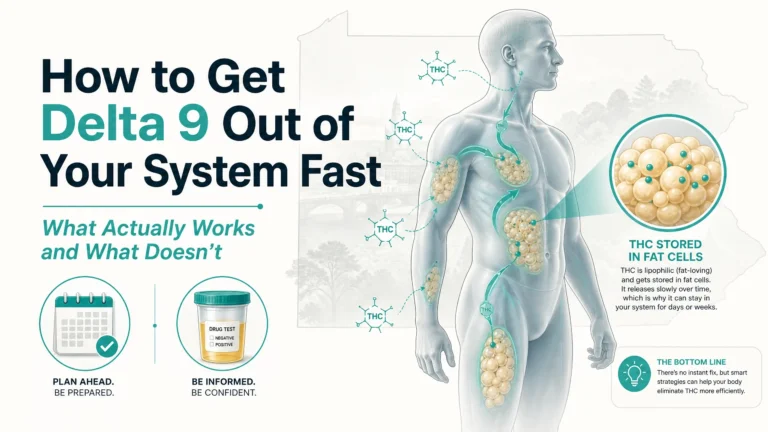
The reason THC-COOH stays detectable for so long is directly tied to THC’s chemistry. Delta 9 THC is lipophilic — it binds to fat. Rather than dissolving in water and being flushed out quickly through urine the way alcohol metabolites are, THC and its metabolites are stored in adipose (fat) tissue throughout the body. They are released gradually into the bloodstream as fat cells turn over, then processed by the liver and excreted — a slow, continuous process that can stretch over days, weeks, or even months depending on how much THC is stored.
Do You Qualify for a PA MMJ Card?
Connect with a licensed Pennsylvania state physician online from home.
This is the fundamental pharmacological reason why there is no reliable “fast” method for clearing delta 9. You cannot dissolve a fat-soluble compound out of your fat tissue with water. You cannot sweat it out meaningfully. You cannot override the pace at which your liver processes metabolites. What you can do is support the natural processes that clear THC — and avoid the mistakes that slow them down or get your sample flagged.
How Long Does Delta 9 Actually Stay in Your System?
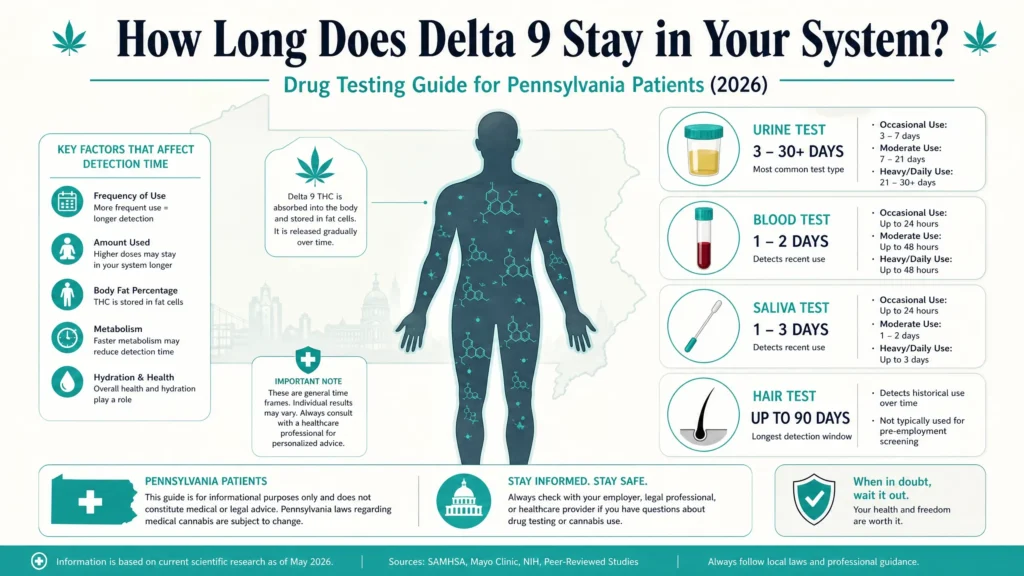
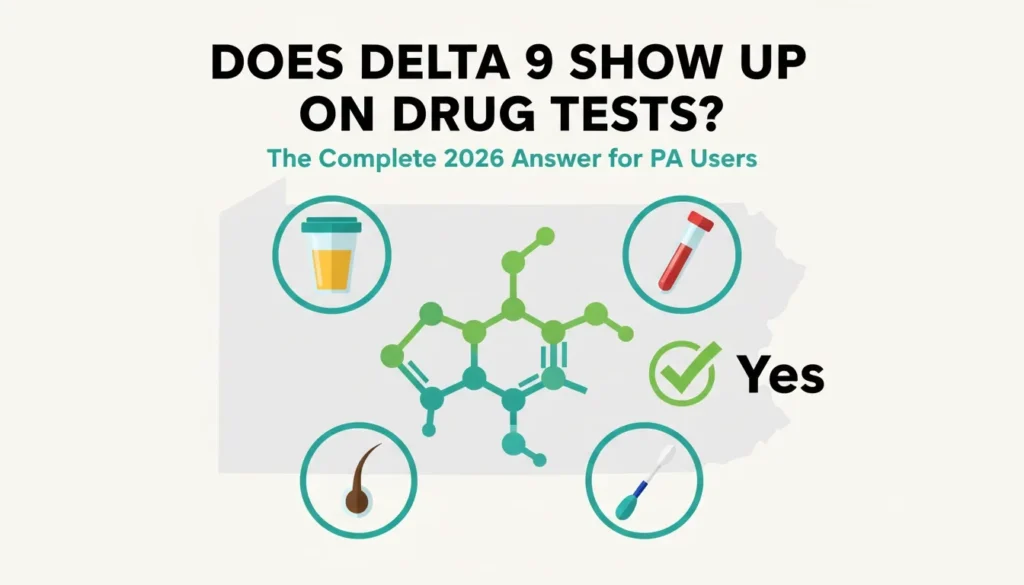
Detection windows vary significantly based on the type of test being administered and your usage frequency. Here are the evidence-based ranges, organized by test type:
Urine Testing (Most Common)

Urine is by far the most common drug test format — used in workplace screenings, probation, pre-employment background checks, and most legal contexts. Standard urine tests use an immunoassay with a cutoff of 50 ng/mL for THC-COOH on the initial screen, confirmed at 15 ng/mL by GC-MS, according to NIH workplace testing interpretation research published in PMC.
| Usage Pattern | Urine Detection Window |
|---|---|
| Single use (one-time) | 3–5 days |
| Occasional use (a few times per week) | 7–14 days |
| Daily use | 21–30 days |
| Heavy chronic use (multiple times daily) | 30–90+ days |
These are general ranges. Individual results vary considerably based on body fat percentage, metabolism speed, and potency of products consumed.
Blood Testing
Blood tests detect active delta 9 THC rather than the metabolite, meaning they measure more recent use. According to research on cannabinoid detection published by the University of Rochester Medical Center, delta 9 is typically detectable in blood for 1–2 days in occasional users, and up to 7 days in chronic users. Blood tests are most commonly used in DUI investigations, accidents, and medical contexts — not standard workplace screenings.
Saliva Testing
Saliva tests detect recent use — typically within 24–72 hours for most users, though some research suggests detection up to 25 days in chronic daily users. Saliva tests are increasingly used in roadside law enforcement and some workplace settings because they reflect recent consumption more accurately than urine.
Hair Follicle Testing
Hair follicle tests detect THC-COOH incorporated into the hair shaft as it grows — providing a roughly 90-day lookback window regardless of usage frequency. One important nuance: hair tests typically cannot detect use within the first 7 days after consumption, as the hair shaft takes time to grow. These tests are most commonly used in federal employment, law enforcement, and some high-security industries.
Factors That Determine Your Personal Clearance Timeline
Understanding why two people with similar usage patterns can have very different clearance timelines helps set realistic expectations.
Body fat percentage. This is the single most influential individual factor. Because THC is stored in fat tissue, people with higher body fat percentages have a larger reservoir from which metabolites are slowly released. A person with 30% body fat who uses cannabis daily will typically test positive significantly longer than a lean person with the same usage pattern, all else equal.
Frequency and duration of use. Occasional use produces far less fat storage than daily use over months or years. A person who smoked cannabis once at a party two weeks ago has a fundamentally different metabolite burden than someone who has used cannabis daily for a year.
⚡ Fast & 100% Online PA Medical Cards
Board-Certified Doctors • 100% Money-Back Guarantee
Book Evaluation Now →Potency of products consumed. A single 5mg THC gummy consumed once will leave a much smaller metabolite footprint than regular use of 25–30% THC concentrate. Higher-potency products mean more THC entering fat storage per use.
Consumption method. Edibles produce a particularly long-lasting metabolite burden. When delta 9 THC is ingested orally, the liver converts it to 11-hydroxy-THC before it enters circulation — a metabolite that is even more fat-soluble and longer-lasting than delta 9 itself. As Cornbread Hemp’s research summary explains, this is why edible users often test positive longer than people who inhaled the same amount of THC.
Individual metabolism. Liver enzyme activity, hormonal factors, and genetics all affect how quickly your body converts THC to its metabolites and excretes them. According to Ocean’s Luxury Rehab’s pharmacokinetics review, plasma clearance averages 11.8 L/hour in women and 14.9 L/hour in men — a meaningful difference driven by body composition and hormonal variation.
Hydration status at time of testing. Well-hydrated urine is more diluted, which means THC metabolite concentrations are lower and may fall below the 50 ng/mL cutoff. This is not a reliable strategy — we will cover exactly why below — but hydration does affect concentration readings.
What Actually Helps Speed Up THC Clearance

Let us be clear about what “helps” means in this context: these are strategies that support your body’s natural clearance processes. None of them will dramatically compress your timeline. None are a guarantee. But they are evidence-based and will not make things worse.
Complete abstinence — immediately and sustained.
This is the single most important thing you can do. Every additional use replenishes the fat-stored THC pool your body is working to clear. The moment you stop consuming, the clearance clock genuinely starts. If you have a test coming up and you are still using, stopping now is the highest-impact action available to you.
Adequate hydration — supportive, not excessive.
Proper hydration supports kidney and liver function — both essential organs in THC metabolite excretion. Aim for approximately 2 to 2.5 liters of water daily. This is not a method to “flush” THC from your system — it is support for the organs doing the actual work. Do not over-hydrate — we address why excessive water intake is counterproductive below.
A fiber-rich, liver-supporting diet.
THC metabolites are excreted both through urine and through bile into the digestive tract. Dietary fiber binds to bile and metabolites in the digestive system and helps carry them out. A diet rich in vegetables, whole grains, and legumes — while reducing processed foods and alcohol — provides general liver support. Alcohol directly competes for the liver enzymes responsible for THC metabolism and should be avoided during any clearance period.
Renewing Your PA MMJ Card?
Quick annual recertification online. No paperwork hassle.
Renew Card Online →Adequate sleep.
Liver detoxification processes operate continuously, but the body’s cellular repair and metabolic activity peaks during quality sleep. Chronic sleep deprivation elevates cortisol, slows metabolic rate, and impairs liver function. Prioritizing 7–9 hours of sleep during your clearance period is genuinely supportive — even if it feels passive.
At-home test strips — used strategically.
Pharmacy-grade urine test strips are inexpensive and widely available. Testing yourself 5–7 days before a real screening establishes a personal baseline. If you test negative at home at or above the standard 50 ng/mL threshold, you have genuine confidence going into the real test. If you test positive, you have time to extend your abstinence period or seek advice. This is one of the most practically useful strategies available and is almost never mentioned by competing content.
What Doesn’t Work — Common Myths Debunked

Drinking excessive amounts of water.
Over-hydrating in the days before a test creates a diluted urine sample. Labs now routinely test for dilution markers — specifically creatinine (normal range 20–300 mg/dL) and specific gravity. A sample with creatinine below 20 mg/dL or specific gravity below 1.003 is flagged as dilute, and many testing protocols treat a dilute sample the same as a positive — requiring a retest or reporting it as invalid. Excessive water intake does not remove THC from your system; it lowers the concentration temporarily while potentially flagging your sample regardless.
Cranberry juice, lemon water, apple cider vinegar.
These are popular suggestions with no credible scientific basis for THC clearance. Cranberry juice may modestly support kidney function generally, but it has no demonstrated effect on THC-COOH excretion rates. None of these alter the fat-storage mechanism through which THC metabolites accumulate.
Niacin (Vitamin B3) in high doses.
Niacin was historically used in attempts to flush THC metabolites through the liver. It does not work reliably, and high-dose niacin carries real health risks including flushing, liver toxicity, and cardiovascular effects. This is a myth that has persisted far longer than the evidence warrants.
Bleach, vinegar, or adulterants added to urine samples.
Get Approved by a Licensed PA Doctor
Schedule your appointment in minutes. You only pay if approved.
Start Online Application →Modern laboratory testing screens specifically for common adulterants — including nitrites, bleach, detergent, and pH abnormalities. Adding substances to a urine sample will almost certainly produce a flagged or invalid result, which in most testing contexts carries consequences equivalent to or worse than a positive test.
Detox teas and herbal cleanses.
These function primarily as mild diuretics, increasing urine volume. The dilution effect they produce carries the same creatinine-flagging risk as excessive water intake. They do not accelerate the pace at which your liver processes THC metabolites or the rate at which your fat cells release them.
The Exercise-Before-a-Drug-Test Warning

This is one of the most important and least-communicated pieces of information in the entire THC detox conversation — and it is a warning, not a recommendation.
Exercise does support long-term THC clearance by reducing body fat over time — less fat means less THC storage capacity and a smaller metabolite reservoir. For clearance over weeks or months, regular exercise is genuinely helpful.
But exercising intensely in the 24 to 48 hours immediately before a drug test can actually increase detectable THC levels in your urine.
When you exercise vigorously, you mobilize fat stores rapidly. THC metabolites stored in fat tissue are released back into the bloodstream during this process, temporarily increasing circulating THC-COOH concentrations before they are excreted. Multiple researchers have noted this effect — as Cornbread Hemp’s pharmacokinetic analysis confirms: intense exercise right before a drug test could mean more detectable THC metabolite levels in urine or blood because they have been released from body fat.
If you have a test within the next 48 hours, avoid intense exercise. Light activity — walking, gentle stretching — is fine. Save the cardio session for after the test.
Detox Drinks and Kits: The Honest Assessment

The THC detox product market generates hundreds of millions of dollars annually. It is worth understanding exactly what these products do and do not do.
Most commercially available “THC detox drinks” work through a combination of:
- High water volume (dilution)
- B vitamins — particularly B2 (riboflavin) and B12 — to add color back to diluted urine
- Creatine supplementation — to raise creatinine levels in diluted urine above the flagging threshold
- Herbal diuretics — to increase urine output
Ready to Get Your Official PA MMJ Card?
State-certified doctor consultations online. No risk—100% refund if not approved.
Claim Your MMJ Card Online →This is not elimination of THC. It is dilution with masking of dilution markers. The strategy is to lower THC-COOH concentrations below the 50 ng/mL threshold while keeping creatinine and specific gravity within normal ranges — a narrow and unreliable window.
As Herb.co’s THC research review clearly states: many THC drug tests now check for creatinine levels, specific gravity, and color — making it harder to pass using detox drinks. Lab testing protocols continue to evolve specifically to catch dilution attempts.
Some people pass using these products. Many do not. Results are highly inconsistent, dose-dependent, and heavily affected by individual clearance rates. For anyone with a high-stakes test — probation, professional licensing, federal employment — relying on a detox drink is a significant and often unnecessary risk.
The one circumstance where these products have the most plausible logic: a person who is genuinely close to clearing naturally (borderline positive on an at-home test) using a quality product with the right creatinine-masking strategy on the day of the test. Even then, it is not reliable.
Pennsylvania-Specific Context: What PA Users Need to Know

Pennsylvania residents face specific legal and practical realities around cannabis and drug testing that deserve direct, honest discussion.
Pennsylvania has no employment drug testing protection for MMJ card holders.
This is the most important PA-specific fact — and one that shocks many patients who assumed their legal medical marijuana card protected their job. It does not. Pennsylvania’s Medical Marijuana Act does not prohibit employers from drug testing employees or applicants, and it does not require employers to accommodate medical marijuana use. As the Pennsylvania Department of Health’s program guidance confirms, employers retain the right to enforce drug-free workplace policies regardless of a patient’s certification status.
This means a Pennsylvania medical marijuana patient who tests positive on an employer drug screen can legally be terminated or denied employment — even if they consumed cannabis legally, with a valid physician certification, through a licensed PA dispensary. Federal contractors, safety-sensitive positions, transportation workers, and healthcare employees face even stricter restrictions under federal law.
If you hold a PA MMJ card and are concerned about workplace drug testing, the most important step is understanding your employer’s specific drug testing policy in writing before a test occurs. Some employers are moving toward impairment-based testing policies rather than metabolite-based ones — particularly in light of how long THC metabolites persist compared to actual impairment — but this varies by employer and industry.
Pennsylvania’s per se DUI law applies regardless of card status.
Under 75 Pa. C.S. § 3802(d), any detectable amount of THC metabolites in your blood while driving constitutes a DUI offense in Pennsylvania — even if you are a certified MMJ patient who consumed cannabis legally hours or days before driving. A PA medical marijuana card is not a defense to a THC DUI charge under Pennsylvania law. This is a critical distinction that many patients do not understand until it is too late.
If you are using cannabis without a PA MMJ card, you are doing so illegally.
Recreational cannabis remains illegal in Pennsylvania as of May 2026. Possessing cannabis without medical certification is a criminal offense. If you are currently using cannabis for anxiety, chronic pain, PTSD, sleep, or another health reason — and you do not have a PA MMJ card — you are accepting legal risk that a certification removes.
The path to legal, physician-supervised access.
Pennsylvania recognizes 24 qualifying conditions for medical marijuana certification. The most common by a significant margin is anxiety disorder, which accounts for approximately 60% of all PA certifications according to a July 2025 study published in the Annals of Internal Medicine, based on analysis of 1,730,600 certification records. Chronic pain and PTSD are the next most common qualifying conditions.
If you are using cannabis regularly for a health condition, legal access through the PA MMJ program gives you:
- A physician-patient relationship with documentation of your condition
- Access to tested, accurately labeled products at licensed PA dispensaries
- Formal certification that may matter in certain employment and legal contexts
- The ability to work with a dispensary pharmacist who understands your health profile
You can view Pennsylvania’s complete list of qualifying conditions here, or if anxiety is your primary condition, learn specifically about anxiety disorder and PA medical marijuana certification here.
Cost breakdown for PA MMJ certification:
| Fee | Amount |
|---|---|
| Physician certification fee (new patient) | $159 |
| PA state registration fee | $50 |
| Total (new patient) | $209 |
| Physician certification fee (renewal) | $149 |
| PA state registration fee | $50 |
| Total (renewal) | $199 |
Pennsylvania residents qualifying for Medicaid, SNAP, WIC, CHIP, PACE, or PACENET may have the $50 state fee waived through Pennsylvania’s MMAP program.
The certification process is done entirely online through telehealth at Pennsylvania Marijuana Cards — no in-person clinic visit required.
Frequently Asked Questions
Q: How long does delta 9 stay in your system for a urine test?
A: Delta 9 THC itself clears from the bloodstream within hours, but the metabolite that urine tests detect — THC-COOH — persists far longer because it is stored in fat tissue. For occasional users (a few times per month), urine detection windows are typically 3 to 7 days. For weekly users, expect 7 to 14 days. Daily users should plan for 21 to 30 days, and heavy chronic users — particularly those who consume edibles or high-potency concentrates — may test positive for 30 to 90 days or longer after stopping. These are general ranges; individual results vary significantly based on body fat percentage, metabolism, and product potency.
Q: Does drinking lots of water help clear delta 9 faster?
A: Proper hydration — around 2 to 2.5 liters daily — supports kidney and liver function and is genuinely helpful during any clearance period. However, drinking excessive amounts of water to “flush” THC does not work and creates a new problem: over-diluted urine is flagged by drug labs through creatinine and specific gravity testing. A urine sample with creatinine below 20 mg/dL is flagged as dilute, and many testing protocols treat a diluted sample the same as a positive — requiring a retest or triggering adverse consequences. Stay well-hydrated. Do not attempt to flood your system.
Q: Do detox drinks actually work for a delta 9 drug test?
A: Inconsistently and unreliably — which means they are a risky strategy for any high-stakes test. Most detox drinks attempt to lower THC-COOH concentrations through dilution while adding B vitamins and creatine to mask the dilution markers that labs check for. Some people pass using these products; many do not, and results depend heavily on how close you are to clearing naturally in the first place. Modern lab testing increasingly screens specifically for dilution attempts. For probation, professional licensing, or federal employment, relying on a detox drink is a significant gamble. The only approach with a predictable outcome is sufficient abstinence time combined with supporting your body’s natural clearance processes.
Q: Does exercise help get delta 9 out of your system?
A: In the long term, regular exercise reduces body fat — which decreases the storage reservoir for THC metabolites and speeds overall clearance over weeks. However, there is a critical short-term warning: intense exercise in the 24 to 48 hours immediately before a drug test can temporarily increase detectable THC-COOH levels in your urine, because vigorous exercise mobilizes fat stores and releases stored metabolites back into the bloodstream before excretion. If your test is within two days, avoid intense cardio and strength training. Exercise is a long-term clearance strategy, not a pre-test shortcut.
Q: Will a Pennsylvania medical marijuana card protect me from a workplace drug test?
A: No — and this surprises many PA patients. Pennsylvania’s Medical Marijuana Act does not prohibit employers from drug testing or from taking adverse action based on a positive THC result. PA employers retain the legal right to enforce drug-free workplace policies regardless of a patient’s MMJ certification status. This means a certified PA medical marijuana patient who tests positive on a pre-employment or workplace drug screen can legally be denied a job or terminated — even if they consumed cannabis legally through a licensed dispensary. If you hold a PA MMJ card and work in a drug-tested environment, review your employer’s specific policy carefully and consider discussing your situation with a Pennsylvania employment attorney.
Q: How long after stopping cannabis use will I test negative?
A: There is no universal answer — which is genuinely frustrating when you need a specific number. The most honest guidance: occasional users (a few times per month) typically test negative within 3 to 7 days of stopping. Weekly users should expect 1 to 2 weeks. Daily users typically need 3 to 4 weeks minimum. Heavy chronic users — particularly edible users and concentrate users — may need 6 to 12 weeks of complete abstinence to test negative reliably. The single most useful step is purchasing pharmacy-grade urine test strips and testing yourself 5 to 7 days before your actual screening. If you test negative at home, you can approach the real test with genuine confidence. If you test positive at home, you have time to extend your abstinence or adjust your approach.
Q: Is delta 9 from a legal hemp product treated differently on a drug test than marijuana?
A: No. Drug tests detect THC-COOH — the metabolite produced when your liver breaks down any form of delta 9 THC. The test has no way to determine whether your THC-COOH came from a legal hemp-derived delta 9 product, a PA licensed dispensary, or illegal marijuana. The metabolite is biochemically identical regardless of the source. If you consumed a legal hemp delta 9 gummy bought online or at a store, your drug test result will be indistinguishable from someone who used recreational marijuana. This is particularly relevant for Pennsylvania users, because recreational cannabis remains illegal in PA — but even legal delta 9 hemp products will produce a positive drug test result.
Medically reviewed by Dr. Johnathon Chance Miller, MD. This content is for educational purposes only and does not constitute medical or legal advice. Drug testing policies, employment law, and Pennsylvania cannabis regulations are subject to change. If you face legal consequences related to cannabis use or drug testing, consult a licensed Pennsylvania attorney. Do not drive after consuming any THC-containing product. Pennsylvania’s per se DUI law applies to all drivers regardless of medical marijuana card status.
Sources {#sources}
- Chayasirisobhon S. “Mechanisms of Action and Pharmacokinetics of Cannabis.” Permanente Journal / PMC, 2020.
- PMC / NIH. “Interpretation of Workplace Tests for Cannabinoids.”
- University of Rochester Medical Center. “Cannabinoid Screen and Confirmation (Urine).”
- Cornbread Hemp. “How Long Does Delta 9 Stay in Your System?” March 2026.
- Herb.co. “How Long Does Delta 9 Stay in Your System (And How to Clear it Faster).” June 2025.
- Ocean’s Luxury Rehab. “Effective THC Detox: Your Guide to Clearing Cannabis from Your System.” December 2025.
- ChoicePoint Health. “How to Get Delta-9 Out of Your System Fast.” December 2025.
- Sunday Scaries. “How Long Does Delta 9 Stay in Your System?” June 2025.
- Triangle Hemp Wellness. “How Long Does Delta 9 Stay in System?” December 2025.
- Drake C, et al. “Medical Cannabis Certifications After Pennsylvania Added Anxiety Disorders as a Qualifying Condition.” Annals of Internal Medicine, July 2025.
- Pennsylvania Department of Health. Medical Marijuana Program.
- Pennsylvania General Assembly. 75 Pa. C.S. § 3802(d) — Per Se DUI Law.
- EurekAlert / University of Pittsburgh. “Pennsylvania’s medical cannabis program changed drastically when anxiety was added as a qualifying condition.” July 2025.
- Legacy Healing Center. “How to Get Weed Out of Your System: THC Detox Tips and Methods.” February 2026.