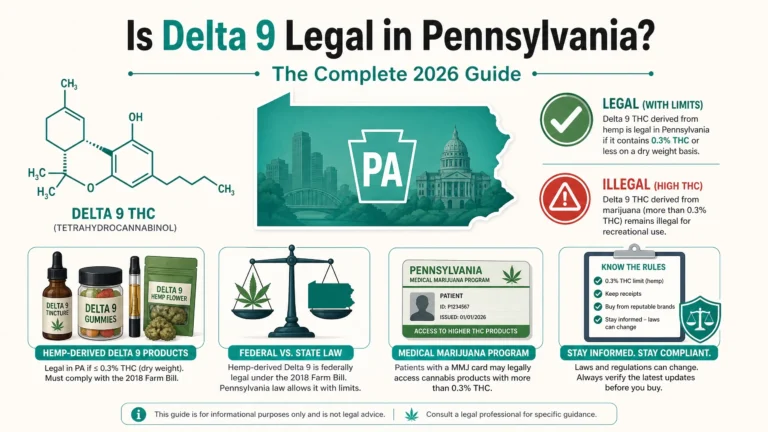

The short answer to “is delta 9 legal in Pennsylvania?” is: it depends entirely on where it comes from and who is using it.
That may sound like a legal dodge, but it is the honest answer — and understanding the three distinct legal scenarios for Delta 9 in Pennsylvania could save you from a costly mistake. It could also open the door to something more useful: legal access to full-strength, properly dosed, regulated Delta 9 through Pennsylvania’s medical marijuana program.
This guide cuts through the confusion with a clear, source-based breakdown of exactly what is and is not legal in Pennsylvania as of May 2026 — including a critical development that most guides are not yet covering: a federal law signed in November 2025 that threatens the hemp-derived Delta 9 market with a hard deadline of November 2026.
What Is Delta 9 THC?
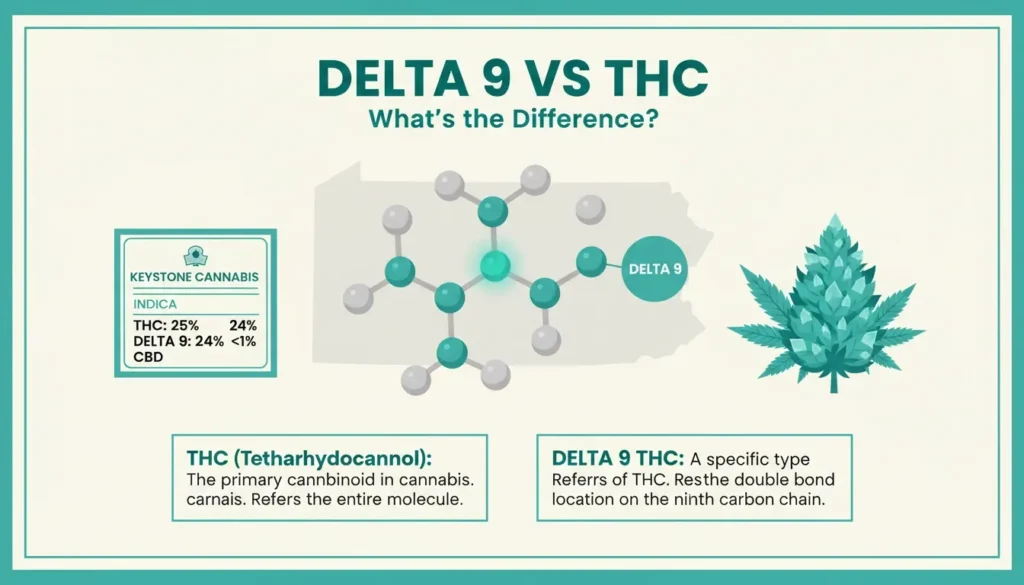
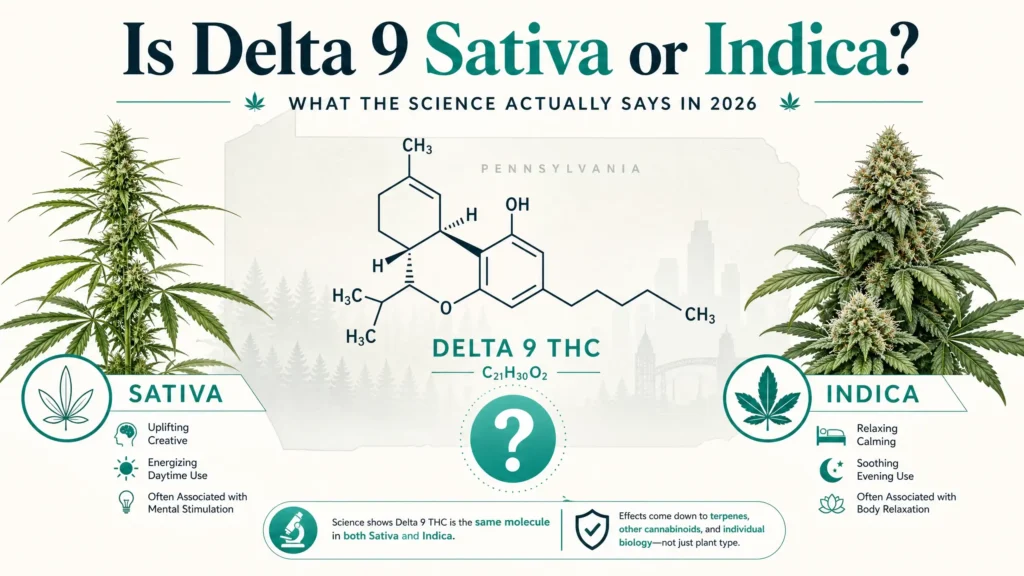
Delta 9 THC — full name delta-9-tetrahydrocannabinol — is the primary psychoactive compound in cannabis. It is the cannabinoid most people mean when they say “THC.” It is responsible for the euphoric high, pain relief, appetite stimulation, and other effects associated with cannabis use.
Unlike delta-8, delta-10, or delta-11 — minor cannabinoids that exist in only trace amounts naturally and are typically synthesized in a laboratory — delta-9 is the dominant THC compound found abundantly in both marijuana and hemp plants. This abundance is exactly why its legal status in Pennsylvania is more nuanced than any other cannabinoid: it exists naturally in both a legal source (hemp, in low concentrations) and a controlled source (marijuana, in high concentrations).
As explained by Pennsylvania State Cannabis, the source of Delta 9 THC — not the compound itself — determines its legal status in Pennsylvania.
The Three Legal Scenarios for Delta 9 in Pennsylvania

| Scenario | Source | Concentration | Legal Status in PA | Who Can Access It |
|---|---|---|---|---|
| Hemp-derived Delta 9 | Hemp plant | ≤0.3% by dry weight | ✅ Legal — for now | Anyone 21+ at hemp retailers |
| Marijuana-derived Delta 9 | Cannabis plant | Full strength (15–30%+) | ✅ Legal for medical use only | Registered PA MMJ patients only |
| Recreational Delta 9 | Either source | Any | ❌ Illegal | No one — criminal offense |
Understanding which scenario applies to the product you are considering is the single most important step for any Pennsylvania resident thinking about Delta 9.
Scenario 1 — Hemp-Derived Delta 9 (≤0.3% THC)
Current status: Legal in Pennsylvania — but a closing window.
Under the federal 2018 Farm Bill, hemp was removed from the federal list of controlled substances. The defining threshold: any cannabis plant or product containing 0.3% or less Delta 9 THC by dry weight is classified as legal hemp — not marijuana.
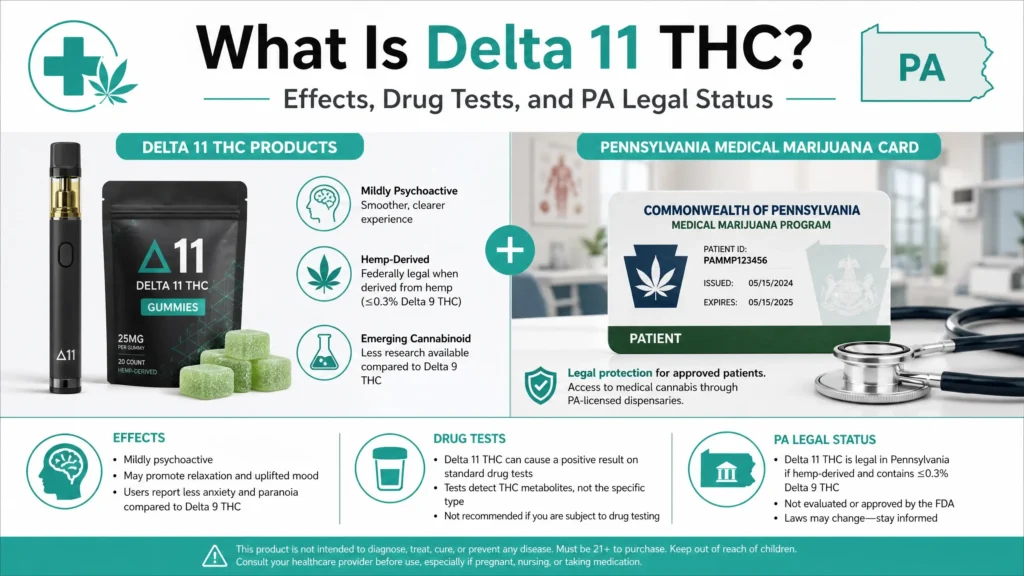
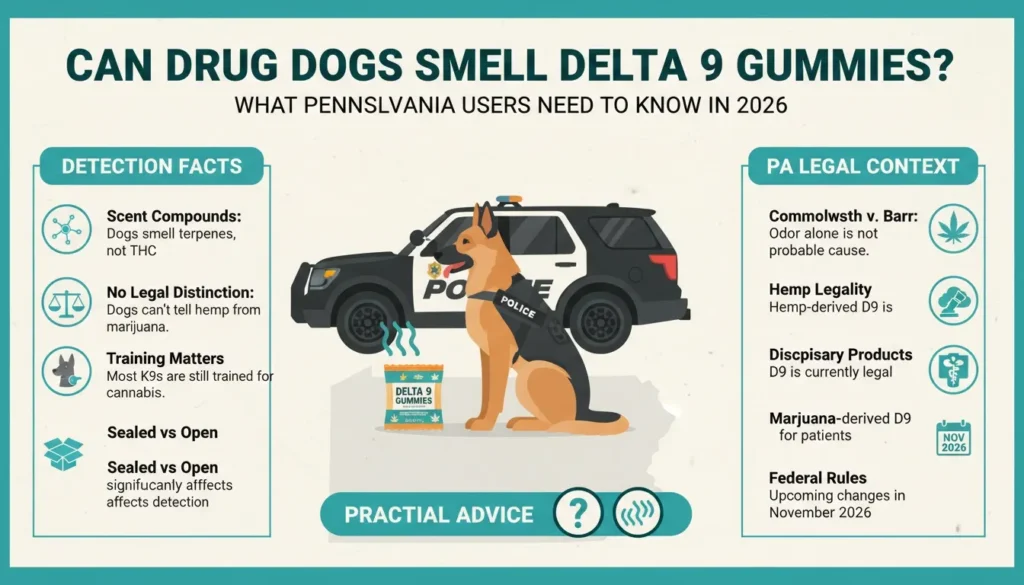
Pennsylvania aligned with this federal framework through Senate Bill 335, signed in 2019, which formally established the state’s industrial hemp program under the Pennsylvania Department of Agriculture. As a result, hemp-derived Delta 9 products — gummies, tinctures, beverages, capsules — containing no more than 0.3% Delta 9 THC by dry weight are currently legal to purchase, possess, and use in Pennsylvania without a medical marijuana card, as confirmed by PennsylvaniaStateCannabis.org.
These products are sold at hemp retailers, smoke shops, specialty stores, and online vendors that ship to Pennsylvania. No prescription. No card required.
The important caveat: 0.3% Delta 9 THC is a very low concentration. Products made within this limit — while technically intoxicating in sufficient quantity — are significantly weaker than the full-strength Delta 9 products available through Pennsylvania’s licensed medical dispensaries, where products routinely test between 15% and 30%+ THC. A hemp Delta 9 gummy and a medical dispensary vape cartridge are in the same cannabinoid family but produce meaningfully different therapeutic effects.
Scenario 2 — Marijuana-Derived Delta 9 Through the PA MMJ Program
Current status: Legal for registered patients only.
Full-strength, marijuana-derived Delta 9 THC — the type that actually mirrors what is sold in recreational states like New Jersey, New York, and Colorado — is legal in Pennsylvania exclusively through the state’s medical marijuana program, established by Governor Wolf’s signing of Act 16 of 2016.
Registered PA MMJ patients can access:
- Dry leaf flower for vaporization (not smoking — smoking remains prohibited in PA)
- Vape cartridges and concentrate products
- Tinctures and oils
- Capsules
- Topicals
- Troches and lozenges
All of these products are available at Pennsylvania’s 186+ licensed dispensaries statewide, tested under PA Department of Health regulations for potency and contaminants, and dispensed under the guidance of licensed pharmacists.
Marijuana-derived Delta 9 — at the concentrations found in actual cannabis flower and concentrates — is what most people are searching for when they ask “is delta 9 legal in PA.” And the answer for this version is: yes, but only through the PA MMJ program with a valid physician certification and state registration.
Patients may possess up to a 90-day supply as determined by their dispensary pharmacist. As confirmed by NORML’s Pennsylvania law summary, the PA MMJ registry is HIPAA-protected and does not appear on standard background checks.
Scenario 3 — Recreational Delta 9
Current status: Illegal. No exceptions.
Pennsylvania has not legalized recreational cannabis. As of May 2026, recreational marijuana — including recreational possession of high-strength Delta 9 THC — remains a criminal offense under the Pennsylvania Controlled Substances, Drug, Device, and Cosmetic Act.
Recreational marijuana-derived Delta 9 is classified as a Schedule I controlled substance in Pennsylvania. Possessing it without a valid medical marijuana card can result in:
- 30g or less: misdemeanor, up to 30 days in jail, $500 fine
- More than 30g: felony-level charges possible depending on circumstances
- In a vehicle: additional charges under PA traffic law
Governor Shapiro has publicly supported legalization, and SB 120 — a bipartisan adult-use legalization bill — remains pending in the Senate as of May 2026. But no recreational bill has passed both chambers. Until one does, full-strength recreational Delta 9 remains illegal for every Pennsylvania resident without a medical card.
The 2026 Legal Threat Hemp Delta 9 Users Need to Know About

If you are currently using hemp-derived Delta 9 products — the low-concentration products available at smoke shops and online — there is a critical legal development you need to be aware of.
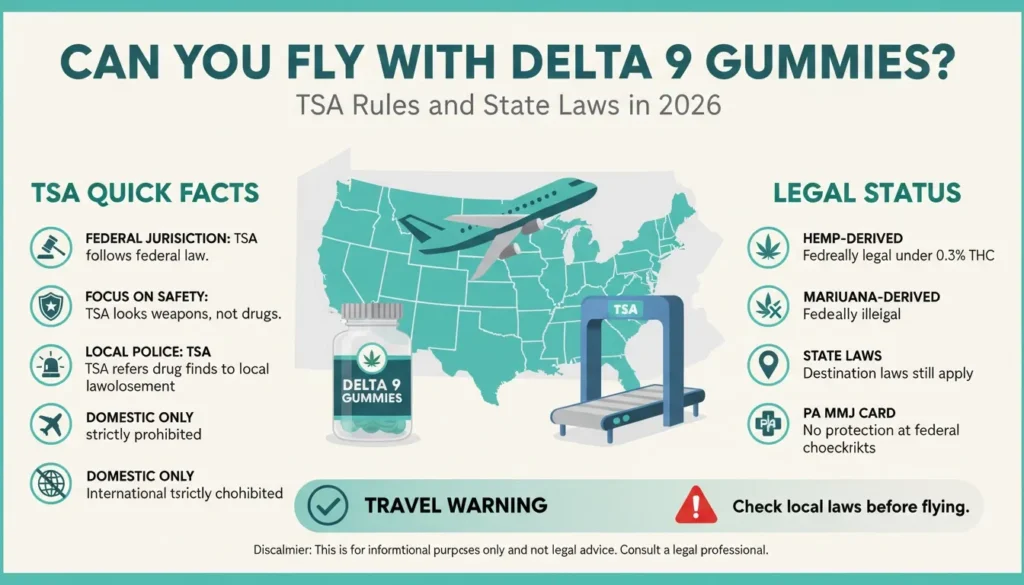
On November 12, 2025, Congress signed H.R. 5371 into law. As analyzed by Regulatory Oversight, this legislation replaces the 2018 Farm Bill’s delta-9-only THC standard with a new “total THC” standard — meaning all THC isomers and analogs now count toward the 0.3% legal limit. The new standard takes effect on November 12, 2026.
The practical impact for hemp Delta 9 users: products that are currently legal because they contain less than 0.3% Delta 9 on a dry weight basis may no longer qualify if their total THC — including THCA and other minor cannabinoids — exceeds the new threshold when calculated together. Most commercial hemp-derived intoxicating products are expected to be reclassified as federally illegal under this standard.
At the Pennsylvania state level, the Senate Law and Justice Committee voted 10-1 in March 2026 to advance an amendment to Senate Bill 49 that explicitly bans the sale of intoxicating hemp-derived THC products. As reported by Cannabis Business Times, PA Senate Law and Justice Chair Senator Daniel Laughlin stated: “Amending Senate Bill 49 to mirror these federal changes helps close the same loopholes that allowed intoxicating hemp products to flood the marketplace with little oversight.”
The bottom line for PA residents buying hemp Delta 9 products today: the legal window for these products is closing at both the federal and state level. If you rely on hemp-derived Delta 9 for any therapeutic reason, exploring the PA MMJ program now — before the ban takes effect — is the most practical path to continued legal access.
Philadelphia and Pittsburgh: Does Local Decriminalization Change Anything?

A question that comes up frequently for residents of Pennsylvania’s two largest cities: does local decriminalization affect Delta 9’s legal status?
The short answer is: partially — and only for small amounts.
Both Philadelphia and Pittsburgh have decriminalized the possession of 30 grams or less of marijuana. In Philadelphia, possession of 30g or less results in a civil fine of $25. In Pittsburgh, similar small possession is treated as a summary offense rather than a criminal charge.
What this does and does not mean:
- ✅ Local decriminalization means you are less likely to face criminal prosecution for small personal amounts in these cities
- ❌ It does not legalize Delta 9 marijuana in Philadelphia or Pittsburgh
- ❌ It does not provide protection under state law — you can still be charged under Pennsylvania state statutes
- ❌ It does not protect you from DUI charges if THC is found in your blood while driving
- ❌ It does not apply to hemp-derived products at gas stations — those fall under a completely separate regulatory framework
Local decriminalization should never be mistaken for legalization. The only fully protected, state-law-authorized route to Delta 9 access in Pennsylvania remains the medical marijuana program.
Delta 9 and Drug Tests in Pennsylvania

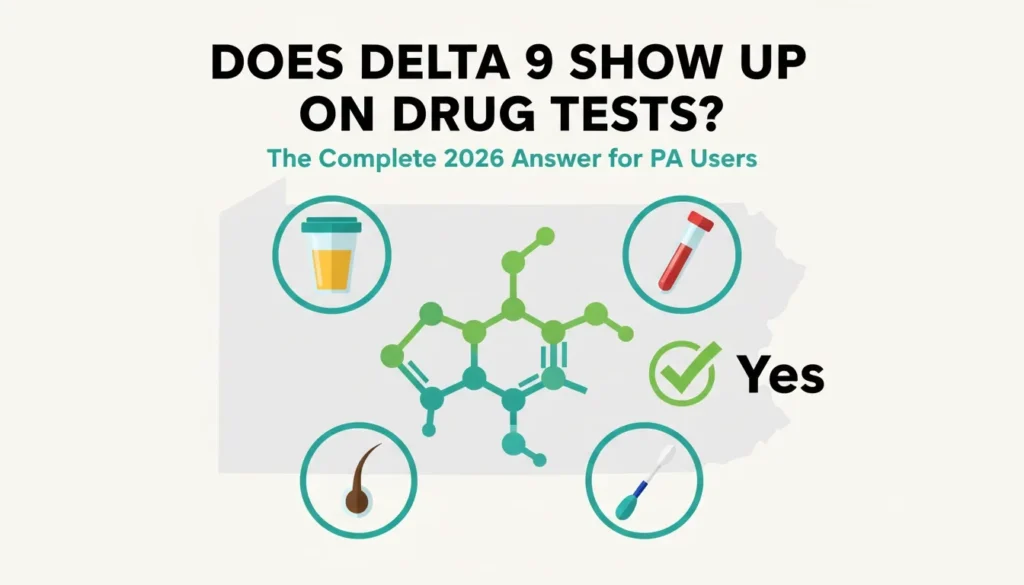
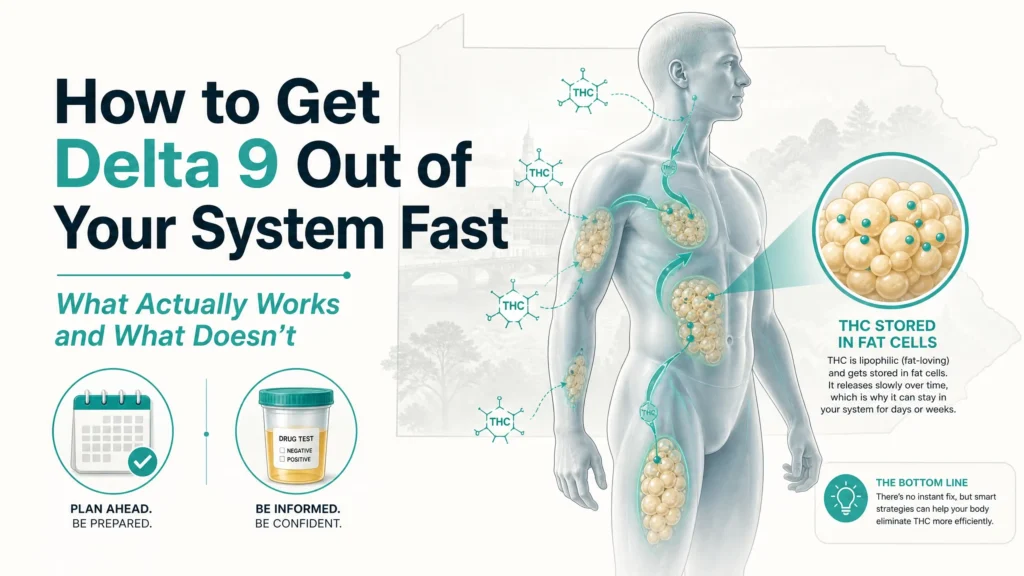
Whether your Delta 9 comes from a hemp gummy, a medical dispensary vape, or anywhere else — it will show up on a standard drug test.
Standard urine drug screens do not distinguish between Delta 9 from a licensed PA dispensary product, a hemp-derived gummy, or illicit marijuana. What they detect is THC-COOH — the metabolite your liver produces when breaking down any form of THC. The test result is identical regardless of source.
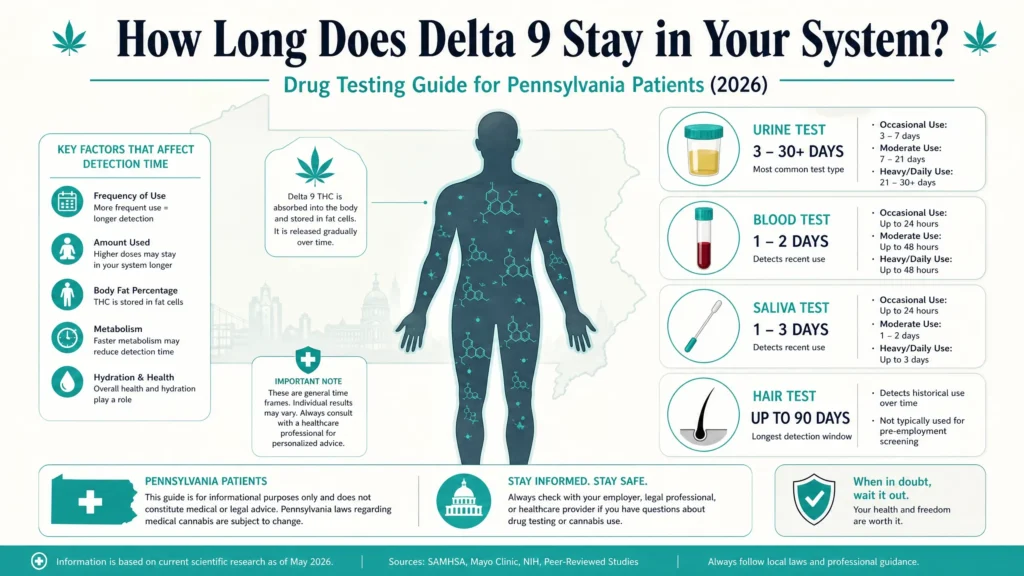
According to peer-reviewed research on workplace drug testing published in PMC, standard urine screens use a threshold of 50 ng/mL for initial immunoassay testing, confirmed at 15 ng/mL by GC-MS. Detection windows for Delta 9 THC:
| Test Type | Occasional Use | Regular Use |
|---|---|---|
| Urine | 3–7 days | Up to 30+ days |
| Blood | Up to 24–48 hours | Up to 48–72 hours |
| Saliva | Up to 24–72 hours | Up to 72 hours |
| Hair | Up to 90 days | Up to 90 days |
One important note for PA medical patients: having a valid PA MMJ card does not protect you from a failed workplace drug test. Pennsylvania’s MMJ law does not require employers to accommodate medical marijuana use. If your employer has a drug-free workplace policy, test positive, and are subject to termination, your card provides no legal shield against that outcome under current PA employment law, as confirmed by the PA Department of Health’s patient FAQ.
Delta 9 and Pennsylvania’s DUI Law

This is one of the most important — and most frequently misunderstood — aspects of Delta 9 legality in Pennsylvania.
Pennsylvania operates under a per se DUI law codified in 75 Pa. C.S. § 3802(d). Under this law, any detectable amount of THC metabolites in your blood while driving is legally sufficient for a DUI charge — regardless of:
- Whether you have a valid PA MMJ card
- Whether your product was hemp-derived and technically legal
- Whether you feel impaired at the time of the stop
- How long ago you consumed the product
This is not a zero-tolerance policy in the sense that police actively test every driver — but if you are pulled over and blood is drawn, any detectable THC-COOH will result in a DUI charge. Given that THC metabolites from regular cannabis use can remain in the blood for 48 to 72 hours — and sometimes longer for daily users — the practical implication is clear: do not drive within several hours of consuming any Delta 9 product, regardless of its source or legality in Pennsylvania.
As the Allegheny County Bar Association’s PA MMJ patient FAQ confirms, Act 16 provides no DUI exemption for registered medical patients.
The Practical Difference: Smoke Shop Delta 9 vs. Dispensary Delta 9
This distinction matters enormously for anyone using Delta 9 for therapeutic reasons — and it is the piece of information that most “is delta 9 legal in PA” guides completely skip.

| Factor | Hemp Delta 9 (Smoke Shop / Online) | Medical Delta 9 (PA Dispensary) |
|---|---|---|
| THC Concentration | Maximum 0.3% by dry weight | 15–30%+ in flower and concentrates |
| Therapeutic strength | Weak — limited clinical effect at label-compliant levels | Full-strength — genuine therapeutic dosing |
| Product testing | No mandatory testing required | Mandatory third-party testing under PA DOH regulations |
| Label accuracy | Not verified — no required third-party confirmation | Verified — dispensary pharmacist oversight |
| Contaminant screening | Not required | Required — tested for pesticides, heavy metals, mold |
| Professional guidance | None | Licensed dispensary pharmacist available at every location |
| Legal protection | Closing window — H.R. 5371 threatens by Nov 2026 | Protected under PA Act 16 — no expiration |
| Cost | Variable — unregulated market pricing | $209 total to obtain card (new patient), then product costs |
The clearest way to put it: if you are using hemp-derived Delta 9 products from a smoke shop because you want the therapeutic effects of cannabis — pain relief, anxiety management, sleep support — you are paying for a significantly diluted version of what PA dispensary patients access legally every day with a medical card.
The 0.3% limit is a federal hemp definition, not a dosing recommendation. Full-strength cannabis — the kind that provides meaningful pain relief, genuine anxiety management, or real sleep support — is only accessible in Pennsylvania through the medical marijuana program.
How to Get Legal Access to Full-Strength Delta 9 in Pennsylvania?

If you are a Pennsylvania resident who wants legal, tested, full-strength Delta 9 — whether for anxiety, chronic pain, PTSD, sleep disorders, or any other qualifying condition — the pathway is the Pennsylvania medical marijuana program.
Pennsylvania recognizes 24 qualifying conditions under Act 16 of 2016. According to a July 2025 study published in the Annals of Internal Medicine by researchers at the University of Pittsburgh and Johns Hopkins University — analyzing 1.73 million PA DOH certification records — anxiety disorder accounts for approximately 60% of all PA MMJ certifications, with monthly certifications nearly tripling since anxiety was added as a qualifying condition in 2019.
Other frequently qualifying conditions include severe chronic or intractable pain, PTSD, and over 20 additional serious medical conditions.
The certification process is entirely online through telehealth at Pennsylvania Marijuana Cards with Dr. Johnathon Chance Miller, MD — a licensed Pennsylvania physician registered with the PA Department of Health. No waiting room. No office visit. The process takes approximately 15 minutes.
Certification Pricing
| Fee | New Patient | Renewal |
|---|---|---|
| Physician Certification Fee | $159 | $149 |
| PA State Registration Fee | $50 | $50 |
| Total | $209 | $199 |
Pennsylvania residents qualifying for Medicaid, SNAP, WIC, CHIP, PACE, or PACENET may have the $50 state fee waived through Pennsylvania’s MMAP program. Renewal pricing is always lower than new patient pricing.
Once certified, your card provides access to all 186+ Pennsylvania licensed dispensaries — carrying full-strength Delta 9 flower, vapes, tinctures, capsules, concentrates, and topicals — all tested, labeled accurately, and dispensed by licensed pharmacists.
For PA residents specifically managing anxiety, you can learn more about how anxiety disorder qualifies for the PA MMJ program here.
Frequently Asked Questions
Q: Is delta 9 THC legal in Pennsylvania in 2026?
A: Yes — but the answer has three layers depending on the source. Hemp-derived Delta 9 products containing no more than 0.3% THC by dry weight are currently legal in Pennsylvania under the state’s hemp framework aligned with the federal 2018 Farm Bill, as confirmed by PennsylvaniaStateCannabis.org. Marijuana-derived Delta 9 is legal only for registered PA medical marijuana patients purchasing from licensed dispensaries under Act 16 of 2016. Recreational Delta 9 — any full-strength cannabis purchased or possessed without a PA MMJ card — remains a criminal offense in Pennsylvania. Recreational legalization has not passed as of May 2026.
Q: Can I buy delta 9 gummies legally in Pennsylvania without a medical card?
A: Yes, currently — but with important caveats. Hemp-derived Delta 9 gummies containing 0.3% THC or less by dry weight are legal for adults 21+ in Pennsylvania and are sold at hemp retailers and online. However, these products are significantly weaker than dispensary-grade cannabis due to the 0.3% concentration ceiling. They also face a serious legal threat: H.R. 5371, signed November 12, 2025, is expected to reclassify most intoxicating hemp products as federally illegal by November 12, 2026, and Pennsylvania’s SB 49 may close access even sooner at the state level.
Q: What is the difference between hemp delta 9 and medical delta 9 in Pennsylvania?
A: The source and the strength. Hemp-derived Delta 9 is capped at 0.3% THC by dry weight — a regulatory threshold, not a therapeutic dose. It is sold at smoke shops and online without a medical card. Medical Delta 9 — available at PA dispensaries to registered patients — comes from marijuana plants and typically tests at 15% to 30%+ THC, providing genuine therapeutic concentrations for conditions like chronic pain, anxiety, and PTSD. Medical dispensary products are also subject to mandatory third-party testing under PA Department of Health regulations — hemp retail products are not.
Q: Will delta 9 show up on a drug test in Pennsylvania?
A: Yes — regardless of whether it was hemp-derived or from a dispensary. Drug tests detect THC-COOH, the metabolite produced when your liver breaks down any form of Delta 9 THC, as confirmed by PMC workplace drug testing research. The test cannot distinguish between legal hemp Delta 9, medical dispensary Delta 9, or illicit marijuana. Detection windows range from 3 to 7 days in urine for occasional users to 30+ days for regular users. A valid PA medical marijuana card does not protect you from a failed workplace drug test if your employer has a drug-free policy.
Q: Can I get a DUI in Pennsylvania from legal delta 9 products?
A: Yes. Pennsylvania’s per se DUI law under 75 Pa. C.S. § 3802(d) makes it illegal to drive with any detectable THC metabolites in your blood — regardless of whether you are actually impaired, and regardless of whether your Delta 9 product was legally purchased as hemp or through a licensed dispensary with a valid MMJ card. This applies equally to hemp-derived gummies purchased at a smoke shop and to medical dispensary products. Do not drive for several hours after consuming any Delta 9 product in Pennsylvania.
Q: Does Philadelphia or Pittsburgh decriminalization make delta 9 fully legal?
A: No. Both cities have decriminalized possession of 30 grams or less — meaning small amounts are treated as civil fines rather than criminal offenses locally. But as confirmed by Pennsylvania State Cannabis, local decriminalization does not override Pennsylvania state law, does not legalize marijuana, and does not protect you from state-level prosecution, DUI charges, or employment consequences. The only legally protected access to full-strength Delta 9 in any Pennsylvania city remains the state medical marijuana program.
Q: How do I legally get access to full-strength delta 9 THC in Pennsylvania?
A: Through Pennsylvania’s medical marijuana program. If you have a qualifying condition — anxiety disorder, chronic pain, PTSD, or any of the other 24 recognized conditions — you can obtain a physician certification through telehealth and register with the state. A July 2025 study in the Annals of Internal Medicine by University of Pittsburgh and Johns Hopkins researchers found that anxiety accounts for approximately 60% of all PA MMJ certifications — so if anxiety is driving your interest in Delta 9, you likely qualify. Pennsylvania Marijuana Cards offers same-day telehealth certifications with Dr. Johnathon Chance Miller, MD — new patient total cost is $209 ($159 physician fee + $50 state fee), with the state fee waived for qualifying low-income patients.
Medically reviewed by Dr. Johnathon Chance Miller, MD. This content is for informational and educational purposes only and does not constitute legal advice. Pennsylvania cannabis and hemp laws are subject to change. Always verify current regulations with official state sources before purchasing or using any cannabinoid product. Do not drive after consuming any THC-containing product. Consult a licensed physician before using cannabis for any medical condition.
Sources
- Pennsylvania Medical Marijuana Act — Act 16 of 2016
- Pennsylvania Senate Bill 335 (2019) — Industrial Hemp Program
- Pennsylvania Controlled Substances, Drug, Device, and Cosmetic Act (Act 64)
- Pennsylvania Department of Health — Medical Marijuana Program (May 2026)
- PennsylvaniaStateCannabis.org — Is Delta 9 Legal in Pennsylvania?
- PennsylvaniaStateCannabis.org — Pennsylvania Marijuana Laws 2026
- NORML — Pennsylvania Medical Marijuana Law Summary
- Marijuana Policy Project — Pennsylvania
- Regulatory Oversight — Congress Narrows Federal Definition of Hemp (December 2025)
- Cannabis Business Times — Pennsylvania Moves to Align Hemp Regulations With Federal Ban (March 2026)
- Senator Daniel Laughlin — SB 49 Amendment Statement (March 2026)
- Allegheny County Bar Association — PA Medical Marijuana Patient FAQ
- PMC / NIH — Interpretation of Workplace Tests for Cannabinoids
- Pennsylvania General Assembly — 75 Pa. C.S. § 3802(d) Per Se DUI Law
- Annals of Internal Medicine — Medical Cannabis Certifications After Pennsylvania Added Anxiety Disorders as Qualifying Condition (July 2025)
- Pennsylvania Capital-Star — Delta 8 Loophole and PA Attorney General (November 2025)