
Walk into any Pennsylvania dispensary and the first question you will probably be asked is whether you want indica, sativa, or hybrid. It is the oldest shorthand in cannabis retail. Indicas are relaxing. Sativas are energizing. Hybrids are somewhere in between.
There is just one problem: Modern genetics and chemistry research has found that this framework does not hold up scientifically.
Need a PA Medical Marijuana Card?
Get certified online in 15 minutes. 100% Money-Back Guarantee.
Get Certified Now →Indica and sativa labels describe the physical appearance of cannabis plants, their height, leaf width, and geographic origin. They do not reliably predict the chemical compounds that actually determine how a product will make you feel.
A 2025 genetic study from Leiden University researchers at Bedrocan found it is genetically impossible to prove whether a cannabis plant is indica or sativa. There is no meaningful genetic distinction between them.
What actually determines your experience is the cannabinoid and terpene profile of the specific product. Not the label.
This guide explains what the science shows, what the labels can and cannot tell you, and exactly how to choose strains at PA dispensaries using the information that actually matters.
Key Takeaways
| Topic | Key Point |
|---|---|
| Scientific validity of labels | A 2025 Leiden University genetic study found no meaningful genetic difference between indica and sativa plants |
| What the labels actually describe | Plant morphology and geographic origin, not chemical profile or consumer experience |
| What actually determines effects | Terpene dominance and cannabinoid profile (THC:CBD ratio), not indica/sativa label |
| The term to know | “Chemovar”, a chemical variety classification based on actual cannabinoid and terpene content |
| Why dispensaries still use the labels | Consumer expectation; budtenders use them as starting-point shorthand, not scientific fact |
| What PA patients should ask instead | “What is the dominant terpene?” and “What is the THC:CBD ratio?” rather than “indica or sativa?” |
Where Indica and Sativa Labels Came From
Do You Qualify for a PA MMJ Card?
Connect with a licensed Pennsylvania state physician online from home.
The terms indica and sativa have been around for centuries, but they were never meant to describe effects.
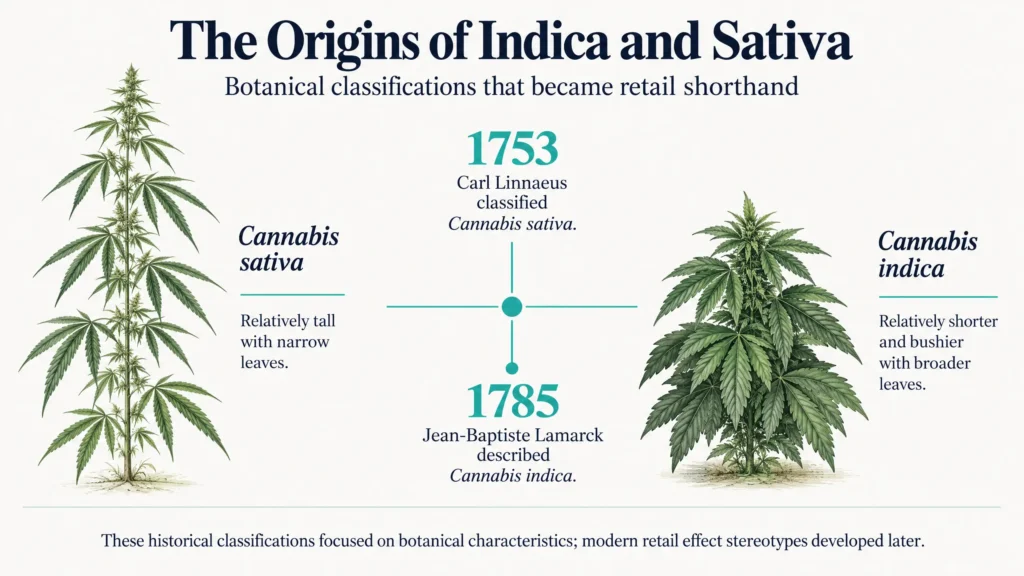
“Cannabis sativa” was first classified by botanist Carl Linnaeus in 1753 to describe tall, narrow-leafed plants from equatorial regions. “Cannabis indica” was added by Jean-Baptiste Lamarck in 1785 to describe shorter, bushier plants from Central Asia, particularly India.
These were botanical classifications. They described plant structure and geographic origin, the same way “oak” and “maple” describe tree morphology rather than how wood from each species behaves in your body.
The association of indica with relaxing effects and sativa with energizing effects developed through commercial cannabis culture from the 1970s onward.
Growers and sellers needed simple language to communicate product differences to customers. Indica and sativa were already established vocabulary. The effect stereotypes attached organically as growers noticed rough correlations between plant type and reported consumer experience.
The problem: Those correlations were never reliable or scientifically validated. They reflected the average terpene profiles that tended to cluster with indica-looking versus sativa-looking plants, not any inherent genetic property of the plants themselves.
What the Research Shows: No Meaningful Genetic Difference
The scientific case against indica/sativa as a meaningful classification system has strengthened considerably in recent years.
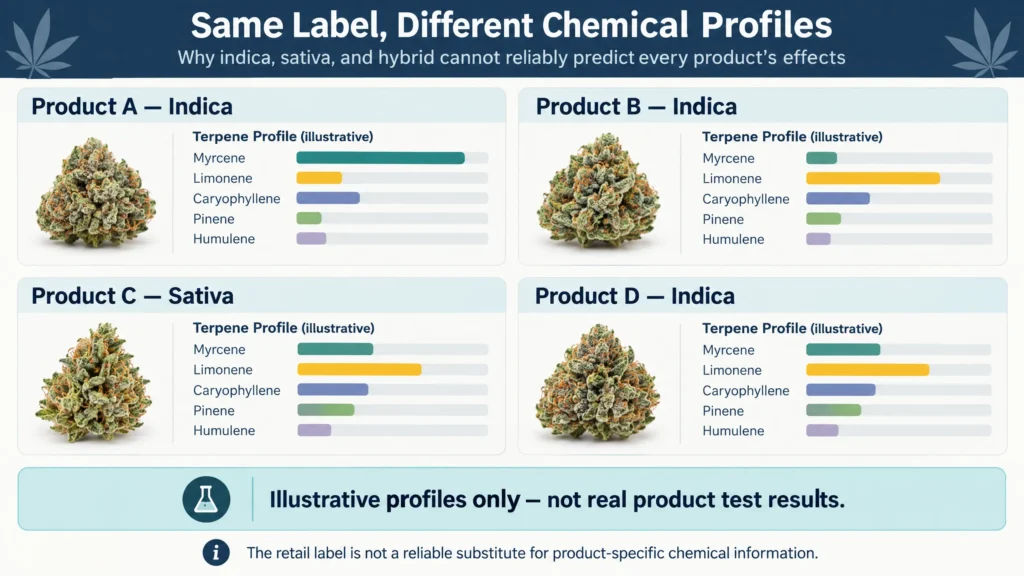
A 2022 study published in the journal PLOS ONE analyzed the cannabinoid and terpene profiles of hundreds of commercially sold cannabis products and found that strains sharing the same label (two indicas, for example) can have dramatically different chemical profiles. Meanwhile, strains labeled differently can be chemically nearly identical.
The labels had weak predictive value for actual chemical content.
A 2025 genetic study from researchers at Leiden University working with Bedrocan, one of the world’s most rigorous medical cannabis producers, went further. As the lead researcher stated: “What our study mainly shows is that you should not just rely on those labels, but that you should look at the specific terpene profile.”
⚡ Fast & 100% Online PA Medical Cards
Board-Certified Doctors • 100% Money-Back Guarantee
Book Evaluation Now →The research found it is genetically impossible to reliably distinguish indica from sativa by plant genetics alone.
As National Geographic summarized the scientific consensus in their 2025 cannabis research review: “Mounting scientific evidence suggests that these labels are largely meaningless, with no significant chemical or genetic differences between the two.”
This does not mean all cannabis products feel the same. It means the indica/sativa label is not the variable causing the differences. Something else is.
Why the Old Framework Developed: The Myrcene Explanation
If indica and sativa labels are not genetically meaningful, why did the indica-equals-relaxing association develop in the first place?
The answer is myrcene.
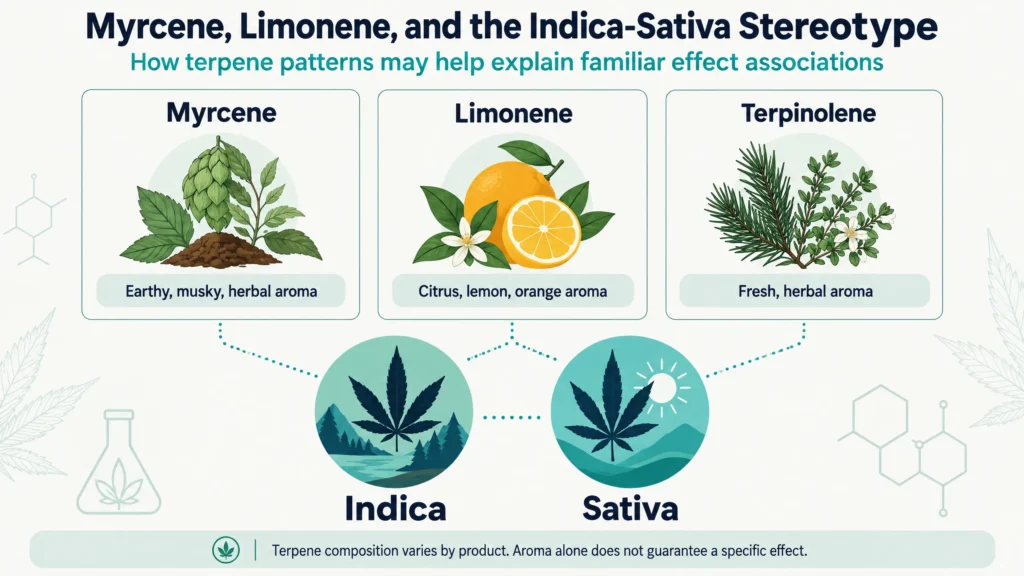
Myrcene is the most abundant terpene in most cannabis varieties. It has documented sedative and muscle-relaxant properties. Research shows myrcene tends to cluster in higher concentrations in plants with indica-type morphology: shorter, broader-leafed plants with the dense bud structure growers associate with indica.
Meanwhile, terpenes like terpinolene and limonene, which are associated with more uplifting, energetic effects, tend to cluster with sativa-type morphology plants.
This is not a genetic rule. It is a tendency that developed through selective breeding patterns. Growers who selected for the visual characteristics associated with indica inadvertently often also selected for higher myrcene expression. Sativa-selecting growers tended toward higher terpinolene and limonene.
The result: indica-labeled products tended to contain more myrcene, producing more relaxing effects on average. Sativa-labeled products tended to contain more terpinolene or limonene, producing more uplifting effects on average.
But “tends to” is not “always does.” As decades of crossbreeding have mixed genetics beyond recognition, a product labeled indica with low myrcene and high limonene will feel energizing regardless of its label. And a product labeled sativa with dominant myrcene will feel relaxing regardless of its label.
The terpene is the variable. The label is an imperfect proxy for the terpene.
What Actually Determines Your Cannabis Experience
Renewing Your PA MMJ Card?
Quick annual recertification online. No paperwork hassle.
Renew Card Online →Two primary factors determine how a specific cannabis product will make you feel.
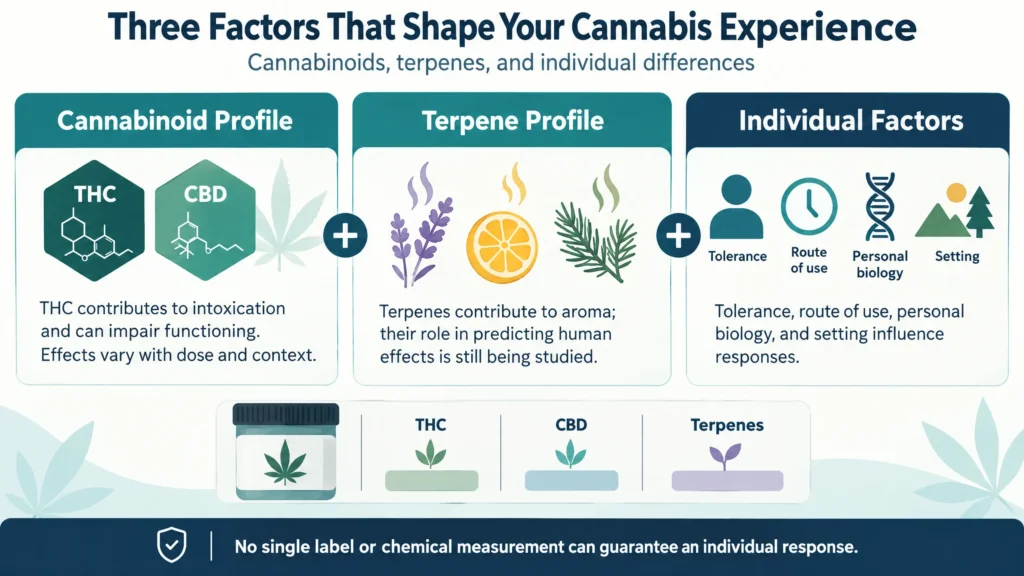
Factor 1: Cannabinoid profile (primarily THC:CBD ratio)
THC drives the psychoactive intensity of the experience. Higher THC at equivalent doses produces stronger psychoactive effects, higher risk of anxiety, and more pronounced impairment.
CBD moderates THC’s effects through CB1 receptor competition and 5-HT1A serotonin pathway activation. Higher CBD relative to THC produces a mellower, less anxious, less intoxicating experience.
The THC:CBD ratio is the single strongest predictor of how intoxicating and potentially anxiety-producing an experience will be.
For more on how THC percentage alone affects experience, see our does THC percentage matter guide.
Factor 2: Terpene profile
Terpenes are aromatic compounds that modulate the cannabis experience through several mechanisms.
They interact with cannabinoids through the entourage effect, influencing how THC and CBD behave in the body. They also have independent pharmacological effects through pathways including GABA modulation (linalool), serotonin activation (limonene), and CB2 receptor binding (caryophyllene).
The dominant terpene or terpene combination in a specific product is the best available predictor of its experiential character, more accurate than the indica/sativa label.
Additional factors
Set and setting (your mood and environment when consuming), personal tolerance, route of consumption, and individual biology all influence the experience. But for any given person in a consistent state, terpene profile and cannabinoid ratio are the most practically controllable variables.
The Four Dominant Terpene Profiles: The Real Framework
Rather than indica versus sativa, think in terms of four broad terpene-dominant profiles that better predict consumer experience.
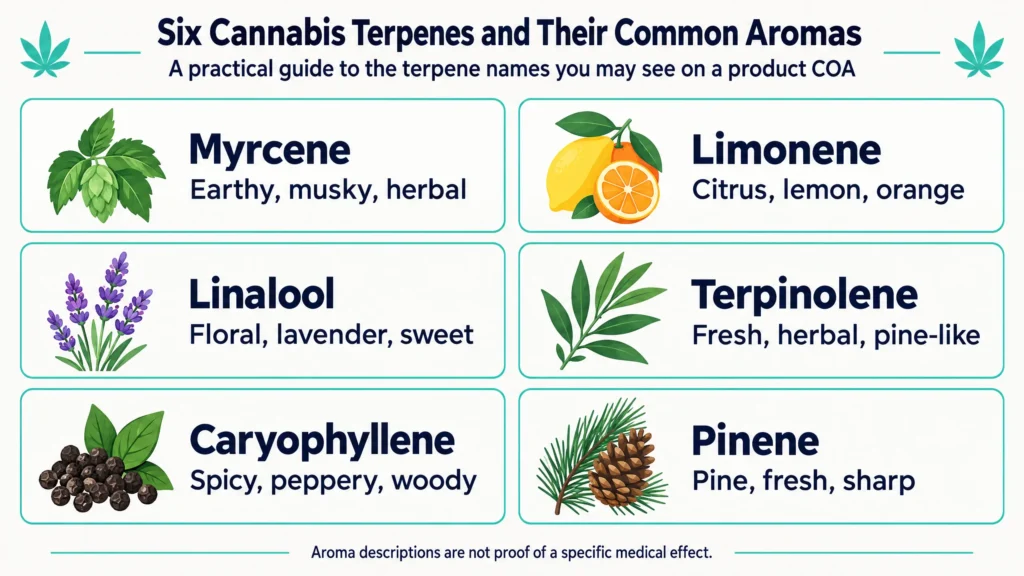
| Dominant Terpene | Common Aroma | Reported Effects | Loose Label Correlation |
|---|---|---|---|
| Myrcene | Earthy, musky, herbal | Relaxing, physically heavy, sedating at high levels | Often clusters with “indica” labels |
| Limonene | Citrus, lemon, orange | Mood-elevating, stress-relieving, anxiolytic | Often clusters with “sativa” labels |
| Linalool | Floral, lavender, sweet | Calming, anxiolytic, GABA-mediated relaxation | Often labeled “indica” but distinct from myrcene |
| Terpinolene | Pine, herbal, fresh | Uplifting, sometimes energetic, creative | Strongly clusters with “sativa” labels |
| Caryophyllene | Spicy, peppery, woody | Grounding, anti-inflammatory, CB2 activity | Appears across both label categories |
| Pinene | Pine, fresh, sharp | Alert, potentially counteracts short-term memory impairment | Appears across both label categories |
How popular strains map to terpene profiles (not indica/sativa labels):
| Strain | Common Label | Dominant Terpene | Typical Experience | Our Guide |
|---|---|---|---|---|
| OG Kush | Indica | Myrcene + Limonene | Relaxing but mood-lifting | OG Kush guide |
| Blue Dream | Sativa/Hybrid | Myrcene + Pinene | Balanced, creative | Blue Dream guide |
| Sour Diesel | Sativa | Caryophyllene + Limonene | Energetic, cerebral | Sour Diesel guide |
| Gelato | Hybrid | Limonene + Caryophyllene | Uplifting, relaxed body | Gelato guide |
| Gorilla Glue | Indica/Hybrid | Myrcene + Caryophyllene | Heavy, relaxing | Gorilla Glue guide |
Get Approved by a Licensed PA Doctor
Schedule your appointment in minutes. You only pay if approved.
Start Online Application →A myrcene-dominant product will tend to feel heavier and more physically relaxing whether the label says indica, hybrid, or even sativa.
A terpinolene-dominant product will tend to feel uplifting and energizing regardless of its morphological classification.
The terpene predicts. The label guesses.
For condition-specific terpene guidance, see our terpenes for anxiety guide.
The Chemovar: The Scientific Replacement for Indica/Sativa
The term researchers and some progressive dispensaries use as a replacement for indica/sativa is “chemovar.”
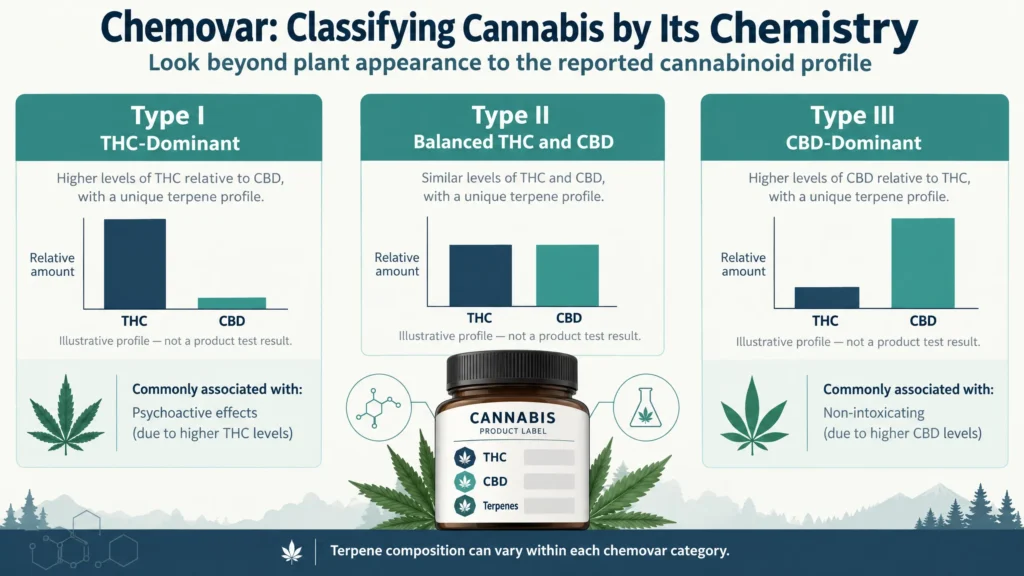
A chemovar (chemical variety) classifies cannabis by its actual biochemical content rather than its physical appearance or geographic origin.
As National Geographic described the scientific proposal: this alternative system “would see labels listing the key compounds present in a particular cultivar, alongside their respective amounts, similar to the Nutrition Facts panel found on food packages.”
Chemovars are typically classified by their dominant cannabinoid and terpene expression:
The three chemovar types:
| Chemovar Type | Cannabinoid Profile | Common Products | Best For |
|---|---|---|---|
| Type I | THC-dominant, low CBD | Most PA dispensary flower and concentrates | Experienced patients, chronic pain, sleep |
| Type II | Balanced THC:CBD (1:1 to 3:1) | Ratio tinctures, some flower and capsules | Anxiety-prone patients, beginners, daytime use |
| Type III | CBD-dominant, low THC | High-CBD tinctures, hemp products | Patients avoiding intoxication, drug testing concerns |
A Type I chemovar is THC-dominant with low or no CBD. This is most recreational and most PA dispensary flower.
Ready to Get Your Official PA MMJ Card?
State-certified doctor consultations online. No risk—100% refund if not approved.
Claim Your MMJ Card Online →A Type II chemovar is balanced THC:CBD, with meaningful amounts of both. These are ratio products like 1:1 tinctures.
A Type III chemovar is CBD-dominant with low THC. This covers most hemp-derived CBD products and some PA dispensary high-CBD strains.
Within each type, the terpene dominance further defines the experience. A Type I chemovar with dominant myrcene is a very different experience from a Type I chemovar with dominant terpinolene, even at equivalent THC percentages.
The chemovar framework gives you two specific variables to evaluate at your PA dispensary: cannabinoid type and terpene dominance. These two data points predict your experience far more accurately than any indica or sativa label.
Are Indica and Sativa Labels Completely Useless?
The honest answer is: not completely useless, just significantly less useful than advertised.
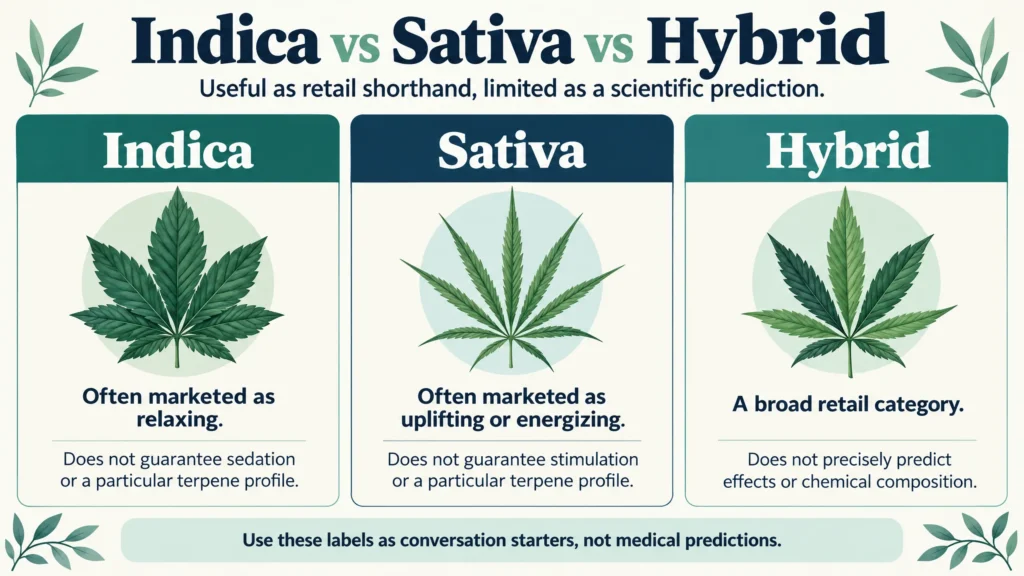
The labels have weak but nonzero predictive value. Because of the historical breeding patterns described in Section 3, indica-labeled products statistically tend toward myrcene dominance and sativa-labeled products tend toward terpinolene or limonene dominance.
This means that if you have no COA and no other information available, an indica label gives you a slightly better-than-random chance of predicting a more relaxing experience. The same weak logic applies to sativa.
But “slightly better than random” is a very low bar.
Two different indica products from two different cultivators at your PA dispensary may have entirely different terpene profiles and produce substantially different experiences.
As Social Dispensary’s April 2026 research review states: “Strains sharing the same label (e.g., two indicas) can have dramatically different chemical profiles, while strains labeled differently can be chemically nearly identical.”
The labels are shorthand that budtenders use as a starting-point conversation, not a precise tool.
Think of them the way you think of a restaurant’s cuisine category. Knowing a restaurant is “Italian” tells you something, but it does not predict whether a specific dish will be spicy, rich, or light. For that you need the actual menu.
The indica/sativa label is the cuisine category. The COA terpene panel is the actual menu.
Why PA Dispensaries Still Use the Labels
If the science has moved on, why does every Pennsylvania dispensary still organize products by indica, sativa, and hybrid?
Several practical reasons:
Consumer expectation: The vast majority of patients entering a PA dispensary for the first time arrive with indica/sativa as their reference framework. Dispensaries that removed the labels would confuse and frustrate most of their customers.
Budtender communication: Even though the labels are imprecise, they give budtenders and patients a starting vocabulary. When a patient says “I want something more indica,” the budtender understands they probably want something relaxing rather than something energizing, and can then refine from there.
Menu design limitations: Most dispensary point-of-sale systems are built around indica/sativa/hybrid categories. Switching to chemovar-based menus would require significant infrastructure changes.
Regulatory labeling: Pennsylvania’s dispensary labeling requirements specify certain information that must be present but do not require terpene-based classification systems.
The result is a gap between what science knows and what retail practice communicates. As a PA patient, understanding this gap lets you use the label as a rough starting point while making your actual decision based on the COA terpene panel, which every licensed PA dispensary is required to provide.
How to Choose Strains at PA Dispensaries Using Real Information
Here is a practical three-question framework to replace “do you want indica or sativa?”
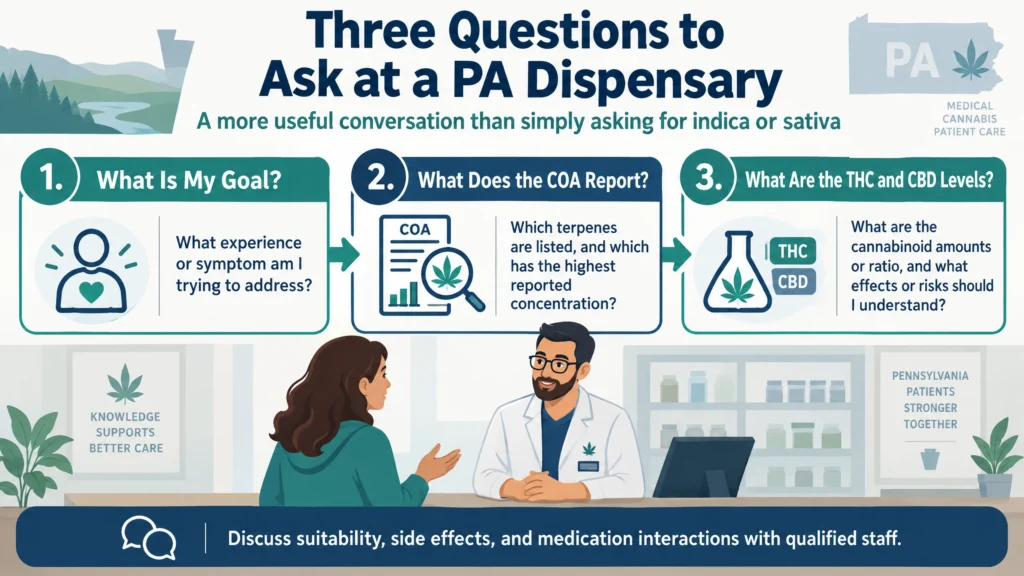
Question 1: What experience am I trying to create?
Describe it in functional terms: help with sleep, reduce daytime anxiety, manage pain without sedation, uplift mood during a depressive period, reduce nausea. Specific functional goals point directly to the terpene profiles that research supports for those outcomes.
For example: sleep support points toward myrcene and linalool. Anxiety reduction points toward limonene, linalool, and caryophyllene. Nausea management points toward strains with higher CBD and moderate THC, with CBDA content potentially relevant. For condition-specific strain guidance, see our best strain for nausea guide.
Goal-to-terpene decision guide:
| Your Functional Goal | Terpene to Look For | What to Avoid |
|---|---|---|
| Sleep and relaxation | Myrcene dominant (0.5%+), linalool secondary | High terpinolene (energizing) |
| Daytime anxiety relief | Limonene dominant, linalool secondary | High myrcene without limonene (too sedating) |
| Pain relief without sedation | Caryophyllene dominant, low-dose THC | Very high THC without CBD |
| Nausea management | Moderate THC + CBD balance, limonene helpful | High-THC concentrate products |
| Focus and creativity | Terpinolene dominant, pinene secondary | Myrcene dominant (too heavy) |
| PTSD nightmares (sleep) | Low-dose THC bedtime + linalool | High-dose daytime THC |
Question 2: What is the dominant terpene in this specific product?
Ask your dispensary budtender or pharmacist: “What is the dominant terpene on the COA for this product?” Most PA dispensary staff can answer this and pull up the COA on request.
If myrcene is dominant and your goal is energy and focus, this is not the right product regardless of the sativa label.
If limonene is dominant and your goal is sleep, you may want to look further.
Question 3: What is the THC:CBD ratio and total THC content?
For new or anxiety-prone patients, a ratio product (3:1 or 5:1 CBD:THC) is safer than a high-THC pure product regardless of the indica/sativa label.
For experienced patients managing chronic pain or spasms, a 1:1 product or higher-THC flower may better match the evidence for those conditions.
These three questions together give you more actionable purchasing information than any combination of indica, sativa, and hybrid labels.
The PA COA Terpene Panel: Your Practical Tool
Every licensed Pennsylvania dispensary product comes with a Certificate of Analysis from two independent, state-approved laboratories. The terpene panel on that COA is the practical tool that replaces the indica/sativa label.
Here is what to look for:
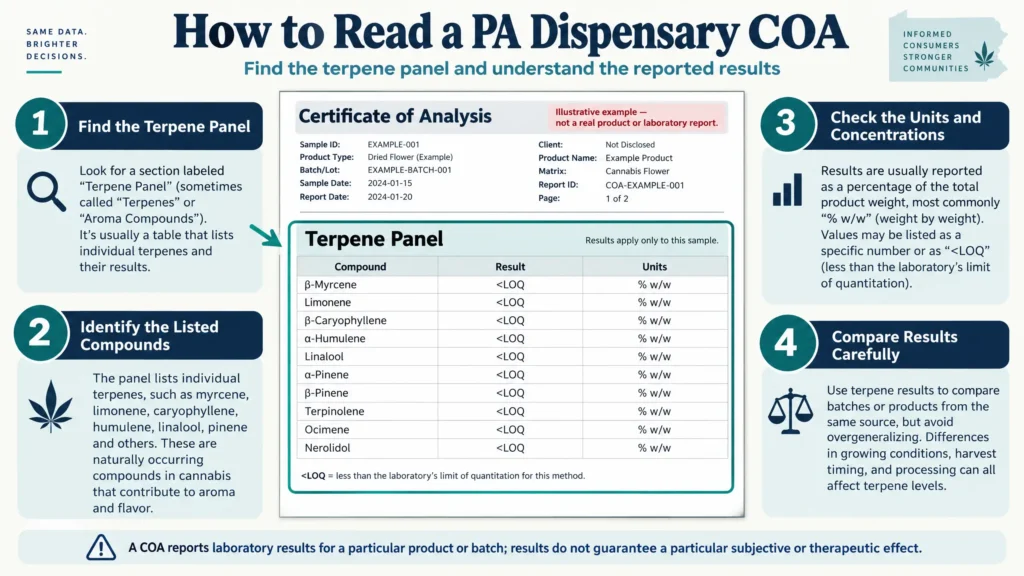
Step 1: Find the terpene panel
Most PA dispensary COAs list cannabinoids on the first page and terpenes on the second or third. The panel lists individual terpenes with their percentage concentrations in the product.
Step 2: Identify the dominant terpene
The terpene listed at the highest percentage is the dominant one. This single data point is the most predictive available for the experience character of the product.
Step 3: Match to your goal
Use the table from Section 5 to match the dominant terpene to your intended outcome. Myrcene for relaxation and sleep. Limonene for mood and anxiety. Linalool for calm and GABA-mediated relaxation. Terpinolene for energy and focus.
Step 4: Check total terpene percentage
A product with 2% or higher total terpenes tends to produce a richer, more complex experience with more entourage effect modulation. Products with very low total terpene content (below 0.5%) may feel flatter and less nuanced even at equivalent THC.
For a complete walkthrough of reading PA dispensary lab reports, see our how to read a PA dispensary COA guide.
If you are not yet a registered PA patient and want access to COA-verified, pharmacist-guided products at licensed PA dispensaries, check your qualifying condition here or get certified at Pennsylvania Marijuana Cards.
Frequently Asked Questions
Q: Is there actually a difference between sativa and indica?
A: Biologically and genetically, no meaningful difference has been found.
A 2025 Leiden University genetic study found it is impossible to reliably distinguish indica from sativa by plant genetics. A 2022 PLOS ONE study found that products with the same label can have dramatically different chemical profiles while products with different labels can be chemically nearly identical.
The labels describe plant morphology and have some weak correlation with terpene tendencies, but they do not reliably predict consumer experience. What does predict experience is the terpene profile and cannabinoid ratio of the specific product.
Q: What is the actual difference between sativa and indica?
A: The original difference was botanical: Cannabis sativa referred to tall, narrow-leafed plants from equatorial regions, Cannabis indica to shorter, bushier plants from Central Asia. These morphological differences have no inherent connection to effects.
The stereotype that indica relaxes and sativa energizes developed through commercial cannabis culture based on loose correlations with terpene profiles that tended to cluster with each plant type. Those correlations are weak and unreliable.
The terpene content is the variable causing the reported differences, not the indica or sativa classification.
Q: What should I look for instead of indica or sativa?
A: Look at the dominant terpene on the product’s COA and the THC:CBD ratio.
A myrcene-dominant product tends to feel relaxing and physically heavy. A limonene-dominant product tends to feel mood-elevating and less sedating. A terpinolene-dominant product tends to feel uplifting and energetic. A linalool-dominant product tends to feel calm and anxiolytic.
Combined with the THC:CBD ratio (which determines intoxication intensity), these two data points predict experience far more accurately than any indica or sativa label.
Q: Why do dispensaries still say indica and sativa if the labels are not scientific?
A: Consumer expectation is the primary reason. Most patients arrive at dispensaries with indica/sativa as their reference framework, and removing the labels would create confusion.
Budtenders also use them as a starting point for conversation. A patient asking for “something more indica” is understood to want something more relaxing, which the budtender can then refine using actual terpene and cannabinoid data.
The labels function as imprecise shorthand, not scientific classifications.
Q: Is a hybrid just a mix of indica and sativa effects?
A: In theory. In practice, virtually every commercially available cannabis strain at PA dispensaries in 2026 is a hybrid.
Pure landrace sativas and pure landrace indicas essentially do not exist in modern dispensary inventory. When a PA dispensary labels something as “hybrid,” it means it does not lean strongly enough in any stereotypical direction to be marketed as indica or sativa.
The hybrid label is even less predictive than indica or sativa. Use the COA instead.
Q: Does this mean THC percentage determines the experience?
A: THC percentage is one factor but not the only one. As covered in our does THC percentage matter guide, THC concentration predicts intoxication intensity but not the experiential character of the session. Two products at 25% THC with different dominant terpenes will feel substantially different. The terpene profile shapes the experience character. The THC level determines the intensity. Both matter. Neither alone is sufficient to predict what a product will feel like.
Q: How do PA dispensaries handle the indica/sativa question?
A: Pennsylvania’s licensed dispensaries organize their menus around indica, sativa, and hybrid categories because that is the consumer language most patients understand.
Every product also comes with a COA that includes the terpene panel, giving patients access to the data that actually predicts experience. Many PA dispensary pharmacists now routinely explain terpene profiles alongside label information.
If you want a more precise recommendation, ask your dispensary pharmacist for the COA and ask which terpene is dominant in the products you are considering.
The Bottom Line
The sativa versus indica framework made intuitive sense for decades, even though it was never built on rigorous science.
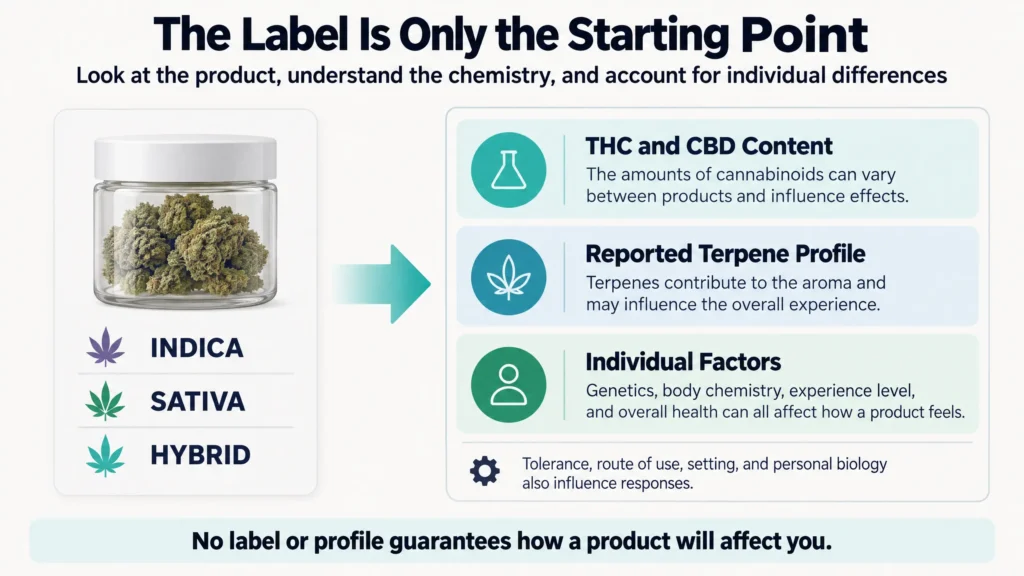
In 2026, the research is clear: plant morphology does not determine consumer experience. The chemical profile of the specific product does. And the chemical profile is determined by terpene dominance and cannabinoid ratio, not whether the plant was tall and narrow-leafed or short and broad-leafed.
PA dispensaries will likely keep using indica, sativa, and hybrid labels for the foreseeable future because patients expect them. Understanding what those labels can and cannot tell you lets you use them as a rough starting point while making your real decisions based on the COA terpene panel.
The three-question practical framework from Section 9 replaces “do you want indica or sativa” with something that actually predicts your experience: what is your functional goal, what is the dominant terpene, and what is the THC:CBD ratio?
This blog post is intended for general educational and informational purposes only and does not constitute medical advice. Individual responses to cannabis vary significantly based on personal biology, tolerance, and setting. Always consult your PA dispensary pharmacist before making significant changes to your cannabis product selection, particularly if you manage a qualifying medical condition. Medically reviewed by Dr. Johnathon Chance Miller, MD.
Sources
- Bedrocan: International Research Shows No Genetic Distinction Between Sativa and Indica Cannabis (June 2025)
- National Geographic: Indica vs. Sativa, Science Suggests There’s Not Actually a Difference (July 2025)
- Social Dispensary: Indica vs Sativa, The Myth and What Research Suggests (April 2026)
- Terpene Belt Farms: Indica vs Sativa Terpenes, What Really Determines Effects (February 2026)
- Green Theory DC: Debunking Indica vs Sativa, What Actually Determines Cannabis Effects (May 2026)
- The Bluntness: Debunking Indica vs Sativa, The Truth Behind Cannabis Effects (September 2025)
- Norddampf: Indica vs Sativa, The Real Difference (April 2026)
- Wikipedia: Entourage Effect, Sativa vs Indica genetic distinction
- PA Department of Health: Medical Marijuana Program