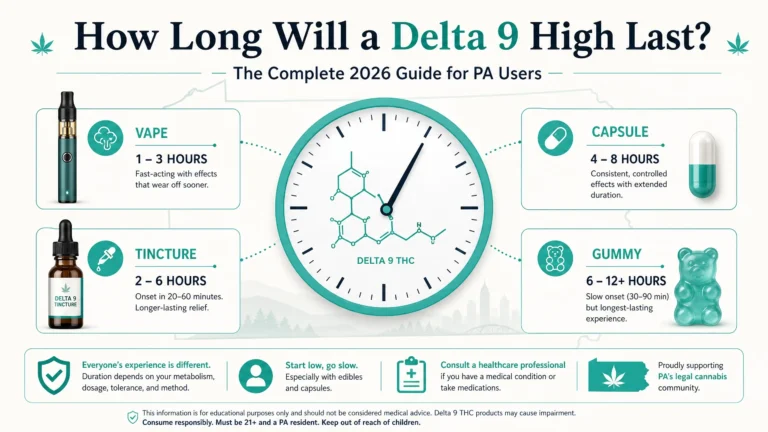

One question. Two very different answers depending on how you consumed it.
A delta 9 vape hit might wear off in two hours. A delta 9 gummy can still have you firmly in its grip six or eight hours later. Same cannabinoid. Completely different experience.
Need a PA Medical Marijuana Card?
Get certified online in 15 minutes. 100% Money-Back Guarantee.
Get Certified Now →Understanding why — and knowing the specific timelines by consumption method — is genuinely useful information whether you’re a Pennsylvania medical marijuana patient managing a chronic condition, someone using hemp-derived delta 9 gummies from a smoke shop, or a first-time user who simply doesn’t want to be caught off guard.
This guide covers duration by method, the science behind why edibles last so much longer, every factor that affects your individual timeline, and — critically for PA residents — what the high duration means under Pennsylvania’s DUI laws, including a significant legal change that took effect in 2025 that most cannabis users in the state don’t know about.
The Quick Answer: Duration by Consumption Method

| Consumption Method | Onset Time | Peak Effects | Total Duration |
|---|---|---|---|
| Vaporized flower | 1–5 minutes | 15–30 minutes | 2–3 hours |
| Vape cartridge / concentrate | 1–5 minutes | 15–45 minutes | 2–4 hours |
| Sublingual tincture | 15–45 minutes | 1–2 hours | 3–5 hours |
| Capsule / softgel | 45–90 minutes | 2–3 hours | 4–8 hours |
| Edible / gummy | 30–120 minutes | 2–4 hours | 4–8 hours |
| High-dose edible (25mg+) | 45–120 minutes | 3–5 hours | 6–10+ hours |
These ranges reflect typical experiences for moderate-tolerance users. Individual results vary — and the factors section below explains exactly why.
Why Edibles Last So Much Longer: The 11-Hydroxy-THC Explanation

The reason edibles hit harder and last longer isn’t because they contain more THC. It’s because of what happens to that THC inside your body.
Do You Qualify for a PA MMJ Card?
Connect with a licensed Pennsylvania state physician online from home.
When you inhale cannabis, delta 9 THC travels directly from your lungs into your bloodstream and reaches your brain within minutes. Your liver sees relatively little of it during that initial pass.
When you eat or swallow delta 9 — in a gummy, capsule, or oil — everything changes. The THC must travel through your digestive system, enter your intestinal wall, and then pass through your liver before it can reach your bloodstream. During that liver transit, an enzyme process converts delta 9 THC into a different compound: 11-hydroxy-THC (11-OH-THC).
11-hydroxy-THC is not a weaker version of delta 9. It is significantly more potent — with research suggesting 2 to 7 times the psychoactive effect of inhaled delta 9 THC, due to a dramatically higher affinity for CB1 receptors (Ki = 0.37 nM versus 35 nM for delta 9 THC). It also crosses the blood-brain barrier more efficiently than delta 9 itself, and it clears the body more slowly.
The practical result: edibles can be up to four times more potent than inhaled cannabis, and their effects last 4–8 hours compared to 2–3 hours from vaporization — because 11-hydroxy-THC takes longer to build, peak, and clear than inhaled delta 9.
This is also why 10mg of a delta 9 gummy does not feel equivalent to 10mg of vaporized THC. Your body is converting that ingested THC into something materially stronger before it ever reaches your brain.
The conversion process depends on your liver enzymes — specifically CYP2C9 and CYP3A4. Genetic variations in these enzymes mean that two people consuming the identical dose from the identical product can produce very different amounts of 11-hydroxy-THC — which is a core reason why edible experiences vary so dramatically between individuals.
Vaping and Flower: Fast On, Fast Off

Vaporized cannabis — whether from dry leaf flower in a vaporizer device or from a concentrate in a vape cartridge — follows a completely different pharmacokinetic pathway.
Inhaled THC peaks in your bloodstream within 6–10 minutes and begins declining almost immediately after. Because the liver’s first-pass conversion of delta 9 to 11-hydroxy-THC is largely bypassed, you get the effects of delta 9 THC itself — faster onset, lower peak potency per mg, and a much shorter window.
Typical vaporization timeline:
- Onset: 1–5 minutes
- Peak: 15–30 minutes
- Primary effects: 1–2 hours
- Residual mild effects: Up to 3 hours total
This faster offset is one of the main reasons vaporized flower is recommended for acute symptom management — nausea, breakthrough pain, acute anxiety — where rapid relief and predictable duration matter. It’s also one reason PA dispensaries predominantly stock flower and concentrate formats: they’re the most controllable for medical patients.
⚡ Fast & 100% Online PA Medical Cards
Board-Certified Doctors • 100% Money-Back Guarantee
Book Evaluation Now →Note for PA patients: Pennsylvania’s Medical Marijuana Act permits dry leaf flower for vaporization only — not combustion/smoking. All PA dispensary flower products are intended for use in a vaporizer device. This is both a legal requirement and a respiratory health benefit.
Sublingual Tinctures: The Middle Ground
Sublingual tinctures — cannabis oils held under the tongue for 60–90 seconds before swallowing — occupy a distinct middle ground that most duration guides don’t address separately.
When absorbed through the mucous membranes under the tongue, a portion of the delta 9 THC enters the bloodstream directly, bypassing first-pass liver metabolism. The fraction that’s swallowed does go through the liver and converts to 11-hydroxy-THC. This dual absorption pathway produces a timeline that’s meaningfully different from either pure inhalation or pure edible consumption:
- Onset: 15–45 minutes (faster than edibles due to sublingual absorption)
- Peak: 1–2 hours
- Total duration: 3–5 hours
For PA medical marijuana patients, tinctures are one of the approved product formats at licensed dispensaries. For patients who cannot or prefer not to vaporize but want a more predictable and controllable duration than edibles, tinctures are often the recommended alternative.
Capsules and Oils: Edible-Level Duration
Cannabis capsules and oil-based oral products (swallowed, not held under the tongue) go entirely through the digestive system and liver — making them functionally equivalent to edibles for duration purposes.
Expect the same 4–8 hour window as gummies, with similar delayed onset (45–90 minutes). Capsules are often preferred by PA medical marijuana patients for dosing precision — a 10mg capsule delivers a consistent amount of THC without the taste variables of an edible product.
PA dispensaries stock capsules as one of the state-approved product formats. Unlike gummies (which are prohibited at licensed PA dispensaries under the Medical Marijuana Act’s edible food restriction), capsules are fully available and widely stocked.
6 Factors That Affect How Long Your High Lasts

The ranges above are starting points. Your actual experience is shaped by these variables — some you can control, some you can’t.
1. Dose This is the most controllable factor. Higher doses of delta 9 produce both stronger effects and longer duration. A 5mg gummy and a 50mg gummy from the same brand will produce materially different timelines. Starting low and titrating up session by session gives you the most control over your experience.
2. Consumption method Covered above. Inhalation = shorter. Oral = longer. Sublingual = middle. This is the single biggest predictor of duration after dose.
3. Tolerance Regular cannabis users develop tolerance to delta 9 THC at CB1 receptors. For infrequent users, the same dose produces stronger and longer effects than for daily users. Cross-tolerance applies across product types — if you’re a regular hemp gummy user, dispensary-level products at similar mg doses won’t necessarily hit harder, though dispensary products tend toward higher potency.
Renewing Your PA MMJ Card?
Quick annual recertification online. No paperwork hassle.
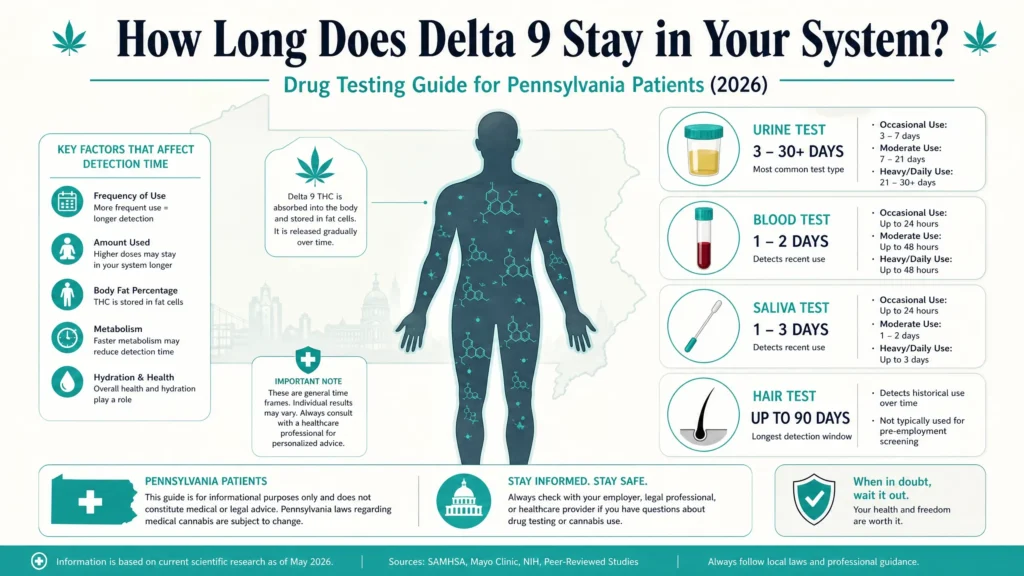
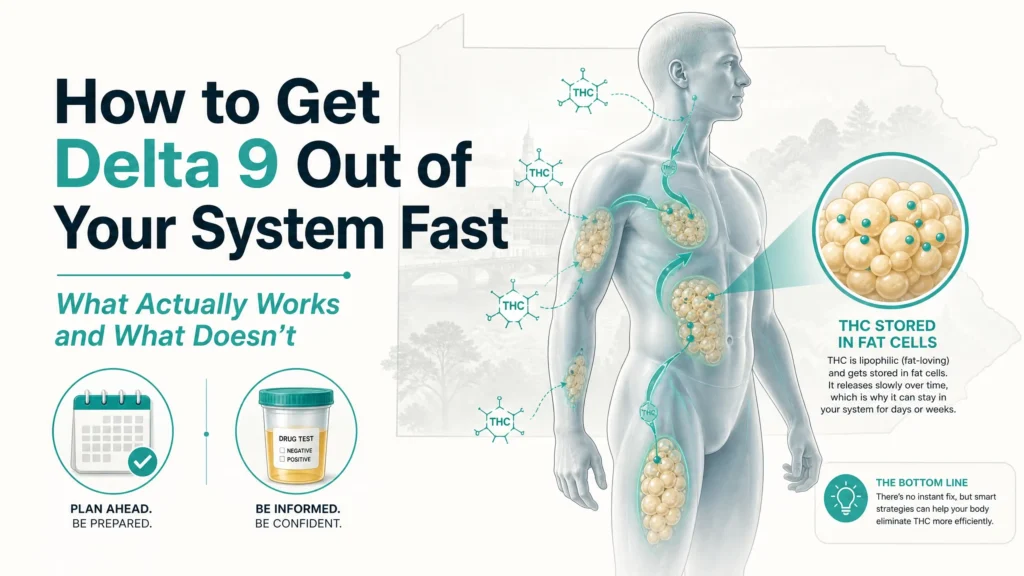
Renew Card Online →4. Body composition and metabolism Delta 9 THC is highly fat-soluble. It binds to fat cells throughout the body and releases back into the bloodstream over time — which is why THC metabolites can be detected in urine weeks after last use even when the high is long gone. Individuals with higher body fat percentages may experience longer-lasting effects and slower clearance. Faster metabolic rates generally mean faster THC clearance and shorter duration.
5. Food consumption A 2019 study in the Annals of Internal Medicine found that consuming a high-fat meal before taking an oral cannabis dose significantly increased both peak THC blood levels and total duration of effects compared to fasting. The fat content appears to enhance intestinal absorption of the oil-soluble THC molecule. Practically: eating a fatty meal before a delta 9 gummy will likely produce a stronger and longer experience than the same gummy taken on an empty stomach.
6. Individual liver enzyme genetics As noted in the 11-hydroxy-THC section, CYP2C9 and CYP3A4 genetic variants affect how efficiently your liver converts delta 9 to 11-hydroxy-THC. Some people are “fast metabolizers” of delta 9 — they convert it quickly to 11-OH-THC and clear it rapidly, producing a shorter but initially intense experience. “Slow metabolizers” may notice delayed onset and longer-than-expected duration. This genetic variability is why no edible dosing guidance is universal.
The Most Common Mistake That Makes It Last Longer Than Expected

It has a name in cannabis culture: “double-dipping.” And it’s the most reliable way to accidentally extend your high well beyond your intended window.
The scenario: you take a delta 9 gummy. Forty-five minutes pass. You feel nothing. So you take another one. Twenty minutes later, both doses hit simultaneously — and you’re now managing twice the intended dose at the same time.
This happens constantly with edibles because the 30–120 minute onset window creates a period of uncertainty that feels like the product isn’t working. The most important rule with edibles: wait a full two hours before concluding a dose isn’t working. Factors like a full stomach, slower individual metabolism, or lower body temperature can push onset toward the far end of the normal range.
If you are a first-time or infrequent edible user: start at 5mg, wait two full hours, and only re-dose if you feel genuinely nothing.
If You Get Too High: Evidence-Based Ways to Come Down Faster

The high will end. But if you’re in an uncomfortable place, these approaches have the most research support behind them.
CBD — The most evidence-backed option. A 1982 study in Psychopharmacology and a 2013 study in the Journal of Psychopharmacology both found CBD reduces THC-induced anxiety and paranoia. CBD modulates CB1 receptor activity, partially blocking THC’s psychoactive effects. A meaningful dose (50mg or more) is generally more effective than a small one. Note: very low CBD doses may paradoxically increase THC’s effects — so don’t underdo it if trying this approach.
Black pepper — Dr. Ethan Russo’s 2011 review in the British Journal of Pharmacology documented that beta-caryophyllene in black pepper binds to CB2 receptors and can “tame the intoxicating effects of THC.” Chewing 2–3 peppercorns or sniffing ground pepper is the traditional approach. The mechanism is pharmacologically plausible — beta-caryophyllene is the only terpene known to directly bind cannabinoid receptors (CB2), and it does not produce intoxication.
The basics — Hydrate, move to a calm and quiet environment, breathe slowly and deliberately, lie down if possible. These are not cures but they significantly reduce the discomfort of an unexpectedly strong experience. The anxiolytic effect of physical calm and controlled breathing is well-documented independent of cannabis.
Get Approved by a Licensed PA Doctor
Schedule your appointment in minutes. You only pay if approved.
Start Online Application →Time — Ultimately the only guaranteed solution. A vape-induced high resolves in 2–3 hours with or without intervention. An edible-induced high will follow its natural arc of 4–8 hours. Knowing this timeline in advance — and reminding yourself when you’re uncomfortable that the feeling is temporary and will end — is itself a meaningful anxiety management tool.
What doesn’t help: Alcohol (can intensify effects), stimulants like caffeine (can increase anxiety), and additional cannabis.
PA-Specific: High Duration vs. Legal Impairment Under Pennsylvania Law
This section applies specifically to Pennsylvania residents — and it addresses the most important practical implication of delta 9 high duration for anyone who drives.
Here is the critical distinction every PA delta 9 user must understand: “feeling high” and “being legally impaired under PA law” are two different things — and the gap between them is significant.
The gap works in both directions:
- You can feel completely sober while still having detectable THC in your blood
- You can feel very high while your blood THC level is actually below the legal threshold
Pennsylvania has a per se DUI law for marijuana — meaning any detectable level of 1 nanogram per milliliter or more of THC or its metabolites in your bloodstream can result in a DUI charge. Active THC clears from blood within hours for most users. But THC metabolites — the breakdown products that no longer produce a high — can remain detectable for days or weeks depending on your usage frequency and metabolism.
This creates a specific risk for regular PA cannabis users: you may feel entirely sober and unimpaired, yet still have detectable THC metabolites that meet the per se threshold. A PA DUI attorney confirms: the joint you used a week ago could lead to THC metabolites being found in your system.
Never drive while you feel any effects from delta 9 THC. The high duration timelines in this article are minimums, not guarantees of when it is safe to drive. For conservative guidance from PA legal experts: medical marijuana patients should avoid driving on any day they have used cannabis.
Senate Bill 363: The PA DUI Law Change MMJ Patients Must Know
This is breaking information that applies specifically to registered Pennsylvania medical marijuana patients — and most cannabis users in the state are unaware of it.
Pennsylvania Senate Bill 363 amended the state’s DUI law to add protections for registered MMJ patients. Under the amended law:
- Proof of actual impairment is now required for MMJ patients facing per se DUI charges — the mere presence of THC in the blood is no longer automatically sufficient for a conviction in cases involving registered patients with a valid PA MMJ card
- A patient’s MMJ card alone cannot justify a chemical test request — police must have reasonable grounds based on driving behavior or other observable evidence, not simply the card’s existence
- Commercial drivers are not protected — federal regulations still apply zero-tolerance to anyone operating a commercial vehicle, regardless of MMJ status
Ready to Get Your Official PA MMJ Card?
State-certified doctor consultations online. No risk—100% refund if not approved.
Claim Your MMJ Card Online →What SB 363 does NOT change: It does not make it legal to drive while impaired. It does not eliminate the risk of DUI charges. It shifts the burden toward requiring behavioral evidence of impairment rather than relying solely on a blood test number. For registered PA MMJ patients, this is a meaningful legal protection — but it is not a green light to drive after medicating.
The practical guidance remains the same: do not drive while feeling any effects of delta 9 THC, regardless of your MMJ status. But if you are a registered PA MMJ patient and face a DUI charge, SB 363 gives your attorney a stronger foundation for defense than existed before.
Does a PA MMJ Card Change Your Duration Experience?

Not directly — delta 9 THC’s pharmacokinetics are the same regardless of whether it came from a licensed PA dispensary or a smoke shop hemp gummy. The molecule behaves identically.
What does differ is the product format access available to PA MMJ patients at licensed dispensaries.
Pennsylvania’s Medical Marijuana Act approves these product formats at PA dispensaries: vaporizable dry leaf flower, concentrates, tinctures, capsules, oils, and topicals. Gummies and traditional edibles are not permitted at PA dispensaries under state law — a restriction that still separates PA from many other medical states.
This means PA MMJ patients can access the full duration spectrum through legal dispensary products:
| Format | Available at PA Dispensaries | Typical Duration |
|---|---|---|
| Dry leaf flower (vaporized) | ✅ Yes | 2–3 hours |
| Concentrate (vape cart / dab) | ✅ Yes | 2–4 hours |
| Tincture (sublingual) | ✅ Yes | 3–5 hours |
| Capsule / softgel | ✅ Yes | 4–8 hours |
| Gummies / edibles | ❌ Not permitted | N/A |
| Topicals | ✅ Yes (no psychoactive effect) | N/A |
For patients whose qualifying condition benefits from sustained overnight relief — such as chronic pain, insomnia components of PTSD, or cancer-related symptoms — capsules are particularly well-suited due to their 4–8 hour window and precise dosing. For acute symptom relief, vaporized flower gives the fastest and most controllable response.
If you have a qualifying condition and are managing it through hemp delta 9 products from smoke shops, a PA MMJ card gives you access to state-tested, physician-guided, COA-verified products across all the formats above — in the right dose, at the right potency, from a licensed Pennsylvania dispensary pharmacist who can advise on duration and form for your specific condition.
Certification pricing through Pennsylvania Marijuana Cards:
| Physician Fee | PA State Fee | Total | |
|---|---|---|---|
| New Patient | $159 | $50 | $209 |
| Renewal | $149 | $50 | $199 |
| MMAP Qualifying Patients (Medicaid, SNAP, WIC, CHIP, PACE, PACENET) | — | $0 (waived) | Physician fee only |
Start your same-day telehealth certification here.
Frequently Asked Questions — How Long Will Delta 9 High Last
Q: How long does a delta 9 high last?
A: Delta 9 high duration depends primarily on how you consume it. Vaporized flower or concentrates: 2–3 hours total, with effects peaking within 15–30 minutes. Sublingual tinctures: 3–5 hours. Capsules and edibles: 4–8 hours, with onset delayed 30–120 minutes and peak effects at 2–4 hours. High-dose edibles (25mg+) can produce effects lasting 6–10 hours or more. The wide range is due to individual factors including dose, tolerance, metabolism, body composition, and whether food was consumed beforehand.
Q: Why do delta 9 edibles last so much longer than vaping?
A: When delta 9 THC is eaten or swallowed, it passes through the digestive system and liver before entering the bloodstream. During that liver transit, enzymes (CYP2C9 and CYP3A4) convert delta 9 THC into 11-hydroxy-THC — a metabolite that is 2 to 7 times more potent than inhaled delta 9 THC, crosses the blood-brain barrier more efficiently, and clears the body much more slowly. This is why edibles hit harder and last 4–8 hours versus 2–3 hours from vaporization. When you inhale cannabis, the liver largely bypasses this conversion, so you feel the effects of delta 9 THC itself — faster but shorter-lasting.
Q: How long should you wait before driving after using delta 9?
A: In Pennsylvania, you should not drive while feeling any effects of delta 9 THC — and this guidance extends beyond when you “feel” high. PA has a per se DUI law: any detectable level of 1 nanogram per milliliter or more of THC or metabolites in your bloodstream can result in DUI charges. THC metabolites can remain detectable for days or weeks after the subjective high has ended, particularly in regular users. Pennsylvania’s Senate Bill 363 added protections for registered MMJ patients — requiring proof of actual impairment rather than just THC presence — but this is not a license to drive after medicating. PA legal experts advise registered patients to avoid driving on any day they have used cannabis.
Q: What makes some people’s delta 9 high last longer than others?
A: Several factors drive individual variation. Dose is the most controllable — higher doses extend duration. Tolerance means regular users experience shorter, less intense effects than infrequent users. Body composition matters because THC is fat-soluble and binds to fat cells, extending clearance time in people with higher body fat. Liver enzyme genetics (CYP2C9/CYP3A4 variants) affect how efficiently the body converts delta 9 to 11-hydroxy-THC during edible metabolism — making edible duration particularly variable between individuals. Eating a high-fat meal before an edible significantly increases both potency and duration according to a 2019 study in the Annals of Internal Medicine.
Q: What can you do to shorten a delta 9 high?
A: The most evidence-backed approaches: CBD at a meaningful dose (50mg+) modulates CB1 receptor activity and has been shown in clinical studies to reduce THC-induced anxiety. Black pepper contains beta-caryophyllene, a terpene documented by neurologist Dr. Ethan Russo to “tame the intoxicating effects of THC” by binding CB2 receptors — chew 2–3 peppercorns or sniff ground pepper. Hydrating, finding a calm quiet environment, and controlled slow breathing all reduce discomfort. Ultimately, time is the only guaranteed solution — vaping effects resolve in 2–3 hours, edible effects in 4–8 hours. Avoid alcohol and stimulants like caffeine, which can worsen the experience.
Q: Can you get a DUI in Pennsylvania after a delta 9 high wears off?
A: Yes. Pennsylvania’s per se DUI law sets the legal threshold at 1 nanogram per milliliter of THC or its metabolites in the blood. The subjective high from delta 9 may last 2–8 hours, but THC metabolites can remain detectable in blood for days or even weeks in regular users — long after any impairment has passed. Importantly, Pennsylvania’s Senate Bill 363 now requires proof of actual impairment for registered medical marijuana patients, not just the presence of THC. However, this protection only applies to registered patients and doesn’t eliminate DUI risk. All delta 9 users should avoid driving while feeling any effects and be aware that metabolites can remain legally relevant well after the high ends.
Q: How long does a 10mg delta 9 gummy high last?
A: A 10mg delta 9 gummy typically produces effects lasting 4–6 hours for an average-tolerance adult who has not eaten a large meal beforehand. Onset takes 30–90 minutes. Effects peak around 2–3 hours after consumption. For first-time or infrequent users, the same 10mg dose may feel stronger and last closer to 6–8 hours due to the conversion to 11-hydroxy-THC in the liver. For regular users with established tolerance, effects may be felt for only 3–4 hours at the same dose. The most important rule: wait a full two hours before concluding the gummy isn’t working and taking more.
Q: What PA dispensary product lasts the longest for medical patients?
A: Capsules and oil-based oral products available at Pennsylvania licensed dispensaries produce the longest duration — 4 to 8 hours — comparable to edibles, because they undergo the same liver metabolism and 11-hydroxy-THC conversion. Tinctures held sublingually for 60–90 seconds before swallowing produce a 3–5 hour window. Vaporized flower offers the shortest window (2–3 hours) but the fastest onset. Pennsylvania dispensaries do not currently permit gummy or traditional edible formats. For patients whose conditions require sustained overnight relief — such as chronic pain or PTSD-related insomnia — dispensary pharmacists often recommend capsules or tinctures taken before sleep for this reason.
This blog post is intended for general educational and informational purposes only and does not constitute medical or legal advice. The information on PA DUI law reflects the state of the law as of May 2026 including Senate Bill 363 protections for registered MMJ patients; laws are subject to change and individual cases vary significantly. Never drive while impaired. Consult a licensed Pennsylvania attorney for legal guidance and a licensed physician for medical guidance. Duration timelines reflect general population ranges and individual results will vary. Medically reviewed by Dr. Johnathon Chance Miller, MD.
Sources:
- Healthline — How Long Does a Cannabis High Last? (updated June 2025)
- Mellow Fellow — 11-Hydroxy-THC vs THC: Why Edibles Hit Different (Science Explained)
- Veriheal — 11-Hydroxy-THC: Why Edibles Hit So Much Harder
- Greenlight Cannabis Doctors — Why Edibles Hit Harder: Understanding 11-Hydroxy-THC (Feb 2026)
- Get Canna Card — Cannabis Metabolism in the Liver Explained (Nov 2025)
- Sativa University — What Is 11-Hydroxy-THC? Effects & Science Explained
- SEABEDEE — Delta 9 THC: How Long Does It Last? Your 2026 Guide (March 2026)
- Clean Remedies — How Long Do Delta 9 Gummies Last? (Dec 2025)
- Annals of Internal Medicine — Effect of Oral vs. Smoked Cannabis on Pharmacokinetics (2019)
- Ack Natural — Too High? How to Sober Up from Weed (May 2025)
- Healthline — How to Stop Being High (updated May 2025)
- Taylor & Francis — 11-Hydroxy-THC: Duration of Effect from Edibles for Overnight Treatments
- Keith J. Williams Law — PA Per Se Marijuana DUI Law (updated 2026)
- Zuckerman Law Firm — Marijuana DUI in Pennsylvania / SB 363 / 1 ng/ml threshold
- J.P. Lesniak Law — Pennsylvania DUI Laws: What Medical Marijuana Patients Need to Know / Senate Bill 363